The Meteoric Rise and Narcissistic Fall of Chris Smalls

Chris Smalls shot to prominence for playing a key role in the shock union win at a New York Amazon warehouse. He was charismatic and energetic at a time labor needed both. But in the years since, his own ego has overwhelmed his political contributions.
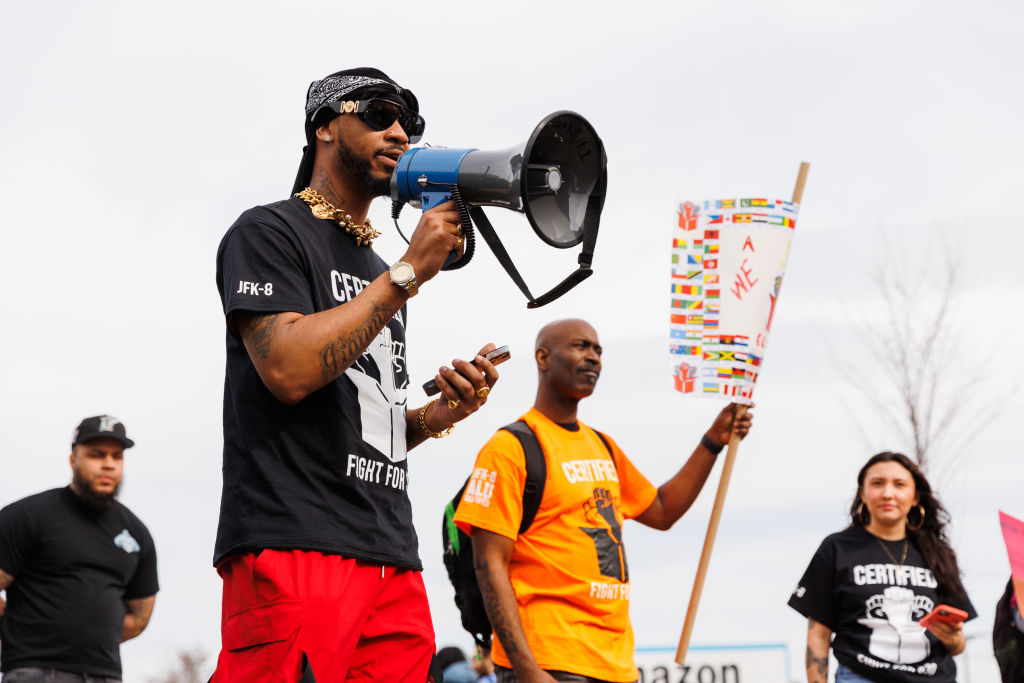
Labor leader Chris Smalls speaks at a rally outside of an Amazon warehouse in Staten Island, New York, on April 11, 2023.

Rarely in the American labor movement’s history has a star burned as brightly and as briefly as Amazon union leader Chris Smalls’s. (Paul Frangipane / Bloomberg via Getty Images)


Christian Smalls’s memoir When the Revolution Comes: A Fight for the Future of the Working Class, comes out at an odd time in the career of the former Amazon Labor Union president.

The book, ghostwritten by author Carvell Wallace, was sold to Pantheon in 2022 shortly after the historic National Labor Relations Board (NLRB) election victory for the Amazon Labor Union (ALU). Today Smalls is unaffiliated with the union, which he exited in 2024 following a period of internal factionalism. Since leaving his post, Smalls has appeared on talk shows, given speeches, and heroically joined aid missions to Gaza and Cuba. Recently he’s been in the news again for breaking into the Met Gala to draw attention to Jeff Bezos’s role as the event’s sponsor.

Presidents of union locals are rarely celebrities, but as the charismatic leader of the first union to win an NLRB election at an Amazon warehouse, Smalls was boosted to left-wing pseudo-stardom. A former party promoter, Smalls was entirely in his element as the much sought-after spokesperson for the ALU. In the year that followed the election, Smalls was everywhere: on picket lines, speaking at the Labor Notes conference, here in Jacobin, on the Daily Show, and being photographed with Zendaya at the Time 100 Gala. For a brief period, Smalls helped bring the labor movement into the mainstream. As someone who came from the working class and made organizing seem glamorous and thrilling, he seemed like the type of leader the labor movement had needed for decades.

His flashy personal style, pairing gold grills and chains with union merchandise and political streetwear, transformed the ALU into something like a fashion brand. Like a music act, Smalls and his ALU cohort toured the country, spreading the good news of worker organizing to Amazon warehouses and university campuses. In New York City in 2022, I saw him numerous times pull up to picket lines in a convertible, decked out head to toe in eye-catching ALU union drip.

During Smalls’s brief rise to prominence, however, it soon became apparent that all was not well within his union. After a new union wins its election, the race to contract bargaining begins. In strong unions, this involves what the late labor strategist Jane McAlevey referred to as structure tests. These include surveying membership to determine what is desired in a contract, developing new leaders, and organizing escalating demonstrations, up to and including a strike — all aimed at building supermajorities of workers who can bring management to the bargaining table, extract concessions, and build worker power.

At the ALU, during this vital period after the union’s initial win, Smalls was not in the warehouse poring over lists and preparing the Amazon workforce for battle against the boss. He was instead transforming into a celebrity and traveling the country, ostensibly to help other Amazon warehouses unionize. Then, LDJ5, the Amazon sorting center on Staten Island right beside JFK8, lost its own NLRB election. This was soon followed by another loss at Albany warehouse ALB1.

According to the New York Times, when McAlevey was leading trainings with JFK8 organizers, she brokered a promise from Smalls to pull back on traveling and backing bids at other warehouses and instead to focus on the contract fight at home. Smalls, the Times writes, almost immediately broke that promise by supporting an election petition in Los Angeles. Smalls told the Times that McAlevey’s experience was not relevant to Amazon workers. Connor Spence, then ALU treasurer, today union president, told Labor Notes that at JFK8 itself at this time, worker committee meetings had become few and far between and soon stopped altogether.

Within the year following the election victory, ALU organizers, including Spence, formed a reform caucus within their union and filed an NLRB complaint against Smalls for refusing to hold officer elections. While vague on details, the chapter in Smalls’s memoir that deals with these events, titled “No One to Trust,” shifts blame for the lost union elections at LDJ5 and ALB1 onto Spence and the caucus. He describes these “professional activists” who joined JFK8 specifically to unionize it as having a “white leftist mindset” and not understanding the mainly black and brown Amazon workers.

In the memoir, Smalls defends his actions during this period. He writes that he was not receiving a salary from the union and therefore had to accept speaking engagements to afford to live and feed his children. He writes that his appearances at celebrity photo shoots were to “plant a seed and raise awareness” and get celebrities to tweet about the ALU. He writes that everywhere he went, workers told him their stories and asked him how they too could organize their workplaces.

“Organizing for me is a matter of talking to people wherever I go,” Smalls writes. “And the more places I go, the more people I can talk to.”

Creating a big platform to promote your union can help your campaign, and having a kind of generalized labor celebrity spreading a pro-union gospel to workers across the land is desperately needed. But any labor strategist will tell you that broadcasting your message far and wide is never enough on its own. Without speaking to the workers at your worksite and engaging in deep organizing, your campaign will flounder.

And while Smalls uses his platform to draw labor organizing into the popular imagination, he also uses it to lash out at labor’s allies. His feed on X has increasingly become left-sectarian and self-promoting, lashing out at left-wing politicians when they fail to give him the attention he desires. Politicians like Rep. Alexandria Ocasio-Cortez and Sen. Bernie Sanders, who helped boost Smalls’s platform from the beginning and have been great allies of the ALU, have been frequent victims of his wrath.

The memoir ends with a critique of the American labor movement and its collaboration with the Democratic Party. Smalls praises European unions supported by communist parties and bitterly compares high-density sectoral unions in Europe with the United States’ shrinking unionized labor force. He blames the two-party system for the state of the American labor movement and concludes vaguely that the solution to this problem is to “build internationally.” In the final chapter, he compares himself to Malcolm X, Medgar Evars, and Fred Hampton. He writes that, like these figures, he is putting his life on the line to disrupt the status quo. “My goal is to rewrite history. Period. Nothing less. And I know that I may be writing a history that I might not be here to see.”

What is most striking about Smalls’s memoir is its lack of tension. The memoir describes him fleeing gang violence while attending college in Fort Pierce, Florida. In the following chapter, we hear about his hazily successful music career that he exited after being offered a $150,000 record deal. These stories cut themselves short before they begin to offer an intimate glimpse into Smalls’s life. We hear repeatedly that he is a charismatic leader good at everything he puts his mind to — athletics, music, organizing — and his only character flaw is that he is so talented and charismatic that he incurs other people’s jealousy.

Smalls in 2026 is more of a left celebrity than a labor leader. He has continued to travel, admirably joining in left-wing coalitions on the Freedom Flotilla to Gaza and the Nuestra América Convoy to Cuba. In just the last year, he was assaulted and imprisoned by the Israeli Defense Forces, detained by Immigration and Customs Enforcement, and jailed by the NYPD following the Met Gala incident. I discovered the existence of his memoir when Smalls argued on X with YouTuber Jessica Burbank, who publicly thanked Ocasio-Cortez’s office for helping locate Smalls after his arrest by the NYPD. Smalls angrily snapped back that the congresswoman had nothing to do with his release and later posted a long thread berating democratic socialist elected officials. Here, too, he shows an individualistic, left-sectarian tendency to make extraordinary demands of popular democratic socialist electeds while defaming them at every turn. The X algorithm ensures that this practice draws plenty of engagement.

Smalls was a powerful force in the original unionization campaign at JFK8 and was by many accounts a fantastic grassroots organizer. He helped show the labor movement that it was possible to organize vast warehouses of high-turnover blue-collar workers. While unable to remain in the struggle with the ALU for the long haul, Smalls’s initial prominence shows how much the labor movement is dearly in need of the qualities he brought in.

Labor needs more charismatic leaders. Smalls isn’t wrong when he writes in his memoir that workers will not become labor organizers when they can’t tell the difference between the president of their union and the president of a bank. But workers will also not organize in their union when their union president is grabbing headlines instead of organizing at the job site.

After Smalls’s arrest at the Met Gala, the ALU released a statement saying that they do not condone “lone-wolf direct actions which aim to center one individual as the focus of what must be a collective struggle.” No one person, no matter how charismatic, can fight the boss on their own. Charisma on its own also cannot break through the structural barriers of American labor law. Within our hostile political environment, only militant discipline and the all-encompassing structure tests McAlevey argued for can build real worker power. Simultaneously, in the legislature, only mass politics, organizing vast coalitions to elect democratic socialists, transform politics, and rewrite labor law, can make the kind of radical changes that Smalls wants.

Eric Blanc recently wrote in Jacobin about how the socialist movement must be social to be successful. It is no accident that the only Amazon warehouse to win its NLRB election was led by a former party promoter. Smalls, like New York City’s first democratic socialist mayor, is a former rapper who knows how to use his voice to hold a crowd. It is a shame that he was too overwhelmed by labor’s structural limitations, and enamored of his own celebrity, to keep using his voice to build worker power within his union.