Toronto’s Tenant Union Is Just Getting Started

Sharlene Henry

Earlier this year, the Toronto Tenant Union held its founding convention. Its sights are set high: it aims to build a mass tenant movement capable of reshaping Toronto politics.
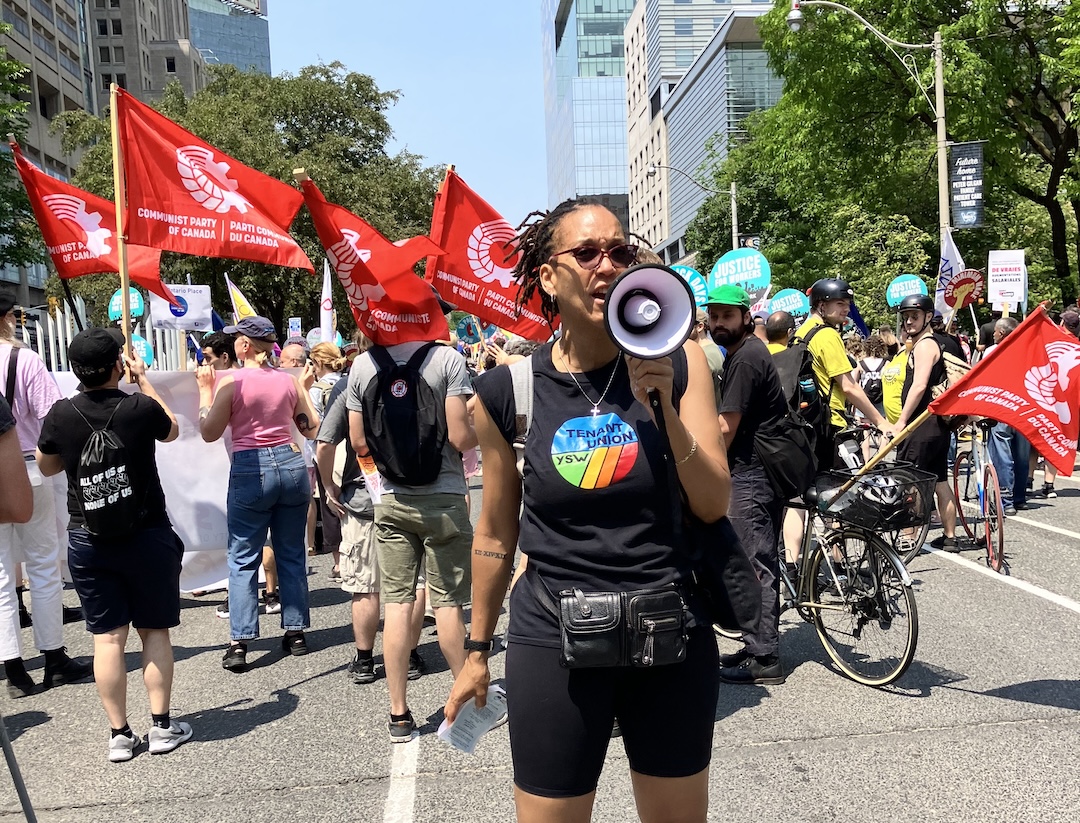
Toronto Tenant Union cochair Sharlene Henry speaks into a bullhorn at a rally.

Sharlene Henry, cochair of the Toronto Tenant Union, on organizing: “How do we push back against a corporate landlord that owns buildings across the city? The idea is for tenants to realize they’re not alone, fighting their landlord by themselves.”


Interview by
James Adair

On April 18, more than three hundred tenants from across Toronto packed in for the founding convention of the Toronto Tenant Union (TTU). A joint project of the York South-Weston Tenant Union (YSW) and Climate Justice Toronto (CJTO), the Toronto Tenant Union aims to unite all tenants in Toronto along a common political line.

This project has been brewing in Toronto for years. In 2023, Jacobin reported on a citywide rent strike led by YSW, in which hundreds of Toronto tenants living in buildings owned by the same landlord organized against renovictions and above-guideline rent increases that would have likely forced many tenants from their homes. Since that historic rent strike, tenant organizing in Ottawa has exploded, inspired in large part by YSW’s example.

Jacobin recently spoke over the phone with Sharlene Henry, cochair of the TTU and former cochair of YSW. In addition to her work with tenant organizing, she is a member of Unifor Local 1285 and serves on Unifor’s executive board as the black and worker of color representative. As a member of the YSW tenant union, she was at the forefront of the historic Toronto rent strikes of 2023.


James Adair

Toronto is Canada’s largest city, but unlike Vancouver or Montreal, the city hasn’t really had a long history of militant tenant organizing. Can you talk about what it was like organizing tenants in Toronto for the first time and getting them to take that leap toward more militant action?

Sharlene Henry

It was difficult. A lot of tenants do stay in the same building for many, many years. They end up retiring there and have raised their families in these units; they want to retire there. People feel a sense of pride because it is their home. They pay their rent on time but are afraid to ask for repairs.

Toronto is a multicultural community. In a lot of communities, there is a fear about speaking out. That fear is deeply embedded in many newcomer and immigrant communities. I never understood why — I would ask people if they could explain it.

Sometimes getting people involved requires something as simple as telling people, “You have the rights to go and demand repairs.” We had a family that didn’t have a running shower for six months, and we were able to help them go to their landlord and demand repairs. Even that is a small act of politicization.

James Adair

You’ve decided to expand this model citywide, and you joined with Climate Justice Toronto to do this. Can you talk a bit about why you made this decision to launch a citywide tenant union and how that partnership with CJTO happened?

Sharlene Henry

When we first sat down at the public library, we talked about forming the YSW tenant union and what we would stand for. And slowly but surely, once we started becoming more public about the actions we were taking, we realized that there are many people beyond ourselves doing the work. And the more public we became, the more people inquired about helping, even outside of our neighborhood. Be it door-knocking, flyering, a phone zap, coming to a protest. And CJTO was really there for us — when a landlord was trying to raise rents in the name of “climate action,” they showed up and called them on their BS.

And many of them were young renters. So, they understood the work that we were doing. Just having that mass of eager, young people to door-knock and help organize was crucial. Especially because so many of the landlords we were facing were justifying their actions through climate rhetoric. It was natural that when we wanted to launch citywide, we would bring in CJTO.

Municipal Socialism

James Adair

Right now, as you’re launching citywide, the idea of municipal socialism has become a really popular idea. Obviously, you have Zohran Mamdani. But with the municipal elections taking place in Canada, you’re seeing a lot more socialist organizing at a local level. I’m wondering if you can talk about what role you think organized tenants have in building socialism.

Sharlene Henry

Having the example of a socialist in office like Zohran is huge; it can open so many doors. The role of organized tenants is to keep the forces of the developers and the landlords on their toes. It also means organizing enough that we have power and leverage.

So many of our members have never voted before. One of our founders ran for city council in Toronto in the last election and came within ninety-four votes of unseating an incumbent, who was later found to have cheated. If we were able to get every tenant to vote, we would have won. But it also goes beyond that. The leverage comes from our ability to threaten a rent strike, which can really bring a city to a halt.

James Adair

I was reading some of the founding documents of the TTU, and a lot of it seems to be modeled off of a workers’ union. Can you talk about your experience with the relationship between worker and tenant organizing?

Sharlene Henry

I was really blessed with Unifor — in a lot of ways, everything I have learned about organizing came from labor unions. It’s funny, a couple years ago, when we were first on the rent strike, a couple of the other organizers came to me and were like, “We’re going to ask Unifor to have your workplace release you for union business so you can work on the tenant union full time.”

So the other organizers wrote to Unifor president Lana Payne, and I remember thinking, she doesn’t know who Sharlene is, and the rent strike isn’t really Unifor’s job. But everyone kept saying, “No, we’re gonna still ask. We’re gonna put it in writing; we’re gonna ask.”

At the time, I was working full-time and then coming home to spend what felt like another full-time job for the tenant union — canvassing three, four, sometimes five hours a day, morning and evening. I was burning the candle at both ends and completely exhausted. Then I got a call: Unifor had approved it. I was released from my job so I could work on the strike full time.

Later I had the chance to talk to Lana about it. She told me, “We can go to the bargaining table and win a 6 percent raise. But then rents go up, and mortgage rates go up, and that money never ends up in workers’ pockets. It doesn’t go to them.”

The Work Before the Strike 

James Adair

In a lot of your founding documents, there’s a focus on the power of your membership. There are clear delineations between staff, elected representatives, and the membership as a whole. Can you talk about the importance of these tenant unions being driven by the membership?

Sharlene Henry

I think it’s all about lived experience. Different neighborhoods have different tenant experiences.

A lot of it comes down to education. How do we educate members in their tenant associations? How do we organize? How do we push back against a corporate landlord that owns buildings across the city? The idea is for tenants to realize they’re not alone. It’s not just one family in a six-unit duplex or triplex fighting their landlord by themselves. There are hundreds of people dealing with the same shitty landlord spread out across the city. And ideally, there’s a tenant union behind them.

We’re talking about hundreds of members. If we say we need to take action, people will come out. That kind of organizing empowers people.

Every member brings something different to the table. Some educate their neighbors, some help build the core organizing group, and some help keep people motivated. It’s about building on work that tenants have already been doing in their buildings around repairs, maintenance, and landlord issues.

At the end of the day, the goal is to make sure tenants aren’t afraid to speak up. We have a vision and a lot of things we want to achieve, but it’s education that empowers tenants to sustain the movement and act collectively. People, especially outside the movement, will say, “When is the next rent strike? Let’s do a rent strike.” But there are many steps before you get to that stage.

It’s important that our membership knows who we are, that they are their own leaders, and that leadership is accountable to membership. This isn’t an NGO. It’s a movement.

That’s reflected in how we endorse candidates. If we are endorsing a candidate, we want it to be a real endorsement. We want to make sure we are getting our own people to run for office and that they are accountable to us as a political movement. That means having things like memoranda of understanding with endorsed candidates. We can provide organizers, a base of voters, but you need to be one of us — you need to be accountable to us. That’s how the landlord and developer class wins elections.

Tenant Power

James Adair

What you’re describing is a very different model than what we’re used to seeing in Canada. Even New Democratic Party (NDP) electeds, beyond party discipline, aren’t really accountable to a membership or even their local NDP riding association. And endorsements from organizations often just amount to an Instagram post and an email blast.

Sharlene Henry

Yeah. We’re still working out the model. We probably won’t endorse anyone in this municipal election, but the goal is to get there.

James Adair

What do you think it would mean for tenants in Toronto being if this broader model were to work? This is still very new and, in a lot of ways, an experiment. What do you think it could mean for tenants in Toronto and for tenants across Canada more broadly?

Sharlene Henry

Right now, what I constantly see are families crowded into one-bedroom apartments — mom, dad, grandma, kids — all in a space that was never meant for that many people. I think about my own mother. I’ve asked her why she came to Canada and what she thought of the country in her first years here. She’s been here for decades now, and she tells me Canada used to feel like a place where families could actually thrive.

She door-knocks with us now, and one thing that shocks her is seeing how many families are living in conditions that didn’t used to exist. Entire families packed into tiny apartments because they have no other option. She’s deeply disappointed by what housing in Canada has become.

I really believe this movement could change lives. I want to see people earning livable wages, able to sustain themselves, and able to afford to live in the communities they want to live in. We hear a lot about building strong communities and local economies in Canada, but those things depend on people being able to put roots down where they live.

The bigger goal is growing this movement into something powerful enough to show politicians and landlords that another way of doing things is possible.