The Social Forces Behind the MAGA Coalition

John Ganz

The glue that holds Donald Trump’s coalition together is not ideological coherence but a volatile compound of empire, spectacle, and grievance. Understanding these tensions helps explain both MAGA’s successes and its weaknesses.
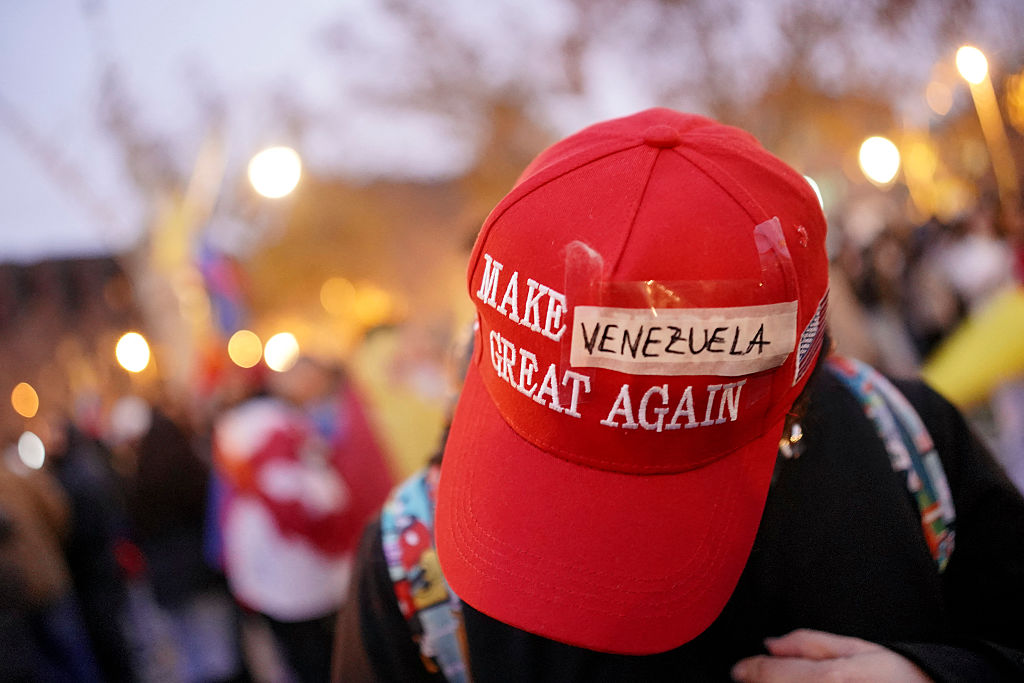
Divisions in the MAGA coalition may not threaten the durability of Donald Trump’s image-driven politics. (Manaure Quintero / AFP via Getty Images)

Interview by
Marshall Pierce

Recent debates over war, imperialism, and domestic state violence have fueled speculation about fractures in the MAGA coalition. But MAGA’s divisions may not seriously threaten the durability of Donald Trump’s image-driven politics, which spans foreign adventurism and ICE deployments and is comfortable with coercive power. Still, these fractures merit close attention — especially insofar as they may point to political openings.

Jacobin recently spoke with John Ganz, author of When the Clock Broke: Con Men, Conspiracists, and How America Cracked Up in the Early 1990s and the Unpopular Front, a newsletter about the social forces holding the MAGA coalition together and where its internal contradictions might matter.


Marshall Pierce

We’re here to talk about whether cracks may be forming within the contemporary right-wing bloc, and whether those cracks could create new political openings for the Left. There’s been a surge of commentary recently about an emerging rift within the Right’s coalition, with the most visible flash point being around foreign policy, particularly the recent invasion of Venezuela. This has unsettled certain prominent figures — Candace Owens, Marjorie Taylor Greene — and has led to speculation about burgeoning tensions within the broader MAGA movement.

At the same time, it’s not clear to me that what we’re seeing will amount to a deep or meaningful fissure. Polling shows limited opposition to the Venezuela invasion among Republican voters, and earlier moments that were framed as coalition-breaking — the Steve Bannon–Elon Musk feud or the more recent Charlie Kirk–Owens conflict — ultimately seemed to generate more light than heat. What do you make of these moments and the discourse surrounding them?

John Ganz

First of all, I think it’s important to think about fissures in terms of upcoming elections. Some candidates have constituencies or ambitions that make positioning themselves as hard anti-interventionists politically advantageous. Marjorie Taylor Greene has resigned from the House and seems to have further ambitions — possibly even the presidency, as implausible as that might sound. Thomas Massie is one of the few figures who we could call a principled “isolationist,” and that is not a position he’s retreated from. So, there are clearly sections of the Right that continue to hold to this tradition of isolationism and see political advantage in maintaining it.

The conflicts among podcasters and streamers, and the broader online drama surrounding these debates, tend to be both ephemeral and spectacular. These fights flare up and then disappear, and the positions involved are often inconsistent. If you look at Nick Fuentes, there’s a noteworthy distinction within his segment of the Right between interventionism on behalf of Israel and what his supporters would frame as a nationalist American foreign policy. Unalloyed imperialism does not trouble them as much; what they oppose are institutions like NATO and the UN — and Israel, for reasons that are not especially admirable.

On the other hand, Fuentes openly cheered the intervention in Venezuela. In reality, this position is consistent with a long-standing tradition on the Right: a sovereigntist or nationalist foreign policy that is neither dovish nor genuinely isolationist. It favors unilateral applications of American power, particularly within the Western Hemisphere, and it must be said frankly that this tradition has historically been far more comfortable with the use of force against non-white populations.

In terms of these foreign policy debates producing a significant split, the tensions are real, but they’re limited. It’s clear that J. D. Vance is trying to position himself to appeal to an anti-interventionist constituency, and divisions could surface in a Republican primary, as they often do. One candidate may represent this nationalist-sovereigntist strain, while another — someone like Marco Rubio — attempts to rehabilitate a form of neoconservatism, but a neoconservatism stripped of its traditional humanitarian rhetoric.

Conventional wisdom holds that foreign policy is rarely decisive for American voters, but that is not entirely accurate. Still, I would strongly caution against pinning hopes on fractures within the ideological core of MAGA.

The more promising development, judging from polling, lies with less committed voters — those who are instinctively dovish or skeptical of foreign interventions. These voters appear increasingly receptive to criticism of interventionism, and we’ve seen significant defection among soft Trump voters who view recent actions as failures and betrayals, often with a sense of alarm. The ideological core of MAGA, on the other hand, may fragment temporarily; but it tends to re-cohere. What we are really seeing is disappointment among voters who supported Trump conditionally rather than a real crisis of his ideologically committed base.

MAGA Interventionism

Marshall Pierce

I also wanted to ask about the longer genealogy of today’s anti-interventionist currents on the Right. In When the Clock Broke, you reconstruct the history of paleoconservatism as a precursor to Trump, tracing how the paleoconservatives’ hostility to liberal internationalism, elite institutions, and postwar consensus politics helped prepare the ideological ground for today’s right-wing populism.

There is, as well, a relatively independent tradition of American libertarianism that shaped the politics of the Tea Party and flared into public view during episodes like the Bunkerville standoff. In a recent conversation with Elle Reeve, you described what you called the “libertarian-to-Nazi pipeline” within contemporary right-wing politics and suggested that libertarianism itself has in some sense faded or been radically reconfigured. Can you talk a bit about how you understand this transition?

John Ganz

The so-called libertarian-to-alt-right pipeline was something many observers noticed, given that a significant number of people associated with libertarianism migrated rightward into openly fascist politics. There are several reasons for this. American libertarianism, particularly its harder variants, has long been highly racialized. It also functioned as a dissident current in American politics, alienated from both the center right and the center left and was therefore prone to forming coalitional alliances with a wide range of fringe and oppositional movements. That dynamic made rightward shifts more likely.

There was, and still is, a strain of paleo-libertarianism whose ideas and strategic moves prefigured aspects of Trumpism. These figures were generally more principled anti-interventionists. Murray Rothbard is a good example: for all his serious flaws, his most consistent position was opposition to what he called the American “warfare-welfare state,” and he was remarkably steady in his opposition to US military interventions abroad.

The other side of the paleo formula — paleoconservatives or American nationalists — was never consistently dovish. Sam Francis, for instance, believed the United States should pursue a muscular, unilateralist foreign policy designed to protect the industries and constituencies associated with what was then called the New Right.

That strand is much closer to what we have in power today. It understands the United States as a competing empire among other empires. Sometimes this outlook takes on an explicitly racial character, but its core logic is geopolitical rather than doctrinal.

The dominance of that tradition means that the number of genuinely principled anti-interventionists on the Right is quite small. This became evident after Venezuela, when many figures who had criticized previous interventions quickly fell in line. Now, to be fair, this pattern is not unique to the Right. In American politics more generally, the party out of power often denounces the foreign policy of the party in power, only to continue similar policies once it takes office. What presents itself as principle frequently turns out to be partisanship.

In short, no one should take seriously the claim that MAGA is a dovish or isolationist movement. Practice alone disproves it, but it is also a misunderstanding of the tradition itself. The underlying attitude of this tradition is that if the United States goes to war, it should fight without restraint. It is a deeply troubling tradition, one that holds that wars should be waged against entire populations — it’s the same mindset that advocated bombing the dikes in Vietnam to flood the country and kill civilians en masse.

Marshall Pierce

This raises a further question concerning the residues of neoconservatism in current American politics. In a recent debate with Ross Barkan, you pointed out that classical fascist regimes were never unified or internally coherent formations; they always reflected an uneven amalgam of old-regime conservatives and militant right-wing newcomers. In this sense, actually-existing fascisms have always been shot through with contradictions rather than being totally integrated.

I’m wondering if you could talk about how you see something like this dynamic playing out in the current moment. That is, how do more traditional conservative or neoconservative elements interact with more recent and in some respects more radical right-wing tendencies?

John Ganz

Much of this can be understood through historical analogy. In the early twentieth century, there was a hawkish, nationalist, and imperialist current in Italian politics that saw in fascism an opportunity to realize long-standing aims such as irredentism and colonial expansion. A similar dynamic existed in Germany. Germany had been a colonial empire before World War I and pursued imperial ambitions even after losing its colonies.

So historically, fascism emerged in contexts where hypernationalism and imperial ambition already existed, and fascism accelerated, absorbed, or co-opted those elements. [Adolf] Hitler depended on the support of militaristic factions within German politics, the bureaucracy, and the armed forces — groups that were antidemocratic and eager to reassert power against France and Russia, even if they were not themselves National Socialists. They saw fascism as an opportunity.

The rapprochement between neoconservatives, hawks, and Trump can be understood in similar terms. What emerges is a coalition that includes old-school imperialists who may not share the most radical domestic ambitions of the fascist wing, but who are nonetheless deeply committed to expansionism and militarism abroad, even if in somewhat moderated form.

But this raises one of the most interesting dimensions of the current fascism debate in foreign policy terms: Italy and Germany were failed or second-tier imperial powers attempting to challenge more dominant powers, and their radicalism was partly a function of their subordinate position within the imperial hierarchy. That’s a dynamic that doesn’t obviously map onto the US case.

What is distinctive about MAGA is a deep split within the US over perceptions of American imperial power. From the perspective of coastal, liberal interventionist elites, American empire remains largely intact. As of now, NATO persists, the United States retains dominance in institutions like the UN and the WTO [World Trade Organization], and although there is competition with China, American primacy is fundamentally secure.

By contrast, another segment of the country perceives the US as a declining power in need of national redemption. Those who hold the latter view are far more likely to support Trump, who echoes their sense of decline and humiliation.

This suggests the presence of a national constituency that experiences defeat and humiliation, creating a latent fascist potential, even though the United States now is more historically analogous to a hegemonic power like Britain than a desperate second-rate empire. Understanding how the US is transitioning into this new configuration of imperial politics is a crucial problem.

“Dingbat Imperialism”

Marshall Pierce

That brings to mind how, after the Venezuela invasion, we saw a surge of commentary suggesting that the Trump administration had simply “taken the mask off” American imperialism. Obviously there were explicit references to the Monroe Doctrine in the National Security Strategy, and on the Left this sort of commentary was often framed through comparisons to classical theories of imperialism — something like: “Trump read Lenin on imperialism and decided he liked it.” Yet you recently wrote that what we’re seeing today doesn’t map cleanly onto classical Marxian accounts of imperialism. Can you reconstruct that argument and explain what you see as distinctive about this current form of imperial practice?

John Ganz

The Leninist theory of imperialism rests on the idea that surplus capital in the imperial core must be exported abroad in order to remain profitable. Lenin identifies four core features of imperialism, but capital export is central: the replacement of commodity export with capital export is, for him, the defining shift.

Trump may have assumed that large oil conglomerates would be eager to export capital under these conditions, but in practice they have been highly reluctant to do so. In the classic Leninist model, monopoly or finance capital — understood as the fusion of large industry and banking — seeks out profitable opportunities for overseas investment. That dynamic does not seem to apply here.

Contemporary financialized capital, as distinct from the finance capital Lenin described, is deeply averse to investment in fixed capital. It prefers to remain liquid. Most oil companies today are not inclined toward large-scale production investments; they prefer to hoard cash and limit exposure. There are also internal tensions within the industry: the United States is now a major oil producer, and domestic producers have little incentive to finance projects that would undercut their own prices. Asking US oil interests to invest capital in Venezuela in order to depress global prices is, from their perspective, an irrational proposition.

What may be more illuminating is what I’ve half-jokingly called “dingbat imperialism.” This refers to a layer of smaller, more speculative firms — which are often politically connected within the administration — that lack the corporate structures and public-market exposure of the major conglomerates. These smaller firms are drawn to short-term, high-risk ventures: foreign adventures that promise rapid gains rather than slow, long-term accumulation. They appear more willing to take on the role Lenin assigned to finance capital in his reading of imperialism.

Rosa Luxemburg may also be relevant here, because her theory of imperialism emphasizes the dumping of commodities into external markets, rather than capital export. Trump’s repeated fantasies about US firms selling commodities abroad align more closely with her framework, making her work worth revisiting.

Even more compelling, however, may be Hannah Arendt’s theory of imperialism, which drew heavily on Luxemburg. Lenin understood imperialism as the final or highest stage of capitalism, in which capitalists are forced into a merger with the state to sustain accumulation. Arendt, by contrast, treats imperialism as the beginning of the bourgeois capture of the state, where the business ethic of perpetual expansion becomes national policy. This conception of imperialism — as the bourgeois imperative of expansion transformed into a state project — captures much of what we are seeing today and deserves more attention.

Another account of imperialism worth looking at is Karl Kautsky’s. Long ridiculed for his position, Kautsky suggested that imperial powers might eventually cooperate, forming something like an international cartel that exploits peripheral regions while avoiding destructive wars among themselves. From this followed a social democratic fantasy, derived from [Rudolf] Hilferding, that increasing cooperation and socialization among great powers would eventually make a peaceful transition to socialism possible, since capitalism would already have done much of the organizational work.

Lenin rejected this outright, insisting that imperialist powers would inevitably turn on one another. Yet for much of the postwar period, the global order looked closer to Kautsky’s vision of ultra-imperialism: a system designed to manage conflicts among major powers through institutions and agreements.

There’s obviously something compelling in Lenin’s insistence that imperial rivalries tend toward conflict, just as there was something prescient in Kautsky’s belief that imperial cooperation was possible. What we’re seeing now is something like a clash between these two worldviews, though the mechanisms at work may not correspond precisely to either Lenin’s or Kautsky’s expectations.

Governance as Spectacle

Marshall Pierce

One of the fascinating things about the Venezuela invasion — as you mentioned — is that the major players in the American oil industry just don’t seem as enthusiastic as we might have expected. On the other hand, this reticence doesn’t seem to be echoed among Republican voters: polls still show extremely limited opposition.

Do you see this as another case in which Trump rolls out policies that appear materially self-defeating — like his economic policy — but without meaningful erosion of base support? Or do you think defection is starting to occur — even if it doesn’t turn up as a dramatic shift in large-scale aggregate data like the overall approval rating?

John Ganz

First, the MAGA movement has a highly committed core that will accept virtually any propaganda line and justify almost anything, even to the point of serious harm to its own interests. The more interesting — and more promising — development lies on the fringes: voters who are not ideologically committed, who may initially accept a narrative but are not prepared to believe every piece of propaganda indefinitely.

Anyway, the situation in Venezuela is ambiguous. It has been something of a disappointment for neoconservatives, who have long wanted the regime to be overthrown and were expecting that outcome. Trump, however, does not appear to be as interested in regime change as in coercion and extortion.

Ultimately, I think it’s worth looking at the whole episode from a propaganda standpoint. As Trump himself would likely put it, the invasion of Venezuela looked cinematic: clean, tactically impressive, and visually compelling. This is the model they seem intent on repeating — producing discrete tactical vignettes that look powerful and decisive to their audience. This is precisely what many American reactionaries fantasize about. It’s Pete Hegseth in a nutshell: politics shaped by television aesthetics.

You see the same logic with recent ICE [Immigration and Customs Enforcement] deployments. Much of the strategy here revolves around the production of spectacular imagery, but images are difficult to control. It’s not clear that the images emerging from Minnesota have benefited the administration. Some core supporters may enjoy seeing masked security forces violently confronting liberals, but most people don’t respond positively to those kinds of scenes.

This points to a central illusion common to authoritarian and totalitarian mindsets: the belief that leaders can manufacture images and reliably predict how the public will react. In reality, public response is far less predictable.

As for foreign policy, it seems to me that any initial momentum the administration gained has been squandered. It was undermined, first, by the Greenland episode, and then by its subsequent rollback. The bellicose posturing toward Greenland was puzzling, since existing treaties with Denmark and NATO already grant the United States extensive latitude there. So the bullying just seemed unnecessary.

One might be inclined to analyze all of this through a purely materialist lens — mapping fractions of capital, class interests, and accumulation strategies. But that approach is insufficient on its own. Any serious analysis has to account for ideology and spectacle, which explain actions that are otherwise difficult to make sense of. The production and circulation of images is not incidental; it is central to how this political project operates.

Populist Openings

Marshall Pierce

I’m wondering if you have any thoughts about what all of this might mean for the Left. One concern is that, even in a best-case scenario — where the right-wing coalition seriously unravels — the beneficiary is likely to be whatever the Democratic Party has on offer, a development that wouldn’t necessarily translate into substantive gains for the Left. In fact, we can all too easily imagine MAGA defectors being rehabilitated as symbols of moderation and stability — a move that pushes mainstream politics to the right, not the left, while resolving nothing about progressives’ deeper problem of building hegemony. How do you think the Left should orient itself amid recent talk of “rifts” and “fault lines” in the MAGA movement?

John Ganz

First, let me say that, as someone working out of an anti-fascist tradition, I am deeply skeptical of any so-called red-brown rapprochement. Any anti-imperialism of the Right, as we have seen repeatedly, is insincere and unserious.

There have historically been figures on the anti-imperialist left who expressed curiosity about Benito Mussolini and Adolf Hitler because they understood themselves as opponents of Anglo-American power. That instinct is, needless to say, frightening and indefensible.

But there is a broader and more durable current in American politics: a generic populism that is deeply skeptical of wealth and war, and that often understands the two as intertwined. That doesn’t always amount to a sophisticated analysis, and it sometimes gets things wrong, but there has long been a natural constituency in the United States for a dovish populism that views wars as projects of elites and large corporations.

As Republicans remain in power and continue engaging in corruption and military adventures, that instinct — that tradition, that voting bloc — becomes politically salient again. Democrats have successfully appealed to it in the past. Bernie Sanders was able to speak effectively to this constituency because he is clearly connected to it.

Public opinion on the Middle East has also shifted substantially. I’m the last person to minimize the role of antisemitism in American politics at this moment, but even on the Right — particularly on the center-right — there is a growing skepticism toward Israel that does not map neatly onto right-wing antisemitism. Many people do not harbor hostility toward Jews or have a conspiratorial worldview; they simply believe US policy toward Israel should be different. That shift matters.

Many voters supported Trump because he presented himself as a populist and an opponent of interventionism. That appeal was not irrational, but it is obvious that Trump betrayed it. A Democratic candidate who can credibly argue that Trump was a false populist and that he abandoned an existing tradition of dovish populism could plausibly win over some of those voters.

Another important dynamic is the role of AI and high-tech capital. Today we have a mass of tech elites who are aggressively hawkish and enthusiastic about rearmament and foreign wars — whether in Ukraine, Israel, or Venezuela — because they profit from selling weapons systems and surveillance infrastructure. This creates tensions on the populist right. Figures like Steve Bannon and Nick Fuentes are openly hostile to the tech right, while J. D. Vance attempts to straddle both camps.

This opens a strategic opportunity. A genuinely populist critique should target the hawkishness of tech oligarchs. The villains are not necessarily oil barons anymore but tech elites who profit from militarization and domestic surveillance.

There is also a materialist dimension to this. Unlike some on the Left who dismiss AI as overhyped, I believe it will drive a significant wave of proletarianization. That process will be painful and destabilizing, but it may also create conditions in which people are more receptive to left-wing populist ideas and politics.

These developments suggest a possible opening. I am usually skeptical of claims that the Left can easily fracture Republican coalitions, but the convergence of AI, technological militarism, and populist discontent may be creating the conditions for such an opening for the first time in quite a while.