We’re Now in the Sopranos Stage of Imperialism

The attack on Venezuela marks the arrival of the Sopranos stage of imperialism: the transformation of US hegemony into naked extortion. As with the Mafia, loyalty may ultimately buy nothing, and deals can be broken at gunpoint.
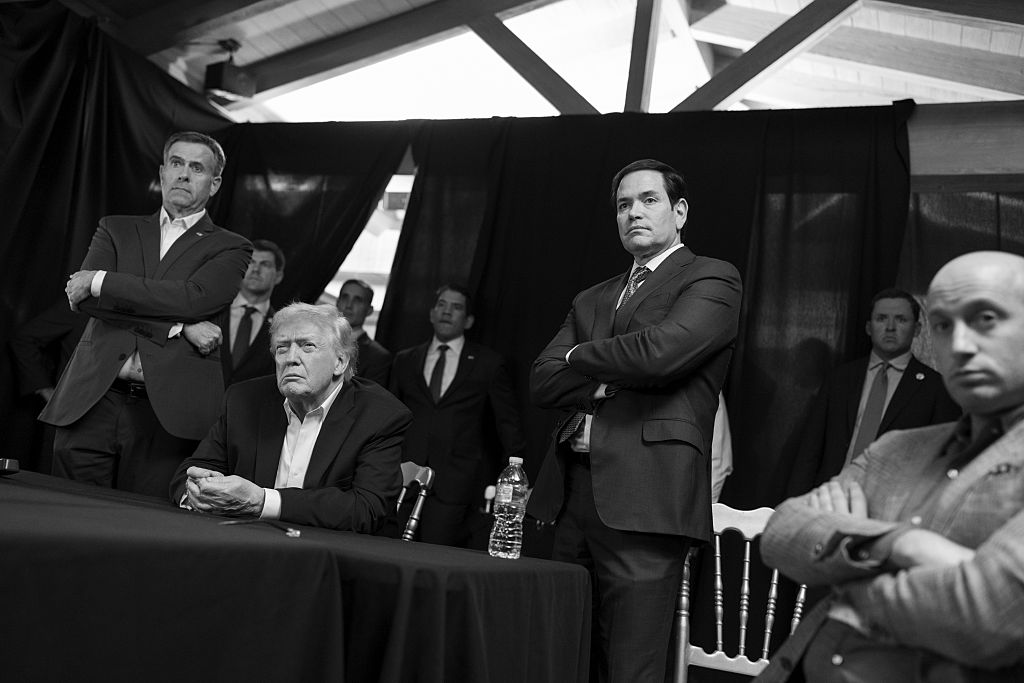
The assault on Venezuela signals a shift from hegemony and consent to Sopranos imperialism: unapologetic gangster-style power. (Molly Riley / The White House via Getty Images)

In the first episode of The Sopranos, Tony Soprano confesses to his new psychologist, Dr Jennifer Melfi, whom he visits after experiencing a panic attack, that “it’s good to be in something from the ground floor. I came too late for that, and I know. But lately, I’m getting the feeling that I came in at the end. The best is over.” While the fictional New Jersey mob boss is referring to the Mafia, it also serves as a metaphor for the anxieties of declining US imperial power in a world in which its hegemony is in marked decline. Donald Trump’s rise, fall, and return to power are, in large part, driven by this anxiety in its various forms — as is the racketeering style of his presidency in his second term — most obviously illustrated by the recent kidnapping of Venezuela’s president, Nicolás Maduro, and his wife, Cilia Flores.

The episode was hardly unprecedented. Since 1989, the United States has kidnapped three sitting presidents, beginning with George H. W. “Pappy” Bush’s betrayal of his old partner in counterrevolutionary drug trafficking, Manuel Noriega, and continuing with George W. “Dubya” Bush’s abduction of Haiti’s democratically elected president Jean-Bertrand Aristide in 2004. Noriega was left to waste away in a US dungeon, while Aristide was eventually granted asylum in South Africa. We will see in the coming months if the pathetic justifications for taking out Maduro hold any weight in a US court, though there is little reason to expect an impartial process. What distinguishes Venezuela is that it is not a small state dependent on the United States like Panama or Haiti. It has been treated as one of the US’s official enemies, with a target on its back since Hugo Chávez came to power. It is also a large country with a population of twenty-eight million and a military that is, at least on paper, capable of inflicting some damage in the event of an invasion.

The spectacle of the operation not only marked a clear end to any lingering idea of an international order premised on state-based sovereignty and international law; it also signaled, as I argued a few months ago, “a return to a conception of sovereignty premised on ‘the strong do what they will.’” Trump’s claim that the United States is effectively running Venezuela, consistent with his turn toward the crudest form of resource imperialism, offers further evidence of this. Given the fog of war, the frenzied hubris of MAGA agitprop, and the difficulty of assessing information coming out of Venezuela, any confident assessment of the future of Venezuelan politics or Chavismo is premature.

Mob Rule

The attack on Venezuela, in this sense, marks the arrival of the Sopranos stage of imperialism: the transformation of US hegemony into open extortion, as I argued in Jacobin last October:

The crudeness of the justification for war with Venezuela reflects both the decline of US soft power, particularly after the destruction of the US Agency for International Development (USAID), and the Trump administration’s belief that it no longer needs to stage the same sorts of propaganda efforts required for past wars. Congress does what it is told, and the public no longer really needs to be won over; public opinion today can be manufactured post hoc through the algorithm.

The fact that Trump has carried out a successful operation against Venezuela without consulting Congress, on what amount to the laziest and most mendacious premises in recent memory further establishes the point:

For the United States, sovereignty now means the right of the sovereign — Donald J. Trump — to exercise whatever forces, economic or military, he deems necessary in pursuit of what he dictates to be in the interest of the United States: from sanctioning Brazil for daring to prosecute a former president for attempting a coup to killing what are likely Venezuelan fishermen in order to appear to be combating drug trafficking.

During a phone call tapped by the feds, Gambino underboss Aniello “Neil” Dellacroce exclaimed to future boss John Gotti, then a mere capo, and family soldier Angelo “Quack Quack” Ruggiero that “La Cosa Nostra means that the boss is your boss.” The takeaway is simple: you will do as you are told because this is how things work in the Mafia. Unlike the Gambino family, however, Trump doesn’t have a few hundred soldiers to call on. He commands the most powerful military machine in history, which he can deploy to extort the world.

The writer John Ganz has made a useful comparison between Gotti’s populist appeal in the outer boroughs and Trump’s meteoric political ascent in his book When the Clock Broke. In Ganz’s view, “Trump has also long viewed the role of capo di tutti capi as an aspiration.”

Protection as Extortion

The attack on Venezuela shows that Trump, with Mar-a-Lago serving as his government’s Bada Bing, has established more or less the same principle in terms of US sovereignty. Only Trump can establish how the US state must act, and he doesn’t need to consult anyone. As he told the New York Times in response to a question on whether there were any limits to his international power, “Yeah, there is one thing. My own morality. My own mind. It’s the only thing that can stop me.”

What Trump and his cronies Stephen Miller and Marc Rubio will take from this is that they can and will get away with imperial extortion without facing congressional censure or any domestic political restrictions. That the European Union and NATO, with the notable exception of Spain, effectively supported the operation, along with what remains of the international community in the form of the Nobel Peace Prize committee, only reinforces this lesson. More acts of naked aggression in Latin America should therefore be expected, likely against Mexico, Colombia, Cuba, Nicaragua, and beyond. This risk is heightened as Trump’s domestic approval drops amid Immigration and Customs Enforcement (ICE) occupation of cities, the regime and its supporters’ defense of a federal agency executing a US citizen, and sharp rises in the cost of living.

Given this trajectory, it is probably only a matter of time until the United States makes a move on Greenland — another expression of the Sopranos stage of imperialism. The transformation of US empire from a hegemon able to provide legitimate protection to its allies after the devastation of World War II, at a tolerable price, into simply an extortion racket that maintains its position via military might amid economic decline was outlined by Giovanni Arrighi in the New Left Review all the way back in 2005: “After a decade of deepening crisis, the Reagan Administration initiated the transformation of legitimate protection into a protection racket.”

Weakness only encourages those with power to tighten the squeeze. Despite their supposed code of honor, both the fictional mobsters of The Sopranos — from Tony killing Chrissy to Paulie “Walnuts” Gualtieri leaking secrets to New York — and their real-life counterparts proved more than willing to betray their allies for short-term gain, self-preservation, and sheer hubris at the first opportunity. After all, what can Denmark and Europe do about it? So far, Europe has only doubled down on accepting its role as a vassal to be extorted. Trump has been rather open about this, boasting to Fox News, “We have to do it again. We can do it again, too. Nobody can stop us.”

Miami Is the Capital of the Future

The attack on Venezuela also served as the clearest signal yet of the return of the Monroe Doctrine — understood here as the sole right of the United States to shake down the Western Hemisphere. In doing so, it unified both Rubio’s frenzied anti-communist wing of MAGA and Miller’s white nationalist “America First” branch in a shared agenda. As Greg Grandin wrote in the Financial Times:

America First is often misunderstood as isolationist. But it’s never been that, for its most vocal advocates have celebrated the projection of US power within the Western Hemisphere. It’s better described as anti-universalist, as a tribalist nationalism that rejects the burden of global stewardship while clinging fiercely to regional supremacy. The Monroe Doctrine occupies a special place in this worldview since, in the form it has taken under Trump, it promises dominance without entanglement. Citing Monroe, Trump officials have carved out an area of the globe where the US need not persuade, integrate or universalise — only command, by fiat.

Miller’s enthusiasm for the Monroe Doctrine in large part stems from the fact that

the war against narco-terrorists abroad will further serve — indeed, already serves — as justification for increased repression domestically, as ICE and the National Guard occupy and terrorize major cities while the Trump administration attempts to fabricate a left-wing terrorist threat to enable it to use the powers of the federal government against the Left. “Right now, Venezuela is not being treated as a foreign policy issue,” said Carrie Filipetti, who led Venezuela policy at the State Department under the first Trump administration. “It’s being treated as a homeland security issue, and rightfully so.”

In this respect, the near future for Latin America appears bleak and uncertain. Miami — a city built by counterrevolutionary CIA-sponsored drug traffickers (including Rubio’s family) and now a haven for cryptoscammers, sports-betting influencers, OnlyFans models, streamers, and the other assorted detritus of MAGA’s base — has effectively become the new capital of US empire. Backed by the most reactionary sections of Latin America’s ruling class, South Florida now functions as a coordination hub for the hemisphere’s reactionary elite. As left-wing Colombian presidential candidate Iván Cepeda told Jacobin:

Miami and Florida have become a center of international politics, coordinating the efforts of the hemispheric far right. They have behind them powerful economic conglomerates, which resort to all kinds of methods. Unlike the politics carried out by the Left, dirty methods of doing politics are common on the far right. This strategic offensive on the continent — all that plays a role. There is also a strengthening of the Left in certain countries and social mobilizations in all of them.

South Florida also figures in The Sopranos as a destination for reinvention and escape. It’s the place where Junior Soprano went to pursue romance, where Little Carmine yearns for a career in the (legitimate) film business, and where Tony and Paulie go on the lam. For nearly a century, it has served as the Mafia’s fantasy of easy living away from the cold and grime of the East Coast and Chicago. Adjusting to the Sopranos stage of imperialism means recognizing this shift in power and the brute fact that the only thing that gangsters respect is strength. As María Corina Machado, among others, can testify, Trump’s affections and deals can always be reneged upon, sometimes at gunpoint.