Trump’s New National Security Memo Is 30 Pages of Insanity

Greg Grandin

Released just before Christmas, Donald Trump’s National Security Strategy memo is a bizarre and frightening manifesto for MAGA’s second term. To help make sense of the document, Jacobin turned to Latin American historian Greg Grandin.
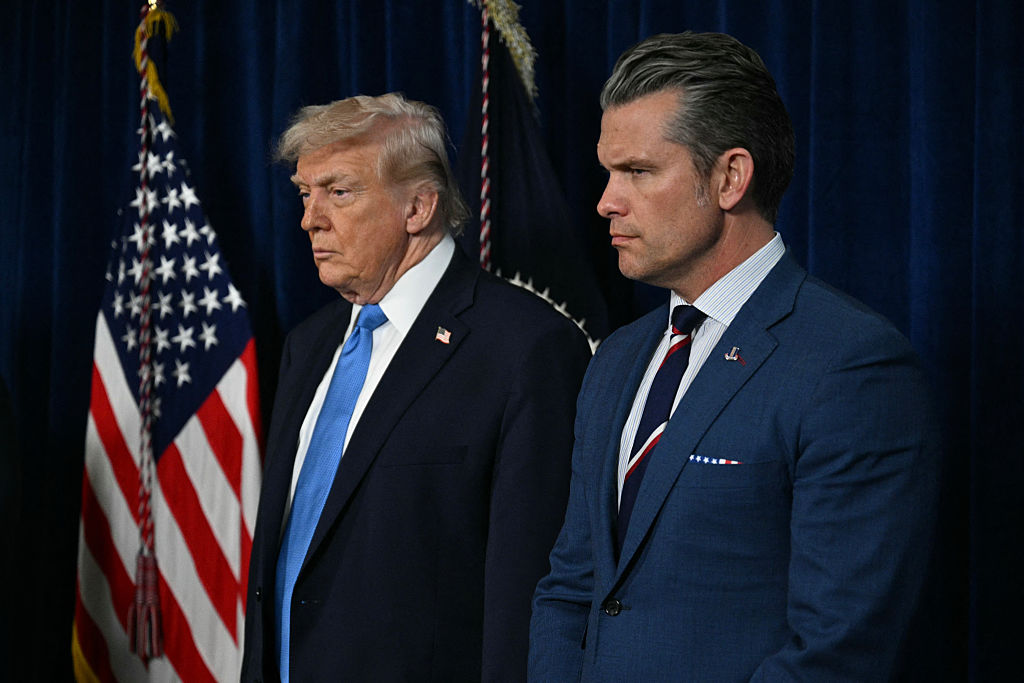
Trump’s new 30-page National Security Strategy memo prompts two basic questions: Who the hell wrote this? And what on earth does it mean? (Jim Watson / AFP via Getty Images)

Interview by
Sebastiaan Faber
Álvaro Guzmán Bastida

A year into his second term, President Donald Trump is wasting little time scouring American history for precedents that he believes legitimize his global belligerence. The latest US National Security Strategy (NSS), released in early December, resurrects the Monroe Doctrine — what began in 1823 as a simple declaration that Europe’s colonial ambitions would no longer be tolerated in the Americas. The NSS also rejects the “globalist” illusions that have guided the United States’ foreign policy for decades, announces the “civilizational erasure” of Europe, and proclaims the need to increase the number of “strong, traditional families” with “healthy children.” The thirty-page document prompts two basic questions: Who the hell wrote this? And what on earth does it mean?

To help decipher this curious text, which at times reads like a postmodernist manifesto (“President Trump’s foreign policy is pragmatic without being ‘pragmatist,’ realistic without being ‘realist’”), at others sounds like a self-help book for single men (“The future belongs to makers”), and at still others, like an internal memo for car dealership employees (“American goods . . . are a far better buy in the long run”), Jacobin turned to Greg Grandin, a historian of Latin America at Yale University.

Grandin is the Pulitzer Prize–winning author of more than ten books, including Fordlandia (2010) and Kissinger’s Shadow (2015). In April, he published America, América: A New History of the New World. Sebastiaan Faber and Álvaro Guzmán Bastida spoke with Grandin in mid-January, asking him to respond and riff on eight passages in the new NSS. “Got it,” Grandin assented. “You guys are Bobby Weir, and I’m Jerry García.”


Sebastiaan Faber and Álvaro Guzmán Bastida

After years of neglect, the United States will reassert and enforce the Monroe Doctrine to restore American preeminence in the Western Hemisphere, and to protect our homeland and our access to key geographies throughout the region. We will deny non-Hemispheric competitors the ability to position forces or other threatening capabilities, or to own or control strategically vital assets, in our Hemisphere. This “Trump Corollary” to the Monroe Doctrine is a common-sense and potent restoration of American power and priorities, consistent with American security interests.

Greg Grandin

This is such a tired trope. It’s often claimed that Latin America needs attention because it has supposedly long been neglected. The trope is invoked in good times, bad times, crisis times, or times of stasis. In fact, it’s so pervasive that it’s absorbed even by critics on the left. A lot of people explained the rise to power of the Latin American left in the 2000s, for example, as a result of George W. Bush being “distracted” by events elsewhere. The truth, of course, is that the vectors of power are constant, whether it’s financial, cultural, or military power, through the everyday operations of US Southern Command and complex military training systems. In smaller countries, the US diplomatic staff is very interventionist, while it’s perhaps a little more hands-off in larger countries. But there is never any time when the United States is “neglecting” Latin America.

Then there’s the passage about the Monroe Doctrine. Right from the beginning, the Monroe Doctrine was a statement whose ambition and vision far outstripped the United States’ capabilities. President James Monroe wasn’t stating any action plan. He barely even hinted at any projection of US power, except for a bit in which he states that the United States will see any event that happens in the Western Hemisphere as it bears on its own peace and happiness. It wasn’t until later, in the nineteenth century, that that phrase was expanded into a doctrine of mandatory power that the United States claims the right to wield.

This statement in the NSS is not all that different: it expresses an ambition that cannot be realized. The United States simply does not have the power to completely dominate Latin American trade and Latin America’s diplomatic interests. At the same time, it also expresses an escalation of the doctrine of mandatory US power: the idea that the United States is going to enforce its will to keep China out. But of course there is no way that the Donald Trump administration is going to be able to roll back, say, China’s investment in Latin American agriculture and infrastructure.

Even a Trump ally like Javier Milei, who was saved by Trump with a credit swap, had a previous peso swap with the Chinese currency that’s still in place. And now Mercosur, which includes Argentina, is about to sign a trade deal with the European Union that cuts the United States out. In other words, the document stakes out the region as a theater of geo-economics, but none of its ambitions will be realized through what we just saw in Venezuela — spectacular acts of military power backed up by bellicose rhetoric.

Sebastiaan Faber and Álvaro Guzmán Bastida

Our goals for the Western Hemisphere can be summarized as “Enlist and Expand.” We will enlist established friends in the Hemisphere to control migration, stop drug flows, and strengthen stability and security on land and sea. We will expand by cultivating and strengthening new partners while bolstering our own nation’s appeal as the Hemisphere’s economic and security partner of choice.

Greg Grandin

Well, we’ve seen what “enlist and expand” means in Venezuela, haven’t we? It means “seize, dispossess, expropriate, and sanction.” I don’t want to sound like some liberal wonk from within the Beltway, but it is true that you have to have a little bit of stability and trust — some confidence that whatever decisions are made are going to be a little bit longer lasting than until the moment Trump gets peeved at some country and slaps them with sanctions or tariffs. The problem is that Trump’s capriciousness is central to his charisma. You can’t excise that from Trumpism without deflating it and taking away its magic.

Sebastiaan Faber and Álvaro Guzmán Bastida

Targeted deployments to secure the border and defeat cartels, including where necessary the use of lethal force to replace the failed law enforcement–only strategy of the last several decades . . .

Greg Grandin

So they’re not only juxtaposing law enforcement with some kind of social vision of rehabilitation — no, they’re juxtaposing law enforcement with even more heavy-handed militarism! But there’s no defeating the cartels with military strikes. For making fentanyl, you basically need a tent and $5 in chemicals to make a thousand pills. Bombing those facilities is like bombing bodegas in the Bronx; you bomb one, another pops up.

The fact is, the United States has been waging a war on drugs for fifty years. But more coca is cultivated, and more cocaine is processed and imported into the United States now than there was at the beginning of Plan Colombia. In some ways, it’s analogous to Afghanistan, where we spent trillions of dollars on a two-decade war to overthrow the Taliban, only to install . . . the Taliban.

It’s the same with the cartels, which have always gone hand-in-glove with the US projection of militarism. We all know that the United States worked closely with repressive forces in the military that were implicated in the cultivation and growth of the cocaine industry, whether it be Augusto Pinochet in Chile or the cocaine colonels in Bolivia or Colombia. At the same time, the DEA is giving these actors millions of dollars to eradicate cocaine!

John Stockwell, a former CIA agent who spilled some of the beans to the public, said that there’s no major operation anywhere in the world that the CIA executed where it didn’t leave behind a major drug cartel. He was talking about Italy in 1947–48, when the CIA used Lucky Luciano to beat back the Communists and allowed him to basically set up the modern heroin trade of poppies from Turkey and elsewhere in the East, to be processed in places like Sicily and then exported to Europe and the United States. The idea that somehow more militarism is going to end the drug cartels is a fantasy that has been going on for more than fifty years. But it’s hard to get anybody in the United States worked up about these issues.

The only way forward is to begin treating drugs as a social problem, as people in the Latin American and US establishment proposed during the Barack Obama administration. But the Obama people didn’t even pretend to bite — because that would entail dealing with the demand for drugs from the United States and going after the banks and money laundering. The same deregulation of the finance sector that gave us Jeffrey Epstein gave us the cartels.

Something similar happens with migration from Central America, which skyrocketed after the region signed free-trade agreements with the United States. All the politicians offer the same formula: “We need a Marshall Plan, an Alliance for Progress, business development,” and so forth. The idea is that somehow, by developing these countries, we’ll stop the mass migration. But the fact of the matter is that all of US developmental aid just goes to building out the infrastructure of further neoliberal dispossession.

Sebastiaan Faber and Álvaro Guzmán Bastida

In the Western Hemisphere — and everywhere in the world — the United States should make clear that American goods, services, and technologies are a far better buy in the long run, because they are higher quality and do not come with the same kind of strings as other countries’ assistance. Successfully protecting our Hemisphere also requires closer collaboration between the US Government and the American private sector. All our embassies must be aware of major business opportunities in their country.

Greg Grandin

So much of this is boilerplate. Look, obviously, there are a lot of reasons why the United States is appealing. But if countries feel like they’re being bullied, they’ll look elsewhere.

Sebastiaan Faber and Álvaro Guzmán Bastida

First and foremost, we want the continued survival and safety of the United States as an independent, sovereign republic whose government secures the God-given natural rights of its citizens and prioritizes their well-being and interests. We want to protect this country, its people, its territory, its economy, and its way of life from military attack and hostile foreign influence, whether espionage, predatory trade practices, drug and human trafficking, destructive propaganda and influence operations, cultural subversion, or any other threat to our nation. . . . We want the restoration and reinvigoration of American spiritual and cultural health. . . . This cannot be accomplished without growing numbers of strong, traditional families that raise healthy children.

Greg Grandin

The hypocrisy is staggering. Because it is in the diversity they despise, the diversity that migrants bring, that you find the cultural values they claim to be promoting. When I lived in Durham, North Carolina, around the turn of the millennium, it was Mexican migrants and their families who resurrected the porch culture that to so many nostalgic Southerners embodies their lost tradition. And it was the Mexicans who were creating small businesses in the strip malls. Still today, if you left immigrants in the United States to their own devices, they would embody exactly the values that were destroyed by neoliberalism. In a weird Freudian dynamic, Trumpism’s anti-immigrant hatred is like a hatred for the object that reminds you of the thing that you killed. The talk about “cultural subversion” is just out-and-out racism. Because let’s face it: Who wouldn’t want a taco truck on every block? In my book, that would be the closest thing to utopia, short of free health care.

For a while, there was a current within the Republican Party that claimed to support Mexican migrants because they’re culturally conservative, patriarchal, and so forth. But when, in Obama’s second election, they all voted Democratic by an enormous margin, polling confirmed that they had a social conception of citizenship and kind of liked public policy. They believe the state should take care of things like health care. The vast majority of Latinos who voted for Obama in 2008 thought they were going to get national health care. There was even a song about it. Of course, they didn’t get it.

Sebastiaan Faber and Álvaro Guzmán Bastida

[Europe’s] economic decline is eclipsed by the real and more stark prospect of civilizational erasure.

Greg Grandin

This idea, with its Spenglerian overtones, breaks with the Monroe Doctrine. Monroe said that the peoples of the Western Hemisphere share certain interests that make them distinct from the Old World. And even the most bellicose advocate of the Monroe Doctrine as it became more and more weaponized in the nineteenth and early twentieth century held on to this idea that when the United States acted, it was in defense of the Western Hemisphere. The Trump corollary is different. It understands the Western Hemisphere in terms of a culture war, or even a civilizational war, in which it’s vital to make the United States as white as possible. It presumes not a commonality of interests but a division of interests that’s explicitly understood in racialized terms.

That goes back to a long tendency in America First nationalism, a tribal nationalism that saw the United States as the promised land of the Anglo-Saxons. This was in tension with a more cosmopolitan view of the country. James Madison said that wealth and prosperity were found in diversity. And while he did not use that term as we do now, it did signal a certain openness to the world.

There is something else that’s worth noting here. The document identifies China as the main economic competitor, especially in Latin America; it situates Latin America as a zone of contest in which the United States is going to push back China. But it does not identify China as a cultural enemy. That role is reserved for the low-birth-rate white people, women who don’t want to have babies, and the mongrels coming from the south.

Sebastiaan Faber and Álvaro Guzmán Bastida

Our elites badly miscalculated America’s willingness to shoulder forever global burdens to which the American people saw no connection to the national interest. They overestimated America’s ability to fund, simultaneously, a massive welfare-regulatory-administrative state alongside a massive military, diplomatic, intelligence, and foreign aid complex. They placed hugely misguided and destructive bets on globalism and so-called “free trade” that hollowed out the very middle class and industrial base on which American economic and military preeminence depend. 

Greg Grandin

On the one hand, this is an open rejection of the post–Cold War liberal consensus in which the United States superintends a unified global market in which nations abide by common laws on property, investment, and trade — a regime created and supervised by the United States. Of course, Trump has been critical of free trade since the 1980s. It is a through line in his thinking. Here, though, it reflects the trajectory of the culture wars and expresses a much more racist framework of global elites and their supposed betrayal.

Here we see the seeds of a certain kind of right-wing antisemitism or anti-cosmopolitanism. Of course, the other reality is that, for all his criticism of free trade, Trump is not offering anything in its place. And I’m not an economist, but I imagine it would be impossible to rewind the disaggregation of the production process and to bring back value-added jobs to the United States. There’s no economics behind Trumpism. There’s no economic agenda, other than just traditional tax cuts, which he got, and running the economy as hard as possible until the next election.

Sebastiaan Faber and Álvaro Guzmán Bastida

President Trump’s foreign policy is pragmatic without being “pragmatist,” realistic without being “realist,” principled without being “idealistic,” muscular without being “hawkish,” and restrained without being “dovish.” It is not grounded in traditional, political ideology. It is motivated above all by what works for America — or, in two words, “America First.”

Greg Grandin

Wait, it actually says that? Literally? I somehow missed that paragraph! Well, what else is this but the perfect cover for Trump’s capriciousness? I mean, seriously, what hypocritical and contradictory action can Trump take that isn’t justified by that description?

Sebastiaan Faber and Álvaro Guzmán Bastida

One last question for you. To quote a T-shirt that has been popping up at demonstrations in recent years: “Is it fascism yet?”

Greg Grandin

I always get a little hung up on these typological questions because the United States has been operating in a state of emergency since its inception. There have been more than fifty since the country’s founding. But of course, every single war is a state of emergency. And every false-flag operation, from the Gulf of Tonkin to Mexico in 1846 or Cuba in 1898, has been a Reichstag Fire in its own way — with the difference that they’ve been directed toward expansion rather than domestic repression. Talking about fascism in the United States is complicated because, as Corey Robin argued some years ago, authoritarianism here functions through the institutions that liberals are saying we have to defend. It’s a profoundly minoritarian government in which the most repressive acts have been legitimized through the court system and through the electoral system.

The problem with the fascism debate during Trump’s first term was that it served to obscure the role of the Democratic Party in laying the groundwork for the collapse of the neoliberal order that led to such disaffection. Or forget neoliberalism: to obscure the way every president since Richard Nixon has escalated the drug war.

So, is it fascism yet? I don’t know. It’s like that apocryphal [Zhou Enlai] quote about the French Revolution: too early to tell.

Share this article

Contributors

Greg Grandin is a professor of history at Yale University. He is the author of seven books, including The End of the Myth: From the Frontier to the Border Wall in the Mind of America, which won a Pulitzer Prize, and Empire's Workshop: Latin America, the United States, and the Making of an Imperial Republic, rereleased in a new and updated paperback edition in 2021.

Sebastiaan Faber is a professor of Hispanic studies at Oberlin College and the author of Exhuming Franco: Spain's Second Transition.

Álvaro Guzmán Bastida is a Spanish writer and filmmaker pursuing an MFA in screenwriting and directing at Columbia University, where he also earned master’s degrees in journalism and politics and government.

Filed Under