Labor’s Role in the Fight for Turkish Democracy
The arrest of Istanbul mayor Ekrem İmamoğlu has prompted more than a month of protests in Turkey. The demonstrations have rallied many working-class Turks, but they’ve also shown the limited strength of organized labor.
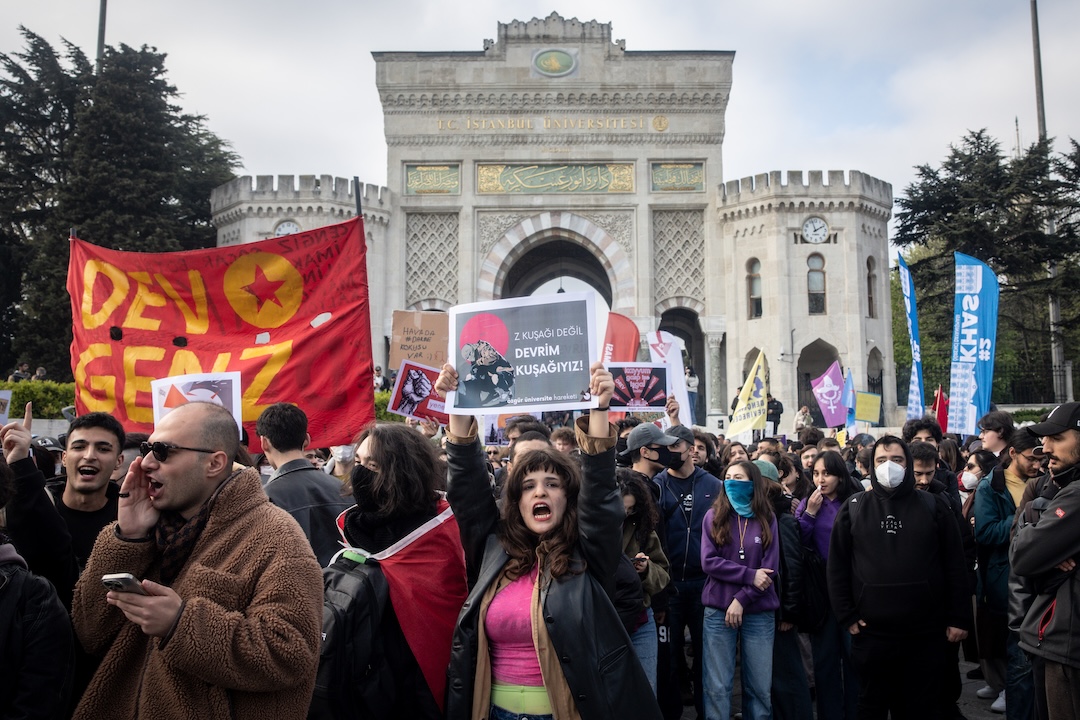
University students chant slogans and hold signs during a protest in support of arrested Istanbul mayor Ekrem İmamoğlu outside Istanbul University on April 19, 2025, in Istanbul, Turkey. (Chris McGrath / Getty Images)
“This is what we’ll do. We won’t work on March 27 and 28. Take sick leave, take a day off, turn off the switch, shut down your computer. Let your absence be felt — make yourself heard!” That was the call from Başaran Aksu, leader of Umut-Sen, a socialist organization supporting workers and independent unions in Turkey. At first glance, the appeal might seem like a minor act amid the wave of social outrage following the arrest of Istanbul’s mayor, Ekrem İmamoğlu, on March 19. In the first two weeks of protests, universities came to a halt, businesses linked to Recep Tayyip Erdoğan’s government were boycotted, and an “economic standstill” was staged — a day of refusing to spend as a form of protest.
Yet Aksu’s proposal is another drop in a rising tide of mobilizations, with growing calls for a general strike from multiple fronts. “The general strike aims to address the real problems of 80 percent of society — lack of future prospects and economic insecurity — beyond this political blockade and systemic clash,” Aksu explains. “It’s about opening a debate on the problems society faces beyond İmamoğlu.”
İmamoğlu’s party, the center-left Republican People’s Party (CHP) — Turkey’s main opposition in parliament — gathered crowds outside Istanbul’s city hall during the first week of protests. There Özgür Özel, leader of the Kemalist CHP, announced that “when necessary,” it would call a general strike to deny the government “room to breathe.” But the warning went no further. “The CHP doesn’t hide its distance from the working-class struggle, aligning with its own interests. At its core, it has no fundamental difference from Erdoğan’s AKP [Justice and Development Party] when it comes to protecting capital,” says Ali Ergin Demirhan, a journalist and analyst for Sendika.org. “The phrase ‘when necessary’ reflects the CHP’s needs, not the working class’s.”