Turkey’s Opposition Party Is Mistaking Defeat for Virtue
After nearly a quarter century of AKP dominance, Turkey’s main opposition party, the CHP, remains unable to name its program, organize its social base, or break with the political culture that has made it so easy to defeat.
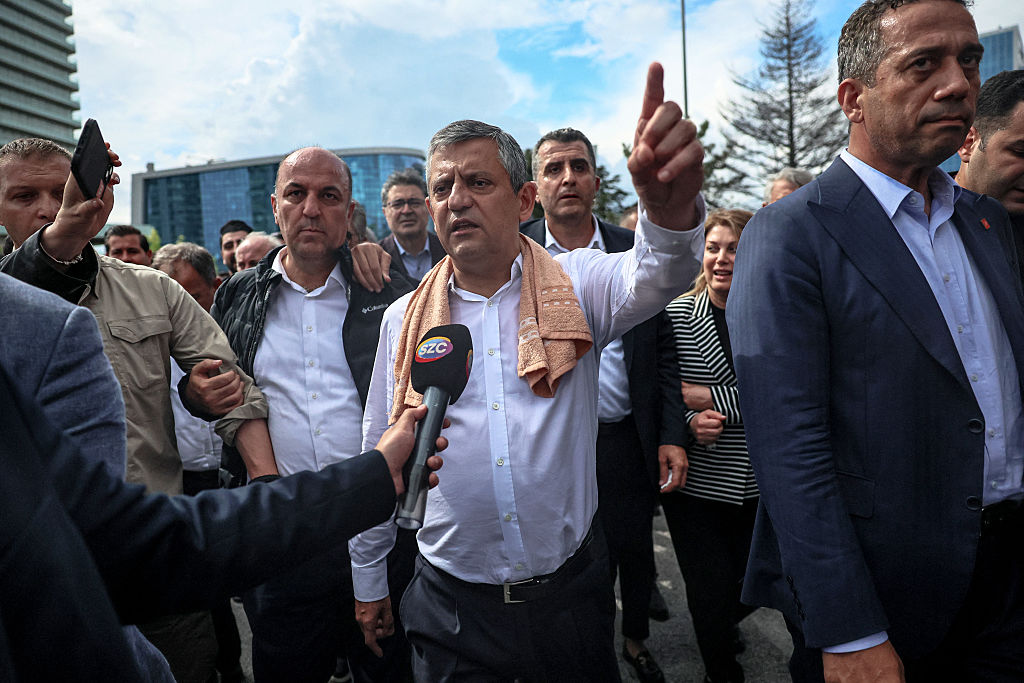
Republican People’s Party leader Ozgur Özel marches with fellow party members after a police raid on the party headquarters in Ankara, on May 24, 2026. (Adem Altan / AFP via Getty Images)
Turkey’s Republican People’s Party (CHP) is both the country’s founding party and its main opposition force. The trouble is, after nearly a quarter century of Justice and Development Party (AKP) dominance, the CHP still does not know who it represents or how to effectively challenge for power.
On May 21, 2026, a court in Ankara annulled the 2023 congress that had brought Özgür Özel to the leadership of the CHP, removed Özel and his team as an interim measure, and restored Kemal Kılıçdaroğlu to office. The case centered on allegations of irregularities at the congress, while the CHP denounced it as part of a broader effort to weaken its elected leadership. The ruling came after more than a year of legal pressure on opposition figures, including the arrest of Istanbul mayor Ekrem İmamoğlu, widely seen as Recep Tayyip Erdoğan’s most serious potential rival.
This is plainly part of a broader effort to discipline the opposition through legal and institutional pressure. But the crisis cannot be understood only as another authoritarian maneuver from above. It also exposes a deeper problem inside the CHP itself: a party that repeatedly promises renewal while refusing the class politics and strategic rupture that victory would require.
What happens when an opposition party becomes attached to the familiar forms of its own defeat? The crisis currently shaking the CHP is not merely a matter of party rules, court procedures, leadership, or factional rivalry. The question is deeper: for what — and for whom — does the CHP exist? Is it the party of the state or society? Of change or the status quo? Of the people or the existing order?
This is not a new question. It has haunted the CHP since at least Turkey’s transition to multiparty politics after 1945, and it became especially sharp during the crises of the 1960s and 1970s, when the party tried to define itself as “left of center” without fully breaking with its authoritarian reflexes. One of the most powerful critics of this ambiguity was Hikmet Kıvılcımlı, a Turkish Marxist theoretician, revolutionary, and lifelong dissident. Writing in 1970, Kıvılcımlı offered a diagnosis that still cuts: “The poor CHP did not know what it was. Turkey’s tragedy lay not in failing to understand democracy or the state, but in failing to understand what the CHP itself was.”
For Kıvılcımlı, a party’s identity was not simply a matter of rhetoric, leadership, or symbols. It was a question of program, principles, and class. The CHP’s tragedy was that it could not name the social forces it represented. Was it the party of workers, peasants, small shopkeepers, secular professionals, state bureaucrats, or progressive capital? This ambiguity allowed it to speak in the name of “the people” while hesitating before the social forces that could actually transform the country. A party that does not know its own social base will, in moments of crisis, return to the ghosts and fantasies of its past.
Today this ambiguity survives in a different form. The CHP speaks the language of social democracy, but much of its political culture remains shaped by secular professionals, municipal elites, liberal constitutionalists, and a cautious relationship with business interests. It can appeal to workers, pensioners, students, and the urban poor — the very groups most damaged by the government — but it has not consistently organized them as a durable class bloc.
That is why the present crisis cannot be reduced to personality. If the differences between the Özel and Kılıçdaroğlu leaderships remain limited on foreign policy, economic strategy, and the party’s relation to the state, then the question is not simply who leads the CHP. The more disturbing question is whether the party, in changing leaders, has changed direction at all.
Sigmund Freud’s “death drive” is useful here less as a psychoanalytic doctrine than as a political metaphor: the tendency to return to familiar forms even when survival requires rupture. The CHP repeatedly stages renewal while retreating, at decisive moments, to older habits: deference to the state, fear of appearing too radical, and ambiguity about class politics.
Catherine Liu’s critique of liberal politics and the professional-managerial class offers a clearer way to understand the social culture surrounding the CHP. Writing about the American liberal imagination, Liu has shown how respectable opposition can become attached not to victory but to the preservation of its own moral superiority in defeat.
This logic is not confined to the United States. Something similar can be seen in the secular-professional culture surrounding the CHP. Much of this milieu does not simply oppose Erdoğan; it also defines itself through refinement, expertise, a moralized idea of meritocracy, constitutionalism, and the comforting belief that “we are not like them.” These are not worthless values. But when they replace organization, class politics, and a willingness to confront power, they become a style of defeat. The opposition learns to lose with dignity, and then mistakes dignity for strategy.
Liu’s point is not that liberal professionals lack compassion. It is that their compassion is often filtered through standards of merit, civility, and proper political conduct. They can imagine themselves as defenders of victims while remaining uneasy with workers, students, or the poor when those groups appear too angry, too unruly, or insufficiently respectable.
A similar pattern appears around the CHP. Much of its secular-professional milieu sees itself as more democratic, more Western-minded, more educated, and more deserving of political authority than the ruling party’s base. This self-image is not entirely invented; the opposition has often faced an uneven political and institutional playing field. But when this sense of superiority replaces organization, it becomes politically sterile.
This is the strategy of moral superiority in failure. It allows the opposition to transform defeat into proof of its own decency. After every crisis, the same consoling narrative returns: we were right, we were civilized, we respected the law, and we did not become like them. There is truth in this self-description. But it is politically insufficient. A party can be decent and still be strategically empty; it can be legally correct and still be powerless; it can be morally superior and still fail to organize the anger of the people it claims to represent.
This weakness has appeared repeatedly. In 2023, strategic criticism of Kılıçdaroğlu’s presidential candidacy was often moralized as disloyalty rather than debated as strategy. After İmamoğlu’s arrest, Özel organized large rallies and briefly gestured toward economic pressure on business groups aligned with the government. But the mobilization remained episodic. It did not become a durable campaign linking legal repression to wages, rents, youth precarity, and workplace power. The party called people into public squares, but it did not build the kind of organization that could turn those gatherings into a sustained political force.
Kıvılcımlı’s critique of the “neutral state” is crucial here. For him, the state does not stand above social conflict and does not operate as an impartial referee; it works, in the last instance, for those who hold power. Yet one of the CHP’s deepest reflexes has been to imagine the state as an arbiter, the legal order as a self-correcting mechanism, and institutions as structures that will eventually behave reasonably. If the state is not neutral, and if the judiciary is not independent of political power, then “remaining within the bounds of order” ceases to be prudence. It becomes disarmament. This is the force of Kıvılcımlı’s warning: “Suicide is not a tactic.”
The question facing the CHP today is therefore not simply whether its future belongs to Kılıçdaroğlu, Özel, the arrested mayor İmamoğlu, or some other figure. It is whether the party can recognize itself. Can it name its program, its social base, and the political forces it seeks to organize? Can it build a concrete historical bloc out of workers, students, pensioners, the poor, the precarious, and the secular middle classes? Or will it return, in every crisis, to the same old refuge: respectable moderation, leadership drama, and the fear of appearing “too radical”?
What the CHP needs is not another leader, another congress, or another slogan. It needs a confrontation with itself: with its class ambiguity, its faith in respectable moderation, and its habit of mistaking legality for strategy. A party that mistakes fear for moderation, ambiguity for inclusiveness, legality for strategy, and repeated defeat for democratic virtue is not merely making mistakes. It is mistaking political suicide for politics.