In Turkey, Criticizing a Corporation Can Land You in Jail
Turkish labor leader Mehmet Türkmen was jailed for spreading “disinformation” after he criticized a business where a worker lost both arms in an accident. It’s part of a wider crackdown designed to suppress trade unions that speak up for workers.
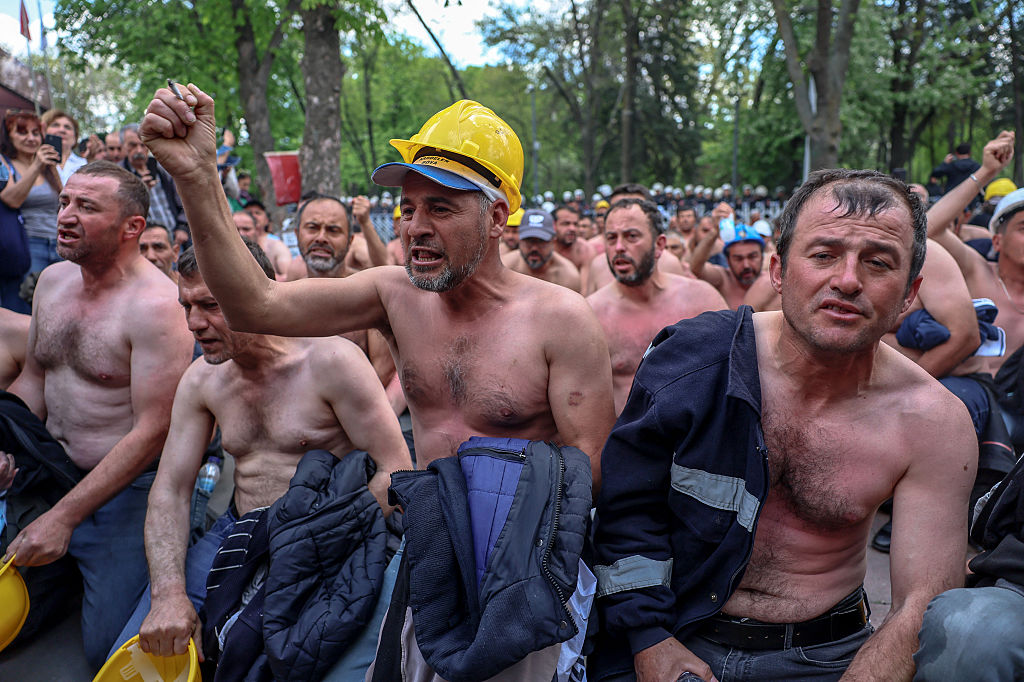
Last year, at least 2,105 workers in Turkey were killed on the job: an average of six deaths every single day. Yet the labor organizers who dare to speak up against these lethal conditions are routinely thrown in jail. (Adem Altan / AFP via Getty Images)
“In this country, laws don’t apply to the rich.”
These words are the reason why Mehmet Türkmen, president of the United Textile, Weaving and Leather Workers’ Union (BİRTEK-SEN), spent two months behind bars. The charge was “publicly disseminating misleading information.” Speaking at a labor protest in southeast Turkey, Türkmen had criticized the impunity of bosses after a grim incident where a worker lost both arms in a factory machine.
Just days later, Esra Işık — a leading voice among villagers fighting a mining giant’s environmental destruction — was arrested. That set off a chain reaction. Başaran Aksu, a coordinator for the labor group Umut-Sen, claimed Işık’s arrest was “ordered” by Limak Holding, the conglomerate behind the contested Akbelen mine project. He was jailed on the same charge. Doğukan Akan, a legal officer for the Independent Mine Workers’ Union, called Aksu’s arrest “proof that the judiciary takes orders from holding companies.” Then he too was swept up in the dragnet.
Pressure on Turkish trade unionists is nothing new. Türkmen himself was jailed last year after a boss filed a complaint against him. What’s striking now is the momentum the labor movement has gained despite this crackdown. Amid strike bans, a deepening economic crisis, and mass layoffs, the country is witnessing a remarkable wave of worker militancy. In just the first two months of this year, more than sixty strikes and work stoppages erupted — a figure that already surpasses the annual totals recorded in each of the previous five years.
While the established “yellow unions” languish in bureaucratic inertia, this does not mean that the working class is merely passive. Rather, independent, militant unions are shouldering a resurgence of struggles. “Because these independent unions have been driving the recent upsurge in militancy,” says Istanbul University political scientist Mustafa Görkem Doğan, “the state is trying to crush them by force. They are a discordant noise in the quiet, settled order of the last twenty to twenty-five years.”
An Era of Unorganized Resistance
Turkey’s unions are in a state of advanced bureaucratic decline. The vast majority of workers belong to no union at all. The affiliation rate has collapsed from 24 percent in 1988 to below 10 percent in the 2010s. Today it hovers around 14 percent — but that figure only accounts for registered workers.
When you factor in that a quarter of the workforce — more than 8 million people — works off the books, the actual unionization rate drops even further.
According to the International Labour Organization, Turkey has one of the highest rates of informal employment among Organisation for Economic Co-operation and Development (OECD) countries. The state’s own Social Security Institution acknowledges that millions of workers are excluded from any legal protection, which also means they are effectively barred from union membership. In sectors like construction and agriculture, informality exceeds 40 percent, making organized labor action virtually impossible in large swaths of the economy.
And of those who are unionized, the overwhelming majority belong to the Confederation of Turkish Trade Unions (TÜRK-İŞ), a conciliatory “yellow union” confederation that prioritizes “social dialogue” with the government over collective action. Only 11 percent of unionized workers are members of the Confederation of Progressive Trade Unions of Turkey (DİSK), the more left-leaning confederation. In this climate, the simple act of joining a union can be grounds for dismissal.
To understand how we got here, you have to look back, says Doğan: “Turkey’s unions, built for an era of import substitution, fell into total atrophy during neoliberal globalization.” He argues that the traditional labor movement fired its last meaningful shot during the 2009–2010 Tekel Resistance, when 12,000 workers were left jobless by privatization and responded with a nationwide, seventy-eight-day tent city protest.
The action was led by Tek Gıda-İş, a union affiliated with the TÜRK-İŞ confederation, but was ultimately abandoned by the confederation’s leadership, which pressured workers to accept a deal. DİSK, for its part, had by then drifted toward the orbit of the main opposition, the Republican People’s Party (CHP), its radical roots eroded by decades of bureaucratic inertia and risk-averse legalism. The betrayal left a lasting scar and marked the effective end of the established confederations as credible fighting forces in the eyes of many rank-and-file workers.
“The space they vacated,” Doğan says,
was filled first by unorganized, wildcat resistance — the “Metal Storm” of 2015, where 30,000 nonunionized autoworkers effectively occupied their plants, was the high point — and then by independent unions pursuing a strategy entirely separate from the established confederations. These independent unions remain small in absolute numbers — most count their members in the hundreds or low thousands, and BİRTEK-SEN, though it has become the most visible force in the textile sector since its founding in 2022, still operates with a modest base — but their influence far outstrips their size.
Earlier this year, that independent spirit was on display when five thousand warehouse workers at Migros, one of Turkey’s largest supermarket chains, organized with the independent union DGD-SEN to protest layoffs — and won, securing the reinstatement of fired workers and a wage deal well beyond what the company had initially offered. In 2024 and early 2025, unions like BİRTEK-SEN, DGD-SEN, and Bağımsız Maden-İş were behind nearly every major strike that captured national attention, from the textile walkouts in Gaziantep to the warehouse occupations on Istanbul’s industrial periphery. Their success has forced even the ossified confederations to make rhetorical gestures toward militancy, though few workers are convinced.
“If You’re Rich, You Can Commit Murder”
The wave of resistance is intensifying in the country’s industrial heartlands. In Gaziantep, a southeastern textile powerhouse and one of Turkey’s largest manufacturing cities, Mikail Kılıçalp, general secretary of BİRTEK-SEN, points to the economic fallout of the US-Israeli war against Iran as a breaking point.
“Layoffs in Antep have skyrocketed in the last year,” Kılıçalp says. “Since the war started, a lot of small shops have just closed. People are being put on unpaid leave. Production is down nearly 30 percent. Wages that should hit accounts on the seventh of the month are coming on the fifteenth, the twentieth — sometimes they’re skipping a whole month.”
It was in this context, at a February protest for workers of Sırma Halı carpet factory who hadn’t been paid, that Türkmen gave the speech that got him sent to prison. Sırma Halı workers walked out over late wages, but their struggle is emblematic of a wider national crisis of precarious labor. In 2025, at least 2,105 workers in Turkey were killed on the job — an average of six deaths every single day.
Condemning the impunity of bosses, Türkmen invoked a worker who lost both arms in a factory machine and saw no investigation follow. “In this country, if you’re the boss, if you’re rich,” he said, “you can steal workers’ wages, you can cause their deaths through negligence, you can commit murder — and no one will hold you to account.”
After a video of his speech spread on social media, prosecutors claimed Türkmen had run afoul of the law. The state’s case rests on the assertion that they had “met with the worker in question.” This charge, enacted in 2022 and carrying a sentence of one to three years, has been dubbed the “censorship law” by press freedom groups and unions due to its deliberate vagueness.
Esmer Özer, one of Türkmen’s lawyers, argues the statute is a weapon. “It’s a crime designed to criminalize thought,” Özer says. “There are no criteria for what constitutes ‘misleading.’ It’s a very useful apparatus for the government and certain business circles. An arbitrary tool to silence expression and organizing.”
Özer notes that the prosecution’s idea of “accountability” is purely bureaucratic. The larger system, she argues, is built on a foundation of corporate impunity:
In the vast majority of workplace deaths, we can see the accident was preventable. If the warning light had worked, if they hadn’t been forced to work on ancient machinery — if those basic precautions had been in place, these “accidents” wouldn’t happen. But no boss ever faces consequences for failing to take them.
Now the indictment against Türkmen is seeking a “political ban,” a legal penalty that would bar him from serving as a union leader.
Corporate Power and the Courts
The link between corporate power and the courts is even more starkly illustrated in the case of the Doruk Mining workers. For months, they’d gone unpaid. They finally decided to march from the central city of Eskişehir to the capital, Ankara, a nine-day trek. Just before they set out, Başaran Aksu — who is also organizer of Independent Mine Workers’ Union — was detained. But the roots of this particular arrest stretch all the way to the country’s southwest, to the village of Akbelen, in Muğla province.
Since 2019, villagers there have been fighting the expansion of coal mines feeding nearby power plants. The widening has devoured farmland and forest. Behind the project is Limak Holding, a giant corporation with close government ties and a hand in a vast array of controversial projects across Turkey. (The company is also known internationally as the firm renovating soccer club FC Barcelona’s Camp Nou stadium).
Shortly after Türkmen’s jailing, Esra Işık, a leader of the Akbelen resistance, was arrested during a protest. Outside the courthouse, an elderly village woman gestured at the building and gave voice to the cynicism felt by so many. “Don’t call this a ‘palace of justice,’” she said. “Write the name of the company on the wall.”
Aksu then took to social media, claiming Işık’s arrest was ordered by the head of Limak Holding. For that, he was charged with “inciting hatred” and “spreading misleading information.” As he was taken into custody, he told reporters, “This regime is built on holding companies and yellow unions. The judiciary and the security forces are just part of the machine. They are powerful, and they are running a massive racket of plunder, looting, and theft. People like Türkmen and Işık are in prison for one reason only: because they stood up to this order.”
Then came Doğukan Akan, the union lawyer. He went online and called Aksu’s arrest “laughable.” Within hours, he himself was arrested for the same reason.
For years already, trade unionists have denounced the increasing government and corporate influence on the judiciary, a chain that involves every aspect of their work, from wages to collective agreements and right to protest
“In Gaziantep, the bosses, the governor, and the state apparatus are completely intertwined,” says BİRTEK-SEN’s Kılıçalp:
When government ministers and officials visit the city, they go straight to the factory owners’ offices. Then those same officials turn around and give propaganda speeches to the workers. So, we know that Türkmen’s arrest was a direct result of bosses complaining and pressuring the governor’s office. This is an open secret. It’s been happening for years.
Professor Doğan concurs, stating bluntly that “justice in Turkey has become a commodity that can be bought. With the right judge, the right prosecutor, and the right political connections, there’s no ruling you can’t secure from the courthouse. That’s precisely why the new justice minister, Akın Gürlek, recently felt compelled to go on state TV and declare, ‘There is no separate justice for the powerful in Turkey.’”
The irony is bitter. Gürlek was only recently appointed. As Istanbul’s chief public prosecutor, he oversaw a string of highly politicized cases. He prepared the sprawling indictment against Istanbul Mayor Ekrem İmamoğlu, a member of the main opposition, the CHP, who was jailed in March 2025 and is seen as President Recep Tayyip Erdoğan’s most formidable rival. Gürlek also presided over the judicial panel that handed down the prison sentence for Selahattin Demirtaş, the former cochair of the pro-Kurdish Peoples’ Democratic Party (HDP) and another key opposition figure. That ruling came just before the European Court of Human Rights — whose jurisdiction Turkey falls under — ordered Demirtaş’s release.
Message Spreads
By late spring, all four had been released: Aksu in mid-April, Akan soon after, Işık in early May, and finally Türkmen, who was acquitted on May 12 after fifty-seven days behind bars. Their freedom, however, came through prolonged public pressure, and each still faces the threat of renewed prosecution.
The story hasn’t ended. The moment Aksu got out, he joined the Doruk miners on their march to Ankara. After nine days on the road, they arrived at the gates of the Ministry of Energy and Natural Resources. To demand a hearing, the workers stripped off their shirts and slammed their hard hats on the pavement. Some had scrawled messages on their chests in marker: “Now we are even hungrier and more naked.” Riot police moved in. One hundred and ten miners were taken into custody. Aksu was among them.
The chain of arrests and repression, adding new links between past and present, is also forging new bonds of solidarity across sectors and regions. The surge in strikes and militant, spontaneous resistance — defying all bans — can only be understood against this backdrop of economic crisis and political repression.
Professor Doğan points to the role of social media and collective memory in spreading the unrest. “The memory of successful actions is alive,” he says. “Workers in Istanbul’s industrial basin talk to workers from Van in eastern Turkey. Footage of protests is accessible. And so, a specter of resistance and struggle is haunting the industrial basins of Anatolia.”
The crackdown on militant unionists in Turkey offers a crude but clear illustration of how the conflict between labor and capital plays out inside a captured judiciary. But it’s also clear that, despite everything, this struggle will persist.