Turkey’s Authoritarian Turn
Yesterday Turkey’s president, Recep Tayyip Erdoğan, oversaw the imprisonment of Istanbul’s mayor, Ekrem İmamoğlu. In jailing his political rival, Erdoğan has joined a global club of authoritarian leaders unwilling to tolerate challengers of any kind.
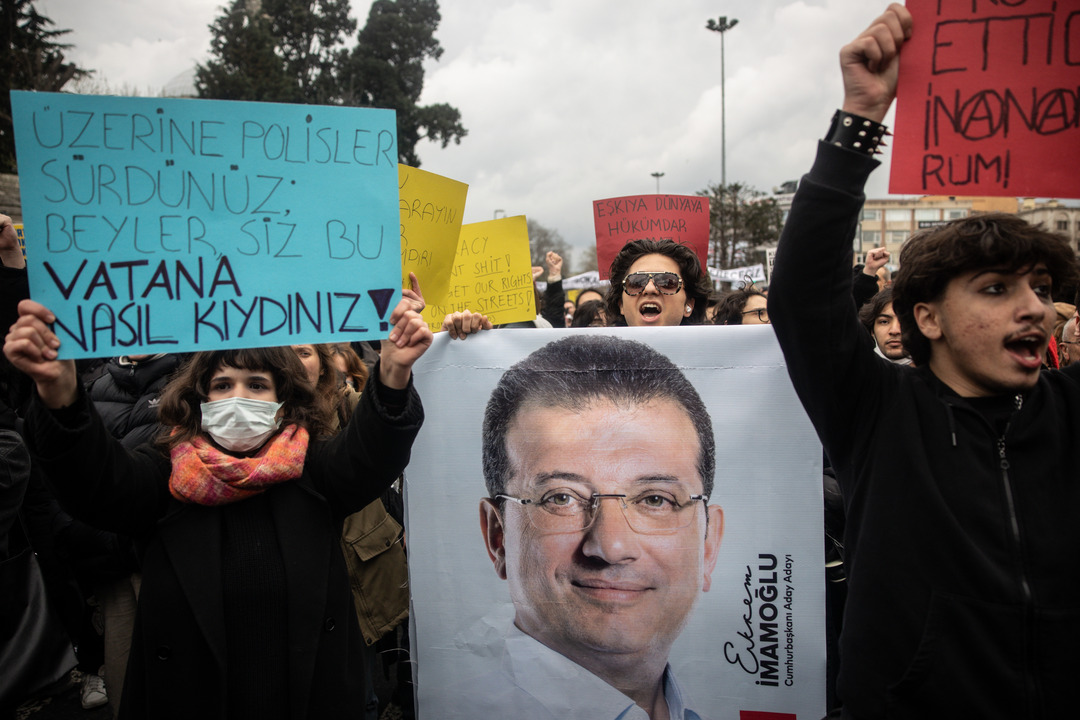
A protester holds a poster of arrested Instanbul mayor Ekrem İmamoğlu during a protest march on March 20, 2025, in Istanbul, Turkey. (Chris McGrath / Getty Images)
The detention of Ekrem İmamoğlu, Istanbul’s mayor and the opposition’s leading contender for the 2028 presidential elections, marks a turning point in Turkey’s descent into full autocracy. Although the country formally transitioned to a one-man regime in 2017 that entirely abolished the separation of powers and rendered parliament functionally irrelevant, elections have continued to function within a legal framework that preserved a veneer of legitimacy.
Now with the candidacy of İmamoğlu — who is widely regarded as Erdoğan’s strongest potential challenger in 2028 — being eliminated through judicial means, Turkey has entered a new phase in which elections will be little more than a ritualistic performance. In this sense, the country has now joined the ranks of Belarus, Russia, and Venezuela.
President Recep Tayyip Erdoğan’s vision for Turkey rests on the ideal of a monolithic society, restructured along the lines of political Islam, where all dissent is either crushed or rendered inconsequential. Today little remains to stand in his way. The first phase of the Islamist transformation, which has unfolded over the past two decades, began with the purge of the civilian and military representatives of the ancien régime through show trials such as the Ergenekon case and Balyoz (“Operation Sledgehammer”), fabricated on bogus evidence.