Zionism’s History Is Also a History of Jewish Anti-Zionism
Defenders of Israel’s brutal war on Gaza have attempted to conflate anti-Zionism with antisemitism. But since its beginning, different forms of Zionist ideology have competed with varied anti-Zionisms for Jewish allegiance.
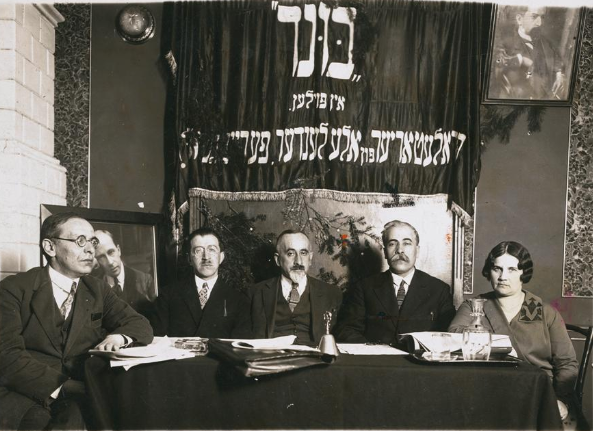
Bundist leaders at a Poland-wide gathering, Warsaw, 1928. (Henryk Bojm / Wikimedia Commons)
Since the Hamas attacks of October 7, defenders of Israel’s assault on Gaza and its long-standing occupation of Palestinian territories have attempted to conflate criticism of the State of Israel with antisemitism. It is an attempt to render invisible or to excommunicate a large and growing number of anti-Zionist American Jews, who have played an important and high-profile role in the Palestine solidarity movement.
The reality, however, is that the Zionization of American Judaism is a relatively recent phenomenon. Zionism itself first emerged in late nineteenth-century Europe, and for decades faced a committed and multifaceted anti-Zionist Jewish majority; Zionism didn’t become dominant among Jews worldwide until the 1920s or ’30s. Even then, though, many Jews continued to oppose Zionism, either on the grounds of religious orthodoxy or on the internationalist premises of socialism and communism. Last month, for the Jacobin Radio podcast the Dig, Daniel Denvir interviewed Shaul Magid, a professor of Jewish studies at Dartmouth College and the author, most recently, of The Necessity of Exile: Essays from a Distance, to discuss the long history of Jewish Zionism and its antagonist, Jewish anti-Zionism. This transcript has been edited for length and clarity.
The Beginnings of Zionism
Daniel Denvir
Why is this an important time to learn about the history of Zionism and anti-Zionism?
Shaul Magid