Bruno Kreisky, a Social Democrat From a Different World
- Julia Damphouse
With his pro-worker reforms and pacifist foreign policy, Bruno Kreisky was Austria’s greatest chancellor. His successes weren’t just a product of his own talent but of the powerful labor movement that shaped him.
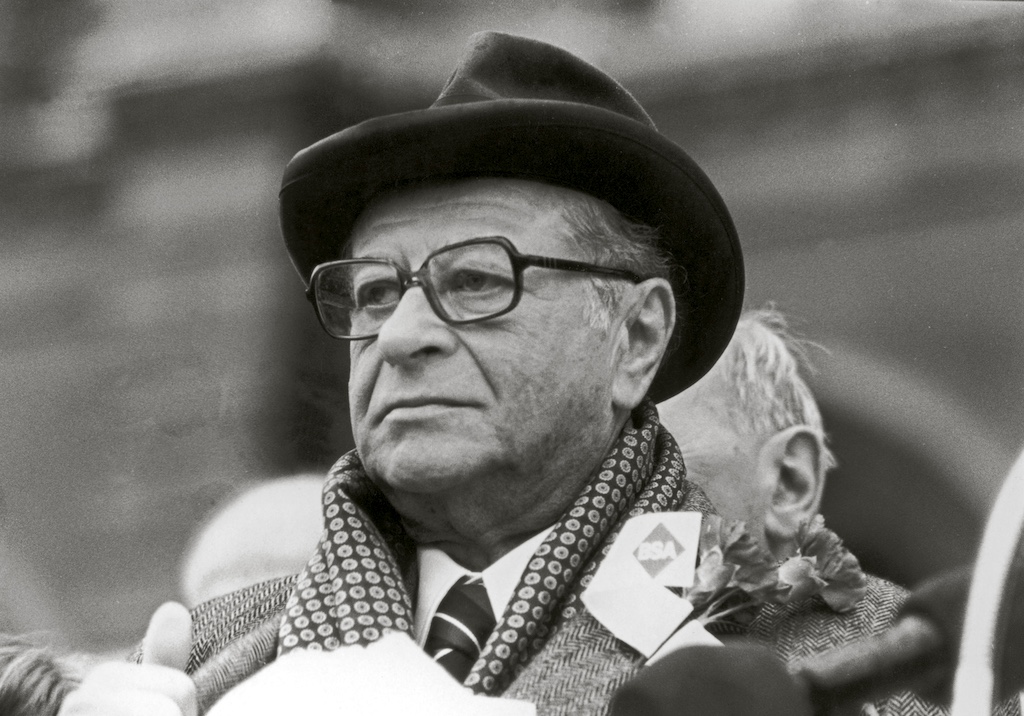
Thirty-six years after his death, there is no doubt that Bruno Kreisky is the specter haunting Social Democracy. (Imagno / Getty Images)
Bruno Kreisky was Austria’s longest-serving chancellor. No other postwar Austrian politician elicits the same amount of reminiscing, stories, myths, and anecdotes. Today, over forty years after his days as chancellor, he looms so large that Kreisky, schau oba! (“Kreisky, look down on us!”) is an ever-popular — and only half-ironic refrain — used to shame today’s Social Democratic Party (SPÖ) for violating their party’s historic principles. There’s no lack of opportunities to use this line.
Despite his death in 1990, Kreisky’s name continues to be mentioned today as if he might still drop in a comment. In January, conservative Austrian daily Die Presse reported “Kreisky would beat Kickl,” as it reported a poll finding that in a hypothetical matchup between Kreisky and Herbert Kickl —leader of the current poll-topping party, the far-right Freedom Party of Austria (FPÖ) — Kreisky would win.
Thirty-six years after his death, there is no doubt that Kreisky is the specter haunting Social Democracy, and Austrian politics as a whole. His legacy has left an indelible mark on Austrian politics, yet hardly anyone outside of the German-speaking countries has heard of him.
The left wing of Austrian Social Democracy has failed to make much progress in recent decades; compared to today, the Kreisky era seems like a land of milk and honey. Politics in 1970s Austria centered on full employment, institutions responded more to women’s issues, mass education was made more accessible, and Austrian military neutrality was deliberately used as an instrument of peace policy.
In retrospect, it is easy to romanticize this essentially social democratic agenda, which sought to give workers more say in politics and a larger piece of the economic pie. Its architect, Kreisky, was undoubtedly a talented politician. But a focus on personality and political style, reducing the era to Kreisky alone, misses what made his lasting influence possible: he was a product of a strong labor movement that no longer exists.
Growing Up in Cosmopolitan Vienna
When Kreisky was born in Vienna’s fifth district in 1911, the multiethnic state of Austria-Hungary still existed, and Vienna was an intellectual and artistic metropolis. In a passage from his memoirs, Kreisky said of his origins: “I have always felt myself to be the product of that tremendous melting pot that was the [Austro-Hungarian] monarchy.”
As the scion of an assimilated Jewish Viennese family, he felt at home amid the city’s “lively mix of Germans, Slavs, Magyars, Italians, and Jews.” He first came into contact with the Social Democratic movement as a high schooler. At first, his upper-class background meant that he wasn’t welcomed with open arms. Yet the young Kreisky quickly worked his way up in the organization.
From the late 1920s onward, Kreisky witnessed the Social Democrats retreating in the face of the rising right. During the February Uprising of 1934, when the labor movement fought back against repression by the Austrofascist regime of Chancellor Engelbert Dollfuss, Kreisky took part as a courier.
After Dollfuss banned the Social Democratic Party in 1934, Kreisky remained active in the party underground. His activity led him to be arrested and sentenced to one year in jail in 1935. This period instilled in him a lifelong hostility toward the Christian Social Party (a Catholic conservative party), which he is said to have loathed even more than the Nazis. “His hatred of Dollfuss was stronger than his fear of anything else,” wrote his longtime colleague Wolfgang Petristch in a detailed biography of Kreisky.
Kreisky earned his doctorate the day before the Anschluss, the annexation of Austria by Nazi Germany, and went into exile in Sweden in March 1938. The decision to go into exile was not taken lightly. “I didn’t want to be a runaway, then nor at any other time in my life,” he later wrote. He also realized, however, that as a Jew and a socialist, he had no chance of survival in Nazi Austria. History tragically proved him right: twenty-five of his closest relatives were later murdered by the Nazis.
In his later life, Kreisky always refused to blame the Austrian people collectively for these crimes. His tactical leniency toward the “little Nazis” was a prerequisite for his later political success. But it also stood in the way of coming to terms with the past. “Who can judge the people of that time?” he wrote in his memoirs. “Only those who saw the circumstances for themselves, who felt the despair of the people and their burning desire for work?” Missing from this analysis is the fact that ordinary Austrians were not simply forced into becoming Nazis by circumstances but actively contributed to the regime.
In exile, Kreisky remained politically active as head of the Austrian Socialists in Sweden and worked as a journalist. This also meant networking with other Social Democrats. The most prominent among them was Willy Brandt, the future German chancellor. Together they founded an international working group: the “Little Stockholm International” and considered possibilities for what Europe might look like after the war. Later he attributed many of the achievements of social democracy in Austria and Germany to the “considerable intellectual work” he did with Brandt in Sweden.
The Kreisky Era
In 1950, Kreisky returned to Vienna, becoming first state secretary and then foreign minister a few years later. He did not expect his career to go any further. In 1967, he said, as journalist Trautl Brandstaller recalls in Petritsch’s biography of Kreisky: “You know, as a Jew and an emigrant, there are two positions I cannot hold in Austria: the chairmanship of the SPÖ and the office of Federal Chancellor.” A few weeks later, he was at the helm of the party, and three years later, at the helm of the country.
Kreisky’s career is inseparable from the era in which he was active in politics. Even before he became chancellor, Austria was going through massive change. The 1960s saw the country transform from an agricultural to an industrial nation within a decade. And “the self-confidence of the working class, which — especially in state-owned industry — understood itself as such for probably the last time in the 1970s,” writes Petritsch, “gave the SPÖ self-confidence and the necessary support for its reformist agenda.”
The Social Democratic desire for reform permeated almost all areas of life. But the most important outcome was the massive gains in prosperity that it brought to Austrians. At the heart of Kreisky’s economic policy were countercyclical budgetary policy and deficit spending, and a strong focus on full employment. This was a solution settled upon between the representatives of labor and management, in a fashion emblematic of Austria’s postwar economic compromise. Kreisky’s statement during the 1970 election campaign, in which he declared that “a few billion [schillings] of debt cause me less sleepless nights than a few hundred thousand unemployed” became a legendary distillation of the politics of his era.
It is no coincidence that Kreisky placed such a strong focus on full employment. It can be explained by his personal history: he knew exactly what consequences mass unemployment and the global economic crisis of 1929–30 had for society and the labor movement in particular. The experiences of the end of World War I and 1920s were what first brought him to socialism. “The experience of the last years of the war, inflation, the devaluation of all values, unemployment — all of this shook me up and awakened in me the need to get to the bottom of this phenomenon,” Kreisky recalls. It was always clear to him that mass unemployment had led Europe into crisis and ultimately to World War II, which is why he defended the policy of full employment even “against some apparent economic rationality,” as Petritsch writes.
Hans Seidel, who served as state secretary in Kreisky’s last cabinet, coined the term “Austro-Keynesianism” for this policy, which earned Austria much international praise and a reputation as an “island of the blessed.” Many achievements became so firmly institutionalized that the Austrian welfare state is still one of the strongest in the world — even though the far-right FPÖ has by now repeatedly been in government with the conservative Austrian People’s Party (ÖVP).
In addition to Keynesian economic policy, Kreisky also focused on progressive social policy, the effects of which are still felt today. These include, for example, the Fristenlösung (“time-limit solution”), which made abortion in the first three months of pregnancy exempt from punishment, and the legal equality of women and men. Around the same time, homosexuality was decriminalized and children born out of wedlock were given the same rights as those born within marriage.
Sun King and Waltzing Tito
Throughout his tenure as chancellor, Kreisky was more publicly prominent than any Austrian chancellor before or since. These days, even Austrians with a reasonable interest in politics may find themselves unable to remember the name of the current chancellor (Christian Stocker, if you didn’t know). But people who lived through the Kreisky era still joke that as kids, they wondered if there would ever be a radio segment “without this Kreisky guy.”
Yet for the SPÖ as a party, having a “Sun King” (another common epithet for him) among their number also had its downsides. The party was repeatedly accused of turning into a rigid political machine devoted to reelecting the chancellor and lacking any source of political ideas besides Kreisky.
The writer Thomas Bernhard probably summed up this relationship most succinctly. In an angry letter to Die Zeit shortly after the 1979 election secured Kreisky his third term in office, he sardonically called Kreisky a “habitually beloved chancellor with the best Viennese wit, who benefits no one and harms no one,” — a “bittersweet” mix of Austria’s Sound of Music–esque “Salzkammergut” region and a “waltzing Tito” akin to the Yugoslav leader. While Kreisky hardly ever responded to this kind of attack publicly, in this case he did take the liberty of calling Bernhard “petty-bourgeois.”
Here, Bernhard summed up his problem with Kreisky, which he considered the weakness of all Austrian political life. A love of compromise was the essential political attitude that shaped the country’s entire postwar history. Kreisky more than any other figure embodied this classic Austrian way of being “in-between.” In particular, he further entrenched the postwar Second Republic’s defining mode of economic governance: compromises between representatives of labor and capital, known in Austria as the “social partnership” model.
The wider Austrian tendency toward compromise was particularly evident during the tumultuous period in Europe around May 1968. Across much of the continent, students and workers took part in massive demonstrations and occupations. In Austria, this period is sometimes called the “May breeze” since its own national variant was negligible in size and impact.
In contrast to Germany, where left-wing radicals were subjected to violent policing and state repression, Kreisky’s strategy focused on integration. The ’68er activist Austrian Fritz Keller once explained that Kreisky had applied “a highly developed form of repressive tolerance toward rebellious young people.” Practically speaking, this meant that he told these rebel youth about his contacts with Fidel Castro and Che Guevara, and invited them to dinner, “where they discussed whether they might not have much better career prospects in the Ford Institute or the Chamber of Labor.”
As a result, he managed to draw an entire generation of young rebels into Social Democracy. The journalist Robert Misik says that the party simply captured the radical leftists and had them write for its publication, the Arbeiterzeitung. In any case, it proved a more successful strategy than the German tactic of outright antagonism, and the deeply controversial banning of radicals from state employment.
The fact that Austria could have a Jewish chancellor just twenty-five years after the Holocaust is, in part, owed to Kreisky’s complex relationship with his Jewishness. “He saw himself first and foremost as an Austrian, but Jewishness was for him a ‘community of fate’ emerging from the Holocaust,” writes Petritsch. Yet despite the Holocaust, Kreisky’s own Jewishness remained rooted in the period before World War II. He thus also saw no reason to be particularly supportive of Israel.
Indeed, Kreisky, the longtime foreign policy chief, was always persona non grata in Israel. He is still hated by older Israelis to this day. He advocated for Palestinian statehood from the start. His stated goal was always to find a political path to resolving conflict in the Middle East. When three Jewish emigrants for the Soviet Union who wanted to travel to Israel via transit centers in Austria were kidnapped by the Palestine Liberation Organization (PLO) in 1973, he quickly responded to the kidnappers’ demands and closed the Schönau transit point. Shortly thereafter, however, Jewish emigrant transit operations through Austria resumed at another location. Kreisky was not an ideological anti-Zionist, as is often claimed, but simply a non-Zionist. Yet today, even this stance is essentially absent from SPÖ.
Kreisky Didn’t Fall From the Sky
The pervasive Social Democratic culture in which Kreisky was socialized is now a relic of the past. With the decline of the industrial workforce, Social Democratic election results have been declining since the 1980s. Workers’ organizations and the numerous front organizations of the SPÖ have shrunk massively. And the figure of Kreisky, too, haunts the country primarily as a myth. But one thing is certain: even thirty-five years after his death, no other contemporary Austrian politician is as well-known to as many people as Kreisky is today. Many on the Austrian left would like to see the return of a Social Democrat of Kreisky’s stature. His name is a stand-in for a form of politics that today’s SPÖ seems unable or unwilling to try to revive.
But socialist politicians like Kreisky don’t just fall from the sky; they grow out of a kind of labor movement that we have today lost. Anyone who wants to experience social democracy as it was under Kreisky should not go looking for a charismatic leader. Rather they should work for a movement strong enough to produce exceptional personnel and bring them to power against all odds.