How October 7 Remade Jewish Politics in America

For decades, American Jews were assumed to be uncritical supporters of Israel. But Israel’s war in Gaza transformed Jewish politics in the US and irrevocably undermined the legitimacy of institutions that sustain Zionism.
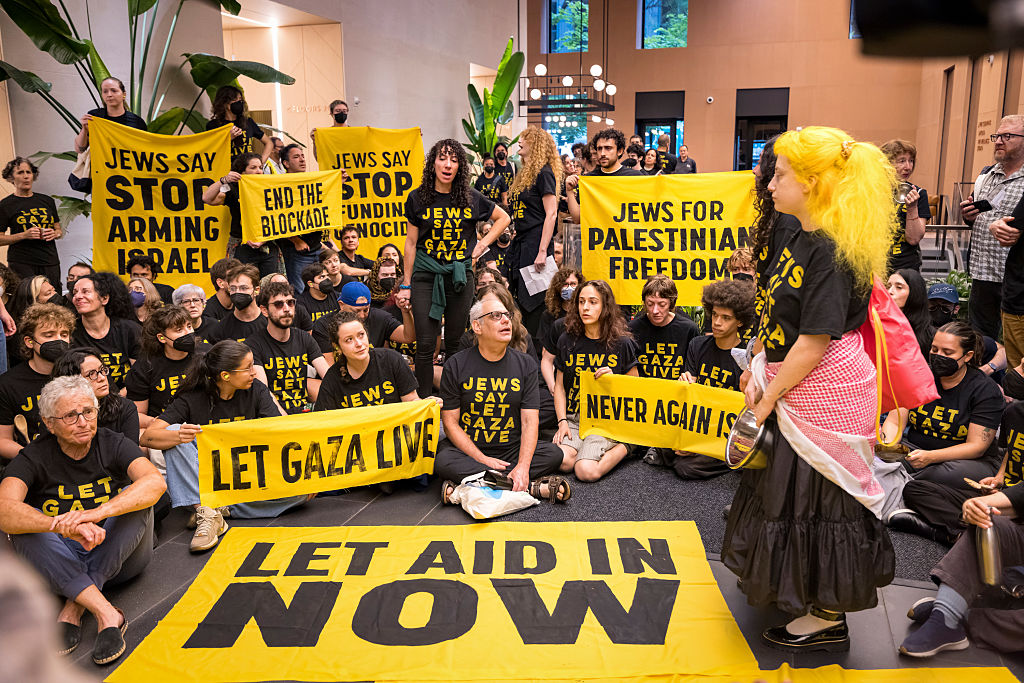
Over two hundred members from Jewish Voice for Peace occupy the lobby outside the offices of Senate minority leader Chuck Schumer and Senator Kirsten Gillibrand on August 1, 2025, in New York City. (Michael Nigro / Pacific Press / LightRocket via Getty Images)

It may be hard to recall the mood in the United States immediately after October 7. Major Jewish institutions assumed that there would be a resurgence of global Jewish unity. President Joe Biden and the US Holocaust Memorial Museum described Hamas’s attack as the greatest act of violence against Jews since the Holocaust. The unexpressed hope among many leaders of American Jewish organizations was that October 7 would spur support for the State of Israel among a new generation of Americans, particularly American Jews.

“Frankly, we don’t know how long it’s going to last, but across American Jewry is a reawakening of identity,“ said Elliot Cosgrove, the rabbi for one of New York City’s largest and wealthiest Conservative synagogues. The slogan “Everything Changed After October 7” became a justification for Israel’s relentless — still ongoing — assault on the Palestinian people, but also a call for the emergence of a new Jewish subject, one united under a single flag of the Jewish nation, unapologetic, proud, and assertive.

Yet only a few weeks after October 7, long before major human rights organizations such as Amnesty International named Israel’s invasion of Gaza a genocide, thousands of Jewish activists who had organized with Jewish Voice for Peace (JVP) occupied Grand Central Station in New York City and dropped a banner reading “Never Again for Anyone.”

The message was unmistakable. Against the prevailing narrative that October 7 was a “pogrom,” a link in a chain of endless violence against Jews that culminated in the Holocaust, the banner suggested a different interpretation of past and present. For these activists, the lesson to draw from Jewish history was one of solidarity with the Palestinians, who have been for a century now rendered stateless and rightless at the hands of a powerful, militaristic nation.

The sit-in at Grand Central Station was followed by JVP sit-ins at the Capitol Rotunda, the Israeli embassy in Chicago, and Senator Chuck Schumer’s office. These demonstrations were also carried out in support of the wave of student encampments that swept through campuses that spring — together these actions amounted to the largest set of Jewish protests in solidarity with Palestine in US history.

Cold War Origins

At least since the late 1960s, an institutional American Jewish consensus had formed around the idea that support for Israel is the most important singular task for the organized American Jewish world. As many Jewish studies scholars have pointed out, including Geoffrey Levin, Marjorie Feld, and Matt Berkman, prior to the Six-Day War and a larger American pivot toward Israel even mainstream US Jewish institutions, such as the Anti-Defamation League (ADL) or American Jewish Committee (AJC), were more accurately described as “non-Zionist.” While they supported Israel, this was not the central aim of their politics, and open criticism of it was often seen as acceptable, even laudable.

But in the last several decades, organizations such as AJC and ADL, which once focused on civil rights, American religious and cultural pluralism, and support for US liberal democracy against the far right, have increasingly closed ranks around Zionism. These groups have muted their criticism of Israel, purged their organizations of members who refuse to do so, and created a significant educational, cultural, and political apparatus whose sole purpose is to conflate the interests of Israel with American Jewish life.

It was against this backdrop that groups such as JVP, Jews for Racial and Economic Justice (JFREJ), IfNotNow (INN), Diaspora Alliance, temples and religious organizations such as Tzedek Chicago, Halachic Left, and Kolot Chayeinu, as well as magazines such as Jewish Currents and Der Spektor have begun the long process of creating new Jewish institutional spaces. These groups are far from acting as a counterweight to the ADL or Jewish Federations, which have deep pockets and strong connections to Israel and the American state. But they have started the long process of grounding an anti-Zionist Jewish identity in a growing network of organizations that collectively represent many tens of thousands of people.

It was once quite rare to see Jewish organizations, divided along political lines about the meaning of a Jewish life, openly clash in public. In 2017, IfNotNow led a series of spectacular sit-ins and protests against the American Israel Public Affairs Committee (AIPAC) and followed this up with a similar round of protests in 2024. At the height of Black Lives Matter protests, JVP’s Deadly Exchange campaign exposed how the ADL, a nominally a civil rights organization, not only devotes most of its resources to defending Israel but actively works with police to target black civil rights organizations critical of Israel and helps to facilitate US–Israeli police counterinsurgency trainings.

Last year, Jewish Currents also published an exposé that discredited much of the ADL’s reporting on antisemitism, noting that a large share of the antisemitic incidents reported by the organization were not attacks against Jewish persons but protests against the actions of the Israeli state.

The ADL and other right-wing Jewish organizations and publications have sought, unsuccessfully, to counter the charges leveled at them but also to demonize anti-Zionist Jews and to lead the charge to ban and censor their organizations. The American conservative magazine Tablet has labeled members of the JVP and the Democratic Socialists of America’s Jewish members as “un-Jews,” linking anti-Zionist Jews to support for assimilation and antisemitic Stalinist purges.

A favorite theory of both Tablet and CBS’s right-wing editor-in-chief Bari Weiss is that organizations such as JVP promote the “displacement” of Jews by woke anti-Zionists as a precursor to the displacing Israelis with Palestinians — a kind of Jewish version of the “great replacement theory.” But the ADL’s actions go beyond demonization. On its website, it claims JVP provides “support for terrorists” and celebrates “antisemitic” and “terrorist” acts, such as the October 7 massacre. The organization has filed lawsuits against JVP, claiming the group violates campaign and election law.

As part of Project 2025, the Heritage Foundation’s plan for governing during Donald Trump’s second term, the organization outlined what it called Project Esther, which it defines on its website as a “national strategy to combat antisemitism.” The initiative has set out to frame groups such as Students for Justice for Palestine (SJP) and JVP as part of a broader “Hamas support network,” which provides rhetorical and political support for terrorism. Combined with lawfare to remove JVP’s tax-exempt status, this has led to anti-Zionist organizations being banned on several campuses, including Columbia, Brandeis, and George Washington University.

The New Antisemitism Thesis

The ideological underpinnings of this assault on progressive Jewish organizations were not formed overnight. They are the product of the “new antisemitism thesis,” which rose to prominence in the early 1970s. Conservatives and Christians, it argued, have finally embraced American Jews and, more important, the Jewish state of Israel. Jews’ new enemies are no longer fascists, but radical leftists who challenge Israel’s right to exist as a Jewish supremacist state.

As the ADL’s Arnold Forster and Benjamin Epstein wrote in their influential 1974 book, The New Anti-Semitism, “black nationalism” has transformed from “racial pride” into a form of “violent racism.” Even more dangerous is the “Radical (totalitarian) Left,” which is determined to undermine Jewish liberal institutions in order to spark their antidemocratic revolution. Together, these forces, often working in tandem, collude to present the Jew as the primary enemy in a crusade against white racism at home and Zionist imperialism abroad, Forster and Epstein argued.

This was a strange inversion. According to Forster and Epstein, the Jews’ erstwhile allies — leftists and minority groups — were now its enemies, and its historical enemies were now its friends. In this schema, Jewish anti-Zionists are at best collaborators with the enemy; at worst “kapos,” a name often used derisively against Jewish leftists.

The ADL often legitimates their unsavory positions with a claim that it speaks for mainstream Jewry, and that organizations such as JVP represent only a “small minority” of Jews in the United States. Many even question whether JVP is Jewish at all (one story in the conservative Jewish publication Commentary put “Jewish” in quotation marks when it mentioned the group). These claims are not entirely unfounded.

While JVP is one of the largest Jewish organizations in the United States, the ADL can still point to statistics which show that when polled, eight in ten US Jews say “caring about Israel” is “important to their identity as Jews.” Of course, what is far less likely to be cited are the many nuances picked up by surveys of this kind. For instance, two-thirds of American Jews support an arms embargo against Israel; half of younger Jews refer to Israel’s war on Gaza and the West Bank as a “genocide”; roughly the same number of Jews under forty believe Israel is an “apartheid state”; and over a third of younger American Jews “sympathize with Hamas.”

A Jewish Left Defeats the Right in America’s Most Jewish City

Zohran Mamdani’s run for, and election to, the position of mayor of New York allowed the public to see the ADL’s claim to represent regular common sense exposed as empty and dishonest. When Mamdani won his primary against Cuomo with a plurality of Jewish votes and then the mayoralty with 30–40 percent of the Jewish vote, the idea that anti-Zionism was beyond the pale, or a fringe opinion within the American Jewish community, was blown apart.

Not only did Mamdani receive a sizable portion of the Jewish New York vote, but he did so also as one of the most intensive propaganda campaigns against any candidate in recent memory branded him an antisemite and supporter of terrorism. High-profile Jewish organizations such as the ADL denounced Mamdani, and a letter signed by over one thousand rabbis asserted that the mayoral candidate would “delegitimize the Jewish community and encourage and exacerbate hostility toward Judaism and Jews.”

Andrew Cuomo, major New York City newspapers, and former mayor Eric Adams have all repeated the ADL’s assertion that Mamdani will create a hostile environment for the city’s Jews. That major forces in the Jewish establishment assert a political candidate is an enemy of the Jewish people, and nearly half the city’s Jews vote for him regardless, has provoked an existential crisis within conservative Jewish organizations — nothing of the kind has ever happened in the United States before.

Rather than the public performance of Jewish unity, two formations of Jewish identity have been on public display the last two years, both heightened in visibility and intensity. Not only have Jewish institutions waged a campaign against Palestine solidarity activists, but organizations such as the ADL have weaponized the discourse of antisemitism to ban student organizations, threaten and remove college presidents, silence critics, and target the very funding structure of progressive nonprofits.

It is fair to say that the dominant organizations of Jewish institutional life view their role not only as maintaining Zionist hegemony but also as part of a reactionary war, not just against the Left, but against liberal principles such as free speech and the right to organize. When Bari Weiss and Jonathan Greenblatt of the ADL both claim that “wokeness” is hostile to Jewish life, one has to understand they are not making an argument so much as joining MAGA’s far-right backlash politics.

Progressive Jewish organizations such as JVP have entered the fray not only in the name of Palestine solidarity but, through an accident of history, as part of a global anti-imperialist struggle. This is because Israel is a key part of American imperial force projection throughout the Middle East and beyond (“our unsinkable aircraft carrier,” to quote former secretary of state Alexander Haig). The fault lines over Zionism therefore cut across much broader struggles to do with the global left, geopolitics, and even whether the idea of human rights will withstand the twenty-first century.

Organizing a New Jewish Left

At JVP’s National Membership Meeting May of 2025, noted historian Robin D. G. Kelley told the assembled crowd of several thousand that JVP was not only an important anti-Zionist organization but had become “one of the most important organizations on the American left.” Any story about the Jewish left and its meaning for the moment, needs to consider the improbable rise — and also the even more improbable staying power — of the largest and longest-lived progressive Jewish anti-Zionist organization in recent history.

JVP began in the Bay Area in 1996, founded by three University of California, Berkeley students, Julie Iny, Julia Caplan, and Rachel Eisner, as a Jewish organization dedicated to both opposing a growing American Zionist right and also to ending the occupation of the West Bank and Gaza. The late 1990s were an auspicious time for Palestinian politics. It witnessed the collapse of the Oslo Accords and the “peace process” and, along with its end, any hope that Israel and the United States would, on their own, resolve fundamental questions of human rights, equality, and the need for reparations for Palestinians.

The late 1990s also marked the end of the Palestine Liberation Organization (PLO) as an organization dedicated to armed struggle and guerrilla warfare and, along with it, the global end of the anti-colonial movements of the twentieth century. And yet with this end, the 1990s also saw Palestinian civil society, largely in the West Bank, consider new forms of struggle against occupation and apartheid, modeled after the success of the South African anti-apartheid movement. In the years following JVP’s founding in the East Bay, JVP “went national” to become one of the largest and most successful early proponents of the Boycott, Divestment, and Sanctions (BDS) campaign against Israeli human rights abuses.

The BDS campaign was organized by Palestinians, but its call is highly decentralized and global — as long as organizations follow its central principles demanding an end to occupation and siege of West Bank and Gaza, equal rights for all citizens of Israel, and Palestinian right of return, then organizations could form their own campaigns and objectives.

In the early years of the BDS movement, JVP organized campaigns against retirement funds such as Teachers Insurance and Annuity Association of America–College Retirement Equities Fund (TIAA-CREF); JVP was crucial in voicing support for Christian denominations such as the Presbyterian Church, United Church of Christ, and Mennonites to engage in their own boycotts of Israel; JVP also led local campaigns against security firms that profit from the occupation of the West Bank such as G4S and telecom companies such as Veolia and Alstom. In addition to supporting BDS, JVP has also highlighted the racism of the ADL, drawing attention to its support for police exchanges to Israel, as well as protesting against the Zionism of the Jewish National Fund and Jewish Federations.

Beyond its role as an activist organization, JVP has become, in the words of its former leaders Rebecca Vilkomerson and Alissa Wise, “a beacon and a litmus test of Jewish politics, central to the Jewish conversation.” Perhaps no action of JVP’s was more significant culturally than its democratic vote in 2019 to formally become an “anti-Zionist” organization. While JVP had long been the only large Jewish organization to support the BDS movement, its framework around Zionism had remained ambivalent.

While at the far-left edge of Jewish life, it still welcomed Jewish Zionists so long as they agreed to support BDS; it talked of “peace” rather than an opposition to Zionism as such. Moving away from a big-tent “peace” perspective, JVP adopted language increasingly embraced by Palestinian thinkers such as Rashid Khalidi, Steven Salaita, and Omar Barghouti. This was a language that stressed that Israel was a settler-colonial project, based on the expulsion of Palestinians, and played a crucial role in maintaining US and Western dominance over the region.

While this change was of course welcome news to the Palestine solidarity movement, it was as much a response to changing conditions in Palestine as it was to other movements in the United States, from Black Lives Matter to the defense of indigenous sovereignty in Standing Rock. As Vilkomerson and Wise narrate in Solidarity Is the Political Version of Love: Lessons From Jewish Anti-Zionist Organizing, their recent book on the history of JVP, the “resurgence of Black resistance” in Ferguson was not just an isolated event but was experienced nationally, even globally, as a call for racial justice.

The 2014 protests called into question the long history of racial and colonial violence, with Palestinian flags often waved among calls to end apartheid regimes around the world. Similarly, the Water Defenders of Standing Rock made explicit analogies between the colonization of indigenous land in the United States and Israeli colonization of Palestine, with many leaders of the Standing Rock movement including Nick Estes making the trip personally to Palestine, declaring that indigenous struggle in the US and Palestinian struggle against Israel was “naturally linked.”

While JVP is a Palestine solidarity organization, it is also a Jewish organization with long and organic ties to the American left. Its positions on Palestine, while well in advance of other left-to-liberal Jewish organizations of comparable size, have moved in tandem with that of the broader left, in the United States and globally. In that sense, JVP’s emergence in the late 1990s was part of another conjuncture, the rise of a new left on the world stage, with the anti–World Trade Organization and global justice protests in Seattle, Washington, DC, Quebec City, São Paulo, Genoa, and elsewhere at the end of the last century.

These protests were part of a global archipelago of movements against neoliberal austerity, authoritarianism, and militarism in the United States. They were followed by the antiwar movement in the early 2000s, the immigrant justice movement, Occupy Wall Street, Black Lives Matter, and the rise of the Democratic Socialists of America (DSA). As JVP activist and writer Dania Rajendra has articulated, JVP represents, in one sense, a (sizable) minority of American Jews and yet is also part of a global majority that sees itself as part of a global movement against both neoliberal austerity and imperialism.

In this respect, JVP is the inheritor of a longer line of progressive Jewish organizations that can trace their immediate and living historical roots to the 1970s. In the wake of the New Left’s breakup in 1969, with the fragmenting of Students of a Democratic Society (SDS) and the assassination of Fred Hampton and Martin Luther King Jr, a number of Jewish radicals formed Jewish socialist collectives, from Brooklyn to Chicago to Los Angeles. Their aim was to explore a way to combine Jewish identity and Jewish cultural politics with the left-wing and anti-colonialist politics of the New Left.

As the left-wing 1970s Jewish socialist organization Chutzpah Collective’s cofounder Myron Perlman put it, their goal was to be “Jews among leftists, and leftists among Jews.” Organizing against fascists and the Jewish right as well as fostering dialogue with the Israeli and Palestinian socialist left, such groups were the first Jewish-identified organizations since the 1940s to place left internationalism and Jewish identity at the center. While short-lived, they proved a training ground for activists who organized progressive Jewish organizations such as New Jewish Agenda (NJA) and JFREJ. While JVP’s intense and often laser-like focus on Palestine is in some ways new, it is crucial to point out how much JVP is part of a longer trajectory of American Jewish leftists acting in coalition with other left-identity organizations, from Black Lives Matter, to NoDAPL, to the New York City Desi organization Desis Rising Up & Moving, to the Council on American–Islamic Relations (CAIR), to the US Palestinian Community Network (USPCN).

As Vilkomerson and Wise say in their history of JVP, JVP is “a hybrid” organization, part nonprofit with an extensive staff over three dozen and a budget of a few million dollars; it is also a movement organization, with dozens of self-formed self-governing chapters across the country, over 30,000 dues-paying members, and hundreds of thousands of supporters who subscribe to JVP listservs, news updates, and campaign organizing announcements. It is an organization that relies on dues and donations from individuals, rather than foundations, to stay independent.

While Vilkomerson and Wise articulate that JVP is in the tradition of the socialist workers’ Bund of Eastern Europe and also religious leftists such as Arthur Waskow and Abraham Joshua Heschel, I would suggest their combination of a materialist critique of Zionism with a rabbinical council and holiday observances shares as much with socialist and communist movements that often combined community with international solidarity. In this sense, JVP is more than simply an activist organization but has become a kind of home for many tens of thousands of Jews who can no longer participate in Zionist institutions. As Chicago JVP’s Jimmy Rothschild (“not that Rothschild” as he often jokes) expressed to me, there is a gap in Jewish institutional life that JVP fills, as fewer and fewer Jews “feel represented” by organizations such as the Federations and the ADL, to say nothing of synagogues that refuse to speak out over Israel’s genocide.

Anti-Zionism as Class Politics

It’s something of a truism to say no social movement is reducible to objective conditions: the explanation, by Ms. Rachel and Hillary Clinton alike, that young people are responding to Palestinian destruction because “it’s on our screens” is necessary but not sufficient. The 1967 Arab–Israeli War witnessed, as neoconservative writer Norm Podhoretz famously said, the “mass conversion of Jews to Zionism,” and as American studies scholar Melani McAlister pointed out, no less so for the American elite. Since 1967, the United States has funneled untold billions in weapons and lent incalculable diplomatic and cultural support to Israel.

Yet this sense that Israel is America’s “fifty-first state” also means what happens there is not simply a distant tragedy but is felt as if it had happened to this country. As one friend put it to me while I was working on this essay, “We experience things in Israel and Palestine as if they are happening here.” After October 7, Biden made a personal visit to Israel and told Benjamin Netanyahu that he thought “of the hostages and families” and “grieve with them.” This is not language usually used for foreign countries.

Mass Jewish support for Israel emerged, as political scientist Dov Waxman points out, at a time when Israel not only represented US imperial interests abroad but also seemed to be a vision of liberal America itself — if one wasn’t looking too closely. With Labor governments, a high rate of unionization, gender equity, secularism, freedom of expression, it appeared, in the minds Jews who knew little about the actual conditions of Palestinians in Israel, as if a neighborhood of Brooklyn had been exported thousands of miles overseas.

This veneer of liberalism began to crack just over a decade later, not only with the election of a far-right wing Likud government but the invasion of Lebanon and the harsh, violent crackdown on the First Intifada. The early 1980s witnessed the first mass, Jewish-identified protests against Israel. In an effort led by New Jewish Agenda, a nationwide progressive Jewish organization that combined New Left veterans (including Noam Chomsky and Adrienne Rich) and progressive religious figures, including Arthur Waskow, activists protested against Israel’s illegal invasion of Lebanon and demanded recognition of the PLO.

These early protests had their limitations, as Waxman has observed. They rarely challenged Israel’s displacement of Palestinians or insisted on the right of refugees to return. However, they were signs that the political landscape in the Jewish community “had completely changed.” It was the beginning of what is now four decades of increasingly polarized debate and acrimony, not only over Israel’s wars but the fundamental nature of its state, its history, its logic for existing.

For understandable reasons, these gradual shifts in the views of different blocs within the Jewish community have often gone underreported. The increasingly far-right nature of Israeli domestic politics, the collapse of the Oslo Accords, and an inexorable stream of ethnic cleansing and genocidal violence has overshadowed these developments.

But Israel is not only a singular settler-colonial state; it is also a proxy for other questions for Jewish and non-Jewish Americans. Increasingly, survey data suggests that support for Israel follows unmistakable class and cultural lines. As Jon Danforth-Apell noted in Jewish Currents, a recent report by the Jim Joseph Foundation “found that one of the greatest predictors of Jewish student support for Israel is class background: ‘students from wealthier families are much more supportive of a Jewish state than those from less wealthy families.’” While this may betray class allegiances, it also reflects the class nature of the Jewish institutional world: Jewish education, synagogue dues, bar/bat mitzvahs, and Jewish summer camps are costly affairs, running into the thousands and many tens of thousands of dollars.

These institutions forge cultural unity, as well as class unity. A Gallup poll during the 2014 Israeli invasion of Gaza found that white people with advanced degrees were more likely, by a two-to-one ratio, to find Israel’s attacks on Gaza “justified.” In Jewish and non-Jewish communities, support for Israel appears to track with class and status.

In the 1930s and ’40s, it was typical for Jewish leftists to decry Zionism as much because it occupied land once owned by Palestinians as because it was a form of “bourgeois nationalism,” tied to the interests of the Jewish elite and sutured to the British Empire. While the right of Palestinians to resist land seizure was understood even in the 1930s as a form of anti-colonial resistance, it was the class nature of Zionism that many left-wing Jews in communist and socialist parties resisted.

For instance, in Mike Gold’s landmark 1930 novel, Jews Without Money, the only Zionist in it is a “dry goods merchant,” Baruch Goldfarb, who the author links to vote-rigging, labor spies, and real estate deals in the all-white suburbs of outer Brooklyn. While Zionism may have had working-class adherents, to Gold they were dupes — people like the father in the novel, who end tragically following Goldfarb’s schemes. Communist writers Robert Gessner and Alexander Bittelman also referred to Zionism as “fascism” and “reactionary and undemocratic.” Jewish progressives denounced Zionism not only in solidarity with Palestinians but in their democratic and working-class self-interest.

As journalist Ari Paul has noted, Elliot Cosgrove, the New York City rabbi leading the charge against Mamdani in the Jewish community, is the rabbi of a wealthy Upper East Side synagogue, and his tirades drip with “class resentment” against a mayor who not only may push to sever the city’s ties to Israel but raise Cosgrove’s taxes as well. As Paul also observes, the Upper East Side, unlike Queens, Harlem, and Brooklyn, went heavily for Andrew Cuomo.

As we witness an Upper East Side rabbi decry the most popular socialist mayor in the United States and the ADL carry water for Donald Trump in his crackdown on both universities and the First Amendment, it seems we are returning full circle to the 1930s: Zionism as part of a wider class conflict over questions of race, nation, and empire.

Thus we can think of the divide in the Jewish community as being as much over Israel as over the question of what kind of country the United States will be. This has international implications, but many also quite domestic and quotidian ones. It is not lost on many Jews who have long worked in disproportionate numbers in the public sector that supporters of Israel are part of the coalition defunding universities and public investments in health and science, in the name of defeating anti-Zionist “antisemitism.” And the billions siphoned off from the public sector to support a war economy are billions that could be spent on education, welfare, science, and health that benefit all Americans.

There are many other reasons for Jewish progressives to reject Israel, from the religious to the ethical. And Jewish anti-Zionism, and the coalitions around it, are increasingly complex as well. What to make of Jewish liberal organizations that may support Mamdani but not BDS? What, also, to make of an increasingly anti-Zionist far right? Of Palestinian solidarity organizations that may engage in tactics that JVP doesn’t support? There are no easy answers to these questions, yet they are questions that are part of building any left movement, any coalitional politics. When Robin Kelley named JVP one of the most important organizations on the US left, he did not only mean for its stance against Israeli violence and apartheid, but also for its role in fighting what is now a democratic, multiethnic class struggle against the US empire and the wealthy who benefit from it.

Despite such open-ended questions, it’s clear the Jewish left has in recent years well exceeded its reach to just the Jewish and Palestine-support communities. When British conservatives and centrists were able to defeat the most progressive candidate in the Anglosphere in decades, Jeremy Corbyn, over false charges of antisemitism, it was not only the cause of Palestine solidarity that suffered but the British and perhaps the entire European working class.

Mamdani, a candidate very much in Corbyn’s tradition (and who Corbyn supported), did not suffer the same fate, despite concerted attempts to brand him as an antisemite. While reasons may be overdetermined, the presence of a well-organized Jewish left in New York City that could counter the ADL’s message both in the media and on the street was central to Mamdani’s victory. Jewish voters who supported Mamdani not only did so for his politics, but because an organized Jewish left could connect with Jewish voters, from progressive synagogues to community organizations. A Jewish left not only showed itself as emergent, but decisive — a role that it may go on to assume in broader American, and even global, politics.