From the War Room to Wall Street
In bringing together sellers and buyers, markets and investors, autocrats and capitalists, Kissinger Associates played an outsize role in the rapid advancement of neoliberalism around the world.
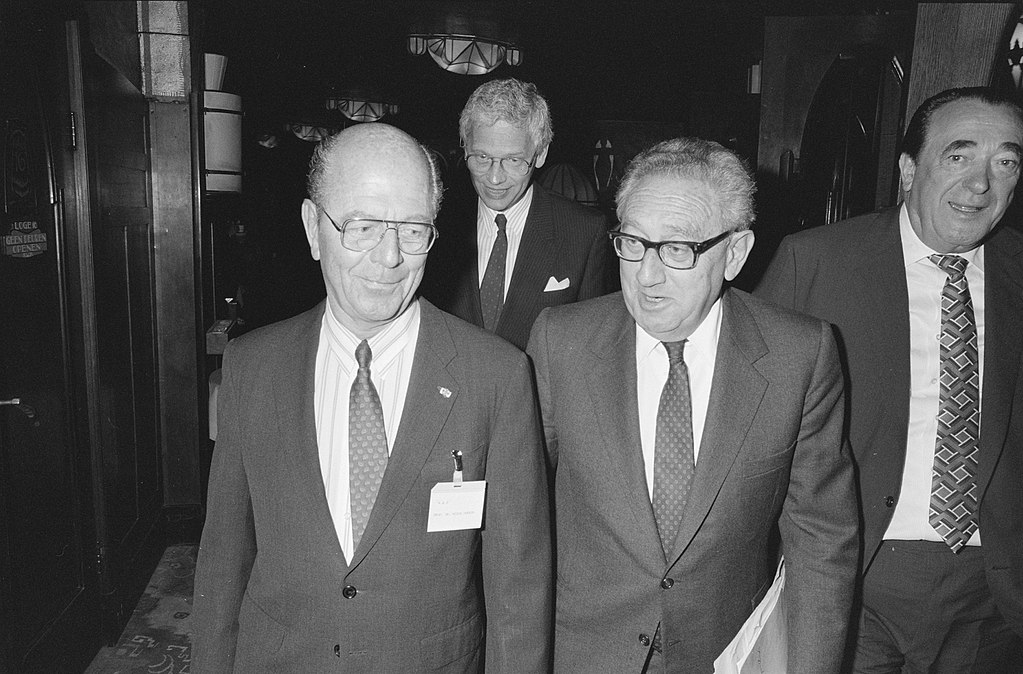
Henry Kissinger (second from right) at the Global Economic Panel in Amsterdam, the Netherlands, in April 1989. (Nationaal Archief NL / Wikimedia Commons)
The scourge of the international investor is uncertainty: the inability to predict the social, political or economic future in a country halfway around the world increases the risk of invest- ing there, and therefore raises the cost of borrowing for or insuring a given venture. How, then, does a firm hedge against an unknowable future in some far-flung corner of the globe? It turns to the expert, the consultant, the analyst, who provides the intelligence that will assure the board of directors, calm the skeptical lender, and still the shaking hand of the insurance broker.
In fact, risk consulting has itself become a multibillion dollar industry, metastasizing within a larger financial economy sick with securities and derivatives of increasing complexity. But even as the risk consulting industry has grown, there was, for decades, one expert par excellence to whom the titans of industry turned: Henry Kissinger.
After leaving the State Department in 1977, Kissinger maintained his position as a commentator and a confidant to those in power. But while the continued clamor from the political classes for his advice and counsel has no doubt stroked his voluble ego, it is the handsomely paid advice he provided to the business class that made Kissinger a rich man. The former secretary of state founded his consulting firm, Kissinger Associates, in New York City in 1982, waiting what he considered to be a prudent five years after leaving office before peddling his expertise to business leaders.