Cities Are Spending More to Brutalize Homeless People Than It Would Cost to House Them
Few scenes are as emblematic of the barbarism of American capitalism as the now-routine “sweeps” in which police round up homeless people and destroy their belongings. By some estimates, it would be cheaper to just provide them with housing.
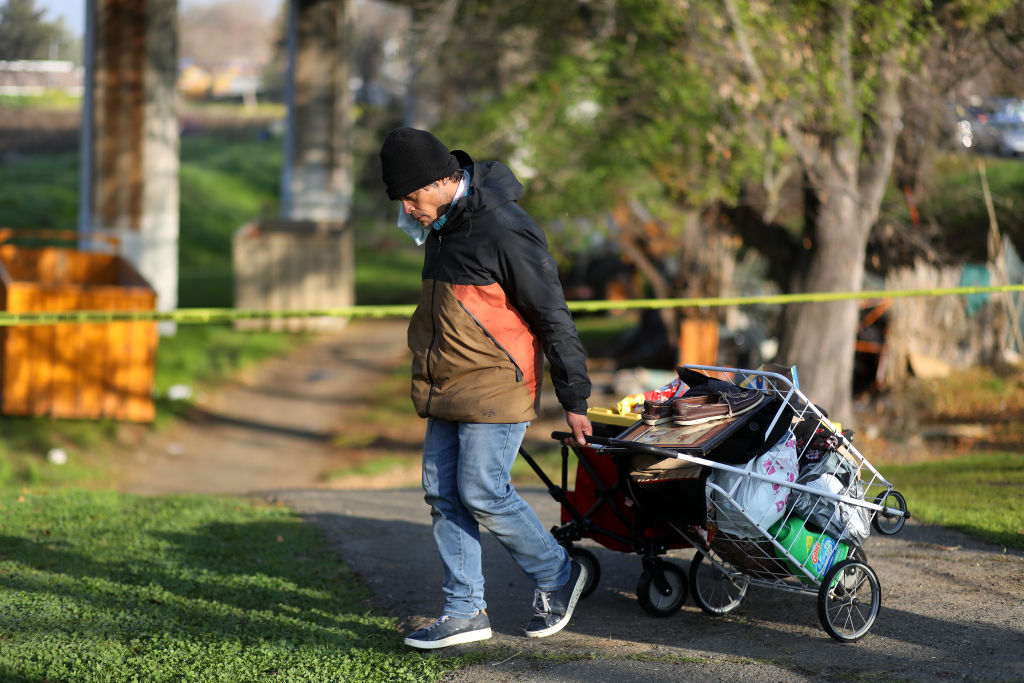
A homeless man moves his belongings from an encampment in Concord, California after city workers cleared the camp and removed structures from the property. (Aric Crabb / MediaNews Group / East Bay Times via Getty Images)
A particular scene, at once horrifying and grotesque, has become increasingly common to America’s major cities: with the blessing of municipal authorities, a phalanx of police stormtroopers descends on a concentration of homeless residents before dispersing them and destroying their belongings. In the years since the 2008 financial crisis — one not incidentally rooted in a Wall Street–driven collapse of the housing market — the number of homeless encampments across the country has dramatically increased, and authorities have responded in kind with escalating brutality.
Fueling the growth of encampments has (unsurprisingly) been a sharp increase in homelessness — itself driven by soaring rents and a chronically inadequate supply of affordable housing. According to one analysis from the National Law Center on Homelessness and Poverty, a single 5 percent increase in rents in a major city such as Los Angeles can force as many as two thousand people onto the streets. The same study found that the number of encampments nationwide rose some 1,342 percent between 2007 and 2017. Given the measurable increase in homelessness since, there’s every reason to believe the figure is even higher today.
In the wake of these developments, big city mayors and councils have leaned heavily on draconian law and order approaches that aim less to address the root causes of homelessness than the visibility of those experiencing it. Police raids on homeless encampments, usually called “sweeps,” often pair raw brutality with a dollop of paternalism as authorities insist (almost always erroneously) that evicted residents have subsequently been sheltered or placed in transitional housing.