Why Is Homelessness Criminalized?
A class-based theory of homelessness helps explain both why anti-homeless laws exist and how homeless people are mistreated by charities and state welfare.
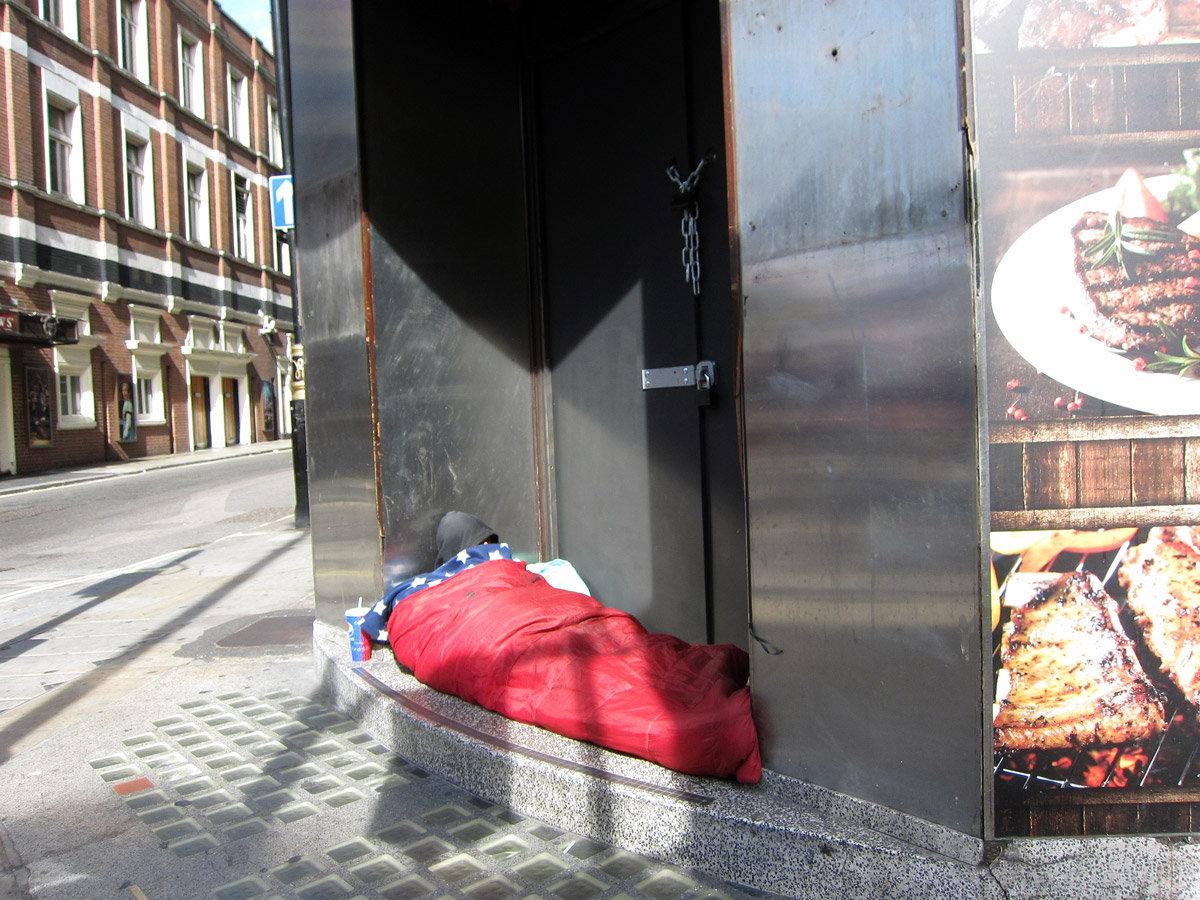
A homeless man sleeps outside a storefront. (Alan Light / Flickr)
The criminalization of homeless people in the United States, already vast, has ballooned in recent years. Anti–“urban camping” laws — being anywhere with a makeshift bed or shelter — have increased by 69 percent; the criminalization of sleeping in public by 31 percent; of sitting or lying down on a sidewalk, 52 percent; of panhandling, 43 percent; and finally against loafing or loitering, 88 percent.
These increases, moreover, do not apply to particular places, as did the first phase of criminalization in the late 1980s and 1990s. Rather, they apply to entire municipalities. Given the lack of shelters (not to mention affordable housing), many have no choice but to violate the law for their very survival.
Scholars of homelessness generally agree that city officials, desperate to attract footloose capital, push criminalization as a means to cleanse the streets for further gentrification. Cities, ravaged by deindustrialization, David Harvey argues, must “appear as an innovative, exciting, creative, and safe place to live or to visit, to play and consume in.”