Friedrich Engels on Why Capitalists Are Guilty of Social Murder
In 1845, Friedrich Engels wrote a scathing condemnation of English capitalism, The Condition of the Working Class in England. In it, he accused the bosses of carrying out “social murder” against workers and the poor.
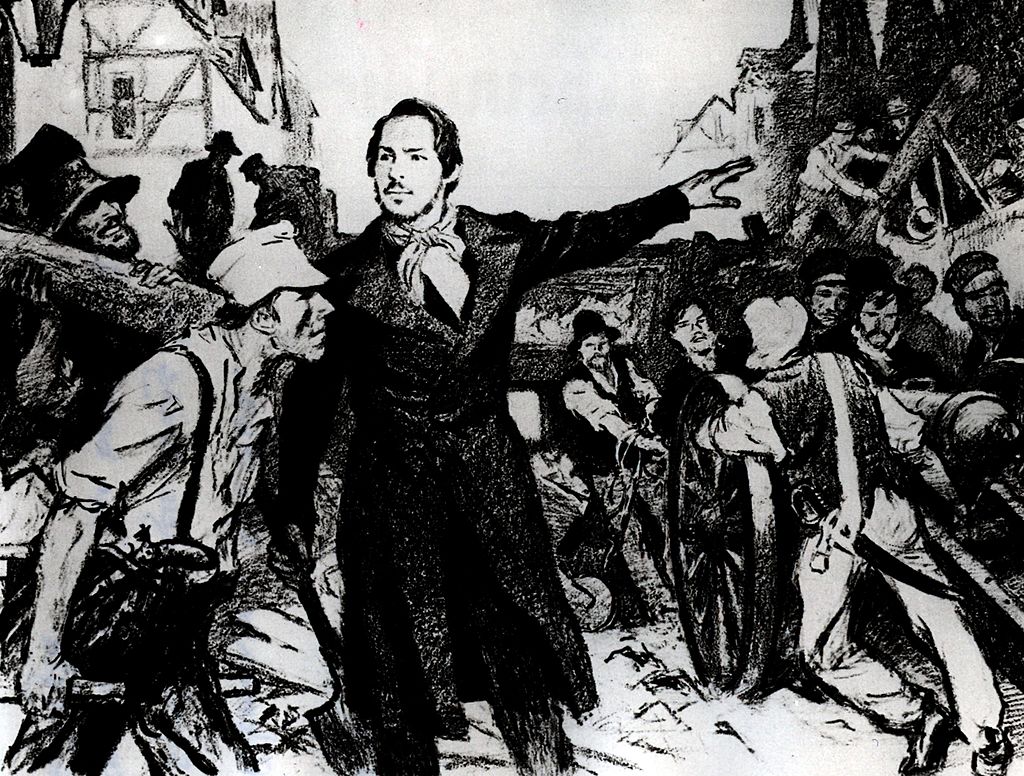
Friedrich Engels directing the construction of a barricade in the streets of Elberfeld during the riots of May 1849 in Prussia. (Universal History Archive / Universal Images Group via Getty Images)
A town, such as London, where a man may wander for hours together without reaching the beginning of the end, without meeting the slightest hint which could lead to the inference that there is open country within reach, is a strange thing. This colossal centralization, this heaping together of two and a half millions of human beings at one point, has multiplied the power of this two and a half millions a hundredfold; has raised London to the commercial capital of the world, created the giant docks and assembled the thousand vessels that continually cover the Thames.
I know nothing more imposing than the view which the Thames offers during the ascent from the sea to London Bridge. The masses of buildings, the wharves on both sides, especially from Woolwich upwards, the countless ships along both shores, crowding ever closer and closer together, until, at last, only a narrow passage remains in the middle of the river, a passage through which hundreds of steamers shoot by one another; all this is so vast, so impressive, that a man cannot collect himself, but is lost in the marvel of England’s greatness before he sets foot upon English soil.
But the sacrifices which all this has cost become apparent later. After roaming the streets of the capital a day or two, making headway with difficulty through the human turmoil and the endless lines of vehicles, after visiting the slums of the metropolis, one realizes for the first time that these Londoners have been forced to sacrifice the best qualities of their human nature, to bring to pass all the marvels of civilization which crowd their city; that a hundred powers which slumbered within them have remained inactive, have been suppressed in order that a few might be developed more fully and multiply through union with those of others. The very turmoil of the streets has something repulsive, something against which human nature rebels. The hundreds of thousands of all classes and ranks crowding past each other, are they not all human beings with the same qualities and powers, and with the same interest in being happy? And have they not, in the end, to seek happiness in the same way, by the same means?