Friedrich Engels Showed Us How We Can Make History

A hostile caricature depicts Friedrich Engels as an arch-determinist who presented human beings as the puppets of economic forces. In fact, his historical writings were subtle and sophisticated, showing how human agency can change the course of history.
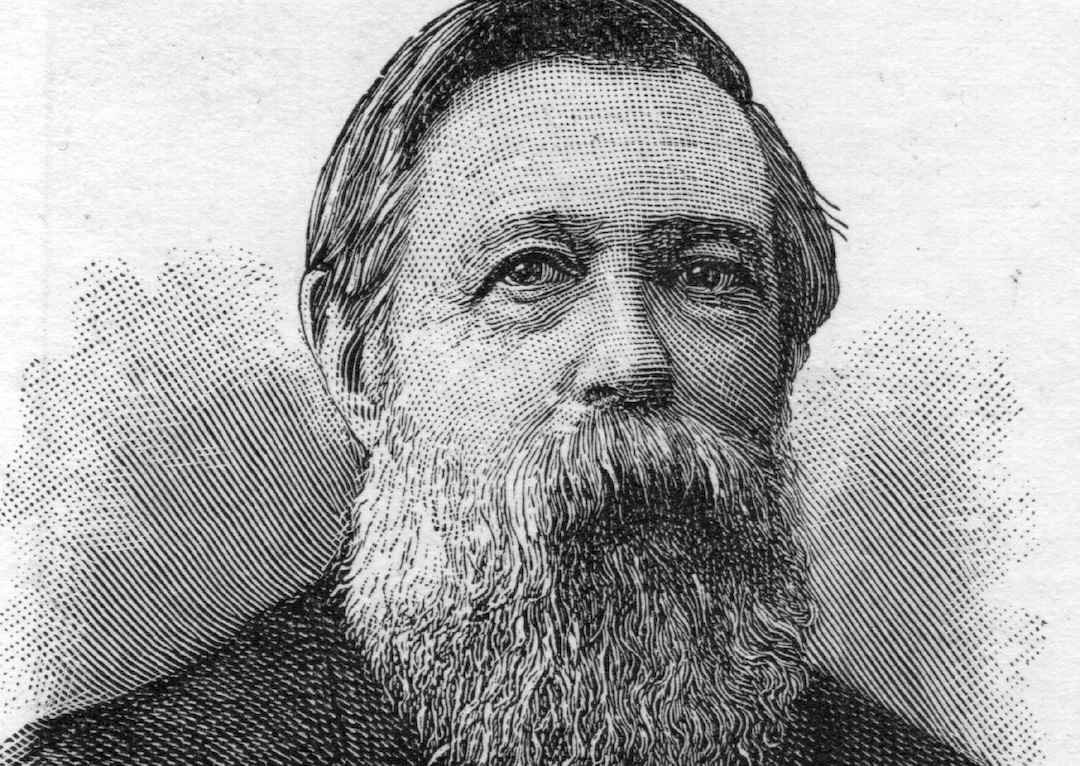
A black-and-white illustration of Friedrich Engels, circa 1980.

There is a myth that Friedrich Engels distorted Karl Marx’s revolutionary social theory into a form of technological determinism. In fact, Engels was a highly sophisticated thinker who placed human agency at the center of the historical process. (Hulton Archive / Getty Images)


There is a myth that Friedrich Engels distorted Karl Marx’s revolutionary social theory into a politically fatalistic form of technological determinism. While it is possible to pull phrases out of context to justify this claim, the truth is that Engels was a highly sophisticated thinker with an encyclopedic knowledge of history who placed conscious human agency at the center of his understanding of the historical process. While he understood human agency to be materially determined, his model of determination was anything but mechanical and reductive.

E. P. Thompson was unquestionably right when he argued that we should guard against attempts to make Engels the “whipping boy” for any defect “that one chooses to impugn to subsequent Marxism.” And Perry Anderson justifiably bent the stick against attempts to denigrate the legacy of Engels legacy when he suggested that he was actually a stronger historian than Marx: “Engels’s historical judgements are nearly always superior to those of Marx. He possessed a deeper knowledge of European history, and had a surer grasp of its successive and salient structures.”

The Birth of Historical Materialism

In his own, eminently sensible comments on the method he and Marx developed, Engels made an observation that has become famous:

If some younger writers attribute more importance to the economic aspect than is its due, Marx and I are to some extent to blame. We had to stress this leading principle in the face of opponents who denied it, and we did not always have the time, space, or opportunity to do justice to the other factors that interacted upon each other. But it was a different matter when it came to depicting a section of history, i.e., to applying the theory in practice, and here no error was permissible.

For Engels, “the determining factor in history is, in the final analysis, the production and reproduction of actual life.” However, he insisted, “if someone distorts this by declaring the economic moment to be the only determining factor, he changes that proposition into a meaningless, abstract, ridiculous piece of jargon.”

Unfortunately, over the last century and more there has been a cottage industry bent on distorting the propositions of Marx and Engels into meaningless, abstract, and ridiculous pieces of jargon. This is particularly true when it comes to the writings of Engels. The calumny heaped upon him may be related to the fact that he not only coined the term “historical materialism” but arguably invented its practice as well through his authorship of the first work of “Marxist” history: The Peasant War in Germany (1850).

Produced against the backdrop of the defeated revolutions of 1848, this study was intended both to provide evidence of an authentic German revolutionary tradition and to counter moralistic and voluntaristic tendencies among the fragments of the defeated revolutionary left. Whereas the father of modern positivist history, Leopold von Ranke, made the superficial and mystical claim that the peasant rising of 1525 emerged as a “convulsion of nature,” Engels treated all the principal characters as rational agents whose behavior one could best understand through an in-depth analysis of their contradictory material interests rooted in contemporary social relations.

His intention was to grasp the underlying social essence of the revolutionary movement beneath its surface appearance as a mere explosion of religious mysticism. Structure and agency are not, according to this model, opposites: in fact, they are mutually constitutive. His claim that revolutions have deep causes is not an alternative to exploring the role of agency within them but rather the necessary prerequisite to such an investigation.

Military Critic

The power of this approach to the study of history is evident in his military writings. As Walter Gallie observed, Engels established himself as “probably the most perceptive military critic of the nineteenth century.” Commenting on one essay by Engels on this subject, “Army” (1857), Marx wrote that he was “thunderstruck” not merely “by the sheer bulk of it” but also by its quality: he saw it as a piece of work that “demonstrates the rightness of our views as to the connection between the productive forces and social relations.”

Whatever else might be said about “Army,” it is not a piece of mechanical materialism or technological determinism. In fact, it is a magisterial survey of Western military history from antiquity to the immediate post-Napoleonic age. Throughout the essay, while Engels framed his narrative in relation to its social context, his focus on organization, leadership, morale, and culture illuminated the nonreductive nature of his materialism.

Charting the clashes between Greeks and Persians, he argued that the organization, training, and leadership of the Greeks meant that the “unwieldy and disorderly crowds” of their opponents were “quite incapable of any but passive resistance against the incipient phalanx of Sparta and Athens.” In relation to the conflicts between the Greeks themselves, he similarly explained the dominance of Sparta in land warfare as a result of its internal organization.

However, he also pointed out that the Greek social system was able to support the military service of free men because it was based on slavery. In Athens, military preparation took the form of two years’ service at the age of eighteen, after which the free man would maintain a position in the reserves until the age of sixty.

If this system created very good soldiers, the forty years of military service for Sparta’s men between the ages of twenty and sixty ensured that its hoplites were even better trained. Since the unified movement demanded of the phalanx could only be mastered through long years of collective practice, “as long as the phalanx decided the battle, the Spartan, in the long run, had the best of it.”

A Practical Art

The characteristic rider Engels added to this argument, “in the long run,” alongside his focus on the organizational moment of analysis, points to the fact that his materialism was anything but mechanical. For instance, take his comments on the revolutionary way that Epaminondas led the Thebans to victory over Sparta in 371 BCE. In a tactical innovation of profound merit, Epaminondas decided against meeting the Spartans in a traditional line but instead formed an oblique order whose strongest point was a deep column that advanced against the strongest wing of his Spartan adversaries.

This novel formation broke the Spartan line at its strongest point, after which Epaminondas flanked an enemy that had become incapable of recreating its tactical order. Engels recognized that the genius of Epaminondas lay in his ability to recognize the organizational power of the enemy and change his tactics to undermine that power. From this moment onward, as he wrote elsewhere, military leadership became an art “which has to be learned theoretically and practically.”

If the Macedonians perfected this tactical revolution, the strength of their military form continued to depend upon an intense training schedule that was only possible because slavery had freed their infantry from the necessity of manual labor. Nonetheless, however much the hoplites trained, they were only as powerful as the phalanx system itself.

As it turned out, the very characteristic that gave the phalanx its power proved to be the cause of its downfall. While the effectiveness of the phalanx depended upon the coherent movement of a mass of men, being in a mass meant that the phalanx was relatively inflexible.

On broken ground especially, the order of the phalanx could be compromised when it met a foe. This proved to be the case with the Romans, who were able to capitalize on this flaw through the deployment of heavy infantry in a more flexible formation.

From Antiquity to Feudalism

The Romans were able to defeat the Greeks because of their organizational innovations. However, as the Roman Empire expanded and stabilized, the army tended to lose its Roman character. Military demands meant that, instead of enslaving defeated barbarians to reproduce existing relations of production, Rome recruited these old adversaries into its army en masse.

For Engels, this process resulted in the gradual de-Romanization of the army and eventual fall of the empire. It was when “all distinction of equipment and armament between Romans and barbarians ceased” that the Germanic tribes, “physically and morally superior, marched over the bodies of the un-Romanized legions.”

Physicality and morale, which had taken a back seat while organization and tactics were to the fore, thus became more important as organizational differences tended to disappear. These organizational changes reflected the decay of the slave mode of production.

As Rome fragmented into the new feudal mode of production, cavalry reemerged as the decisive factor in warfare. While the feudal knights that emerged from this process could easily best untrained local peasants, conflicts with Arab forces during the Crusades and with the Mongols in Eastern Europe showed that these mounted troops were no match for “the active light horsemen of the East.”

Notwithstanding this weakness, defeats at the hands of these light horsemen did not lead to the collapse of the old order. This transformation had to wait until the emergence of embryonic capitalism within the feudal mode of production began to create the conditions through which the feudal military system would eventually break down.

Engels argued that the rise of cities and centralized states, alongside the introduction of gunpowder from the East, underpinned a slow revolution in military organization and tactics. The role of the infantry once again expanded as the limitations of cavalry became increasingly apparent. This process saw muskets become increasingly powerful weapons of war as technological changes increased the speed of reload.

Revolutionary Warfare

These technological innovations informed changes to military tactics as an increased speed of reloading allowed for longer, shallower lines of infantry with an increased rate of fire. The obvious benefits of this new tactic created, however, novel difficulties as unwieldy lines of soldiers required incessant training — remembered today through the obsolete drills as part of parades for dictators and kings — while long thin lines had weak points on their flanks.

Nonetheless, the strengths of the new system initially culminated in the overwhelming successes of Frederick the Great against the Austrians. Frederick himself was the first to admit that he had applied lessons learned from Epaminondas and his oblique order of attack to modern conditions.

Whereas Frederick’s successes depended upon a well-drilled soldiery, within a few years of his death the French Revolution had to defend itself with a relatively untrained citizen army recruited through the levées en masse. This new citizen army forged through national consciousness learned from the successes of similarly raw American troops against the British a decade earlier.

Engels pointed out that like the Americans, the fresh French troops were ideologically committed to their cause but had little time to master the intricacies of drill. Consequently, they gravitated toward skirmishing tactics against the enemy. Unfortunately for the French, they had neither America’s virgin forests in which they could vanish from the enemy nor its endless space for retreat. As a result, the relatively untrained French citizen army needed something more than this tactic in order to make use of their new weapons.

They found it in the close column. When combined with skirmishers, close columns effectively engaged with the enemy in extended line, with troops acting flexibly according to the geographic context. They sought protection in broken ground and in villages, surviving by living off the land.

Engels noted two technological advances that facilitated this flexibility. First, the French in 1777 introduced the slanting rifle butt that allowed their infantry skirmishers (tirailleur) to better aim at the enemy. Second, they took advantage of “the lighter but still solid gun-carriage constructed in the middle of the eighteenth century,” which enabled “the greater mobility later demanded of artillery.”

Rise of the Rifle

The points about skirmishing and living off the land are of cardinal importance to our story. With regard to skirmishing, in his essay “Infantry” (1859), Engels argued that this practice had been a normal part of warfare from antiquity through the Middle Ages and even up to the seventeenth century. It then disappeared, only to reappear in the American War of Independence:

While the soldiers of European armies, held together by compulsion and severe treatment, could not be trusted to fight in extended order, in America they had to contend with a population which, untrained to the regular drill of line soldiers, were good shots and well acquainted with the rifle. The nature of the ground favoured them; instead of attempting manoeuvres of which at first they were incapable, they unconsciously fell into skirmishing. Thus, the engagement of Lexington and Concord marks an epoch in the history of infantry.

These changed tactics underpinned a demand for a revolution in military technology. In his “History of the Rifle” (1861), Engels pointed out that the rifle was a product of fifteenth-century German technology that hardly saw any improvement in its construction before the nineteenth century.

Up to that point, rifles were more accurate than smooth-bore muskets up to a maximum distance of around 400–500 yards, but they were also more complex to make and significantly slower to reload. Consequently, smooth-bore muskets made up the bulk of infantry and cavalry firearms. And though European armies continued to use rifles, their deployment was very limited and largely irrelevant to the outcome of battle.

Things changed, however, with the reemergence of skirmishing in the American and French revolutionary wars. In place of armies predominantly facing each other in lines, “henceforth extended order was introduced in every engagement; the combination of skirmishers with lines or columns became the essential characteristic of modern fighting.”

As Engels points out, the mass of ammunition was expended during skirmishes, directed against targets that were “seldom larger than the front of a company; in most cases, they have to fire at single men well hidden by covering objects. And yet, the effect of their fire is most important.” While the old muskets were virtually useless in this new form of warfare, the existing rifles were almost as inadequate because they were too slow to reload and, as a consequence of the difficulty associated with forcing bullets down longer muzzles, too short to be used with bayonets.

These shortcomings made soldiers armed with rifles susceptible to attack, either by infantry with bayonets or by cavalry. Under these circumstances, wrote Engels, “the problem at once presented itself: to invent a gun which should combine the range and accuracy of the rifle, with the rapidity and ease of loading, and with the length of barrel of the smooth-bore musket.” Such a weapon would have to be “fit to be placed into the hands of every infantry soldier.”

Marching on Its Stomach

The demand for rifled guns created by this revolution in warfare underpinned the revolutionary transformation of the rifle in the nineteenth century. Engels turned technological determinism on its head:

With the very introduction of skirmishing into modern tactics, arose the demand for such an improved arm of war. In the nineteenth century, whenever a demand for a thing arises, and that demand be justified by the circumstances of the case, it is sure to be supplied.

The rest of the essay is a sophisticated account of the cumulative development of the rifle after 1828. In “Infantry Tactics, Derived from Material Causes: 1700–1870” (1877), he described how the universal use of breach-loading rifles in the Franco-Prussian War led to the replacement of columns with compact chains of skirmishers, because the former had become such an easy target for the new weapons.

As to the issue of living off the land, Engels linked this point to the question of technological innovation through the concept of the productivity of labor. If Frederick opened the door to a revolution in warfare, it was Napoleon who massively deepened this revolution in mobility by dividing the Grande Armée into corps d’armée that could act as relatively self-sufficient military forces.

Each corps d’armée was large and complex enough to take the fight to the enemy, while remaining small enough to maintain itself off the land in a way that reduced its supply lines and increased its speed. Napoleon famously married speed with mass by keeping each corps d’armée only a day’s march apart. They could deceive their enemies about their intended goal while still being able to unite together when called upon to engage the enemy: “March divided, fight united,” as he wrote in a line remembered by Vladimir Lenin in his arguments for the united front tactic.

According to Engels, Napoleon’s military system was predicated upon the prior development of the forces of production. Despite the controversy surrounding this aspect of Marxist theory, in this instance at least it appears to be common sense. If the French were “almost unbeatable” but still sometimes vulnerable, even at their peak, this was not simply because of the vicissitudes of local leaders. It was also because their style of mobile warfare depended upon the ability of the soldiers to live off the land.

As Engels pointed out in “Conditions and Prospects of a War of the Holy Alliance against France in 1852” (1851), prior long-term increases in the productivity of labor on the land was the prerequisite for the success of this approach, which made it “impossible for a long period in a poor, semi-barbaric, thinly populated country.” This was why the French armies “perished slowly in Spain, and rapidly in Russia.”

The Unbroken Clue

In the same essay, Engels argued that the two key characteristics of the Napoleonic system — its mass character and its mobility — were products of the emergence of capitalism: “Modern warfare presupposes the emancipation of the bourgeoisie and the peasants; it is the military expression of this emancipation.” As he speculated on the possible consequences of a new French Revolution, he made the materialist point that further developments in the productive forces, specifically the widespread use of the telegraph and the spread of railways across Western Europe, were making Russian dominance “more impossible every day.”

Nevertheless, Engels still stressed the nonreductionist point that any hopes one might have for revolutionary France in a struggle against counterrevolutionary Russia “presupposes that there will be a good Minister of War.” He reiterated his view of the importance of military leadership when addressing the successes of the levée en masse.

Engels argued that the initial successes of France’s raw recruits depended upon the existence of a core of experienced soldiers around which they were organized. Moreover, French victories in the early revolutionary wars of the 1790s, particularly over the Prussians and Austrians at Valmy in 1792, were a consequence not so much of French skill and enthusiasm as of German incompetence.

All of these arguments evidence one key point: Engels’s view of the centrality of historically constituted human agency in making history. As Marx noted in his comments on “Army,” Engels did not reduce human history to a story of technological advancement but deployed his understanding of these advances as the means to a rich understanding of human agency through which he was able to make sense of the rational core of voluntarism while avoiding its superficiality.

In words that paraphrase Marx’s formal solution to the structure-agency relationship in The Eighteenth Brumaire of Louis Napoleon, Engels wrote that

men make their own history, but in a given environment by which they are conditioned, and on the basis of extant and actual relations of which economic relations, no matter how much they may be influenced by others of a political and ideological nature, are ultimately the determining factor and represent the unbroken clue which alone can lead to comprehension.

The historical writings of Engels bring this relationship to life. In so doing, they provide a powerful resource for anyone wanting to make sense of history in a way that escapes the trivial superficialities of so much contemporary historical and political work.