Will More Warehouses Burn?

A California logistics worker allegedly burned down a 1.2-million-square-foot warehouse in anger over low pay. The billionaire class may have to learn the hard way: you can only pack so much pressure into a deeply unequal system before it blows.
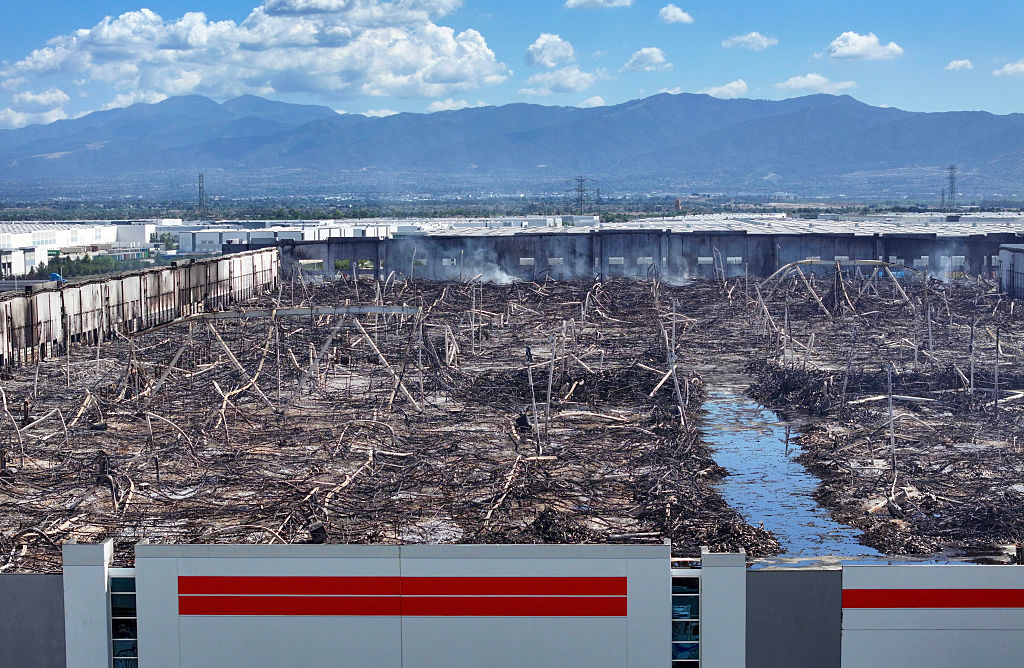
A California logistics worker texted his coworkers before allegedly burning his workplace to the ground: “All you had to do was pay us enough to live. Pay more of the value WE bring. Not corporate. Don’t see the shareholders picking up a shift.” (Jeff Gritchen / MediaNews Group / Orange County Register via Getty Images)

“If you’re not going to pay us enough to fucking live, you can at least pay us enough to not do this shit,” the man says as he reaches out with a lighter and ignites a pallet of toilet paper. Minutes later, multiple pallets can be seen burning in a video taken inside the 1.2-million-square-foot Kimberly-Clark warehouse located in California’s Inland Empire. “There goes your inventory,” the man says.

The warehouse quickly became a raging inferno, requiring 175 firefighters and fifteen truck companies to subdue the six-alarm fire over the next fifteen hours. Warehouse workers were safely evacuated, and no one was injured by the blaze.

Police quickly arrested twenty-nine year old Chamel Abdulkarim, who they say posted several self-incriminating videos of himself lighting the fire on social media. If convicted, Abdulkarim could face up to twenty years in federal prison. He has pleaded not guilty.

I’ve spent my life trying to organize workers in smart and strategic ways to build power. Burning down a warehouse is not on my list of effective working-class tactics — quite the contrary. But I doubt that this is the last time we will hear a story of one low-wage worker’s incendiary revenge, and this story in particular goes much deeper. To understand it, we need to start with Kimberly-Clark’s financial disclosures to the Securities and Exchange Commission (SEC).

The Primacy of Shareholder Value

Kimberly-Clark, manufacturer of popular household products such as Kleenex, Huggies, and Scott toilet paper and paper towels, has been on the Fortune 500 every year since it was first established in 1955. It is a global company with tens of thousands of employees. And it is incredibly profitable.

I reviewed Kimberly-Clark’s 10-K disclosures, annual reports on the company’s finances and operations that the SEC requires publicly traded companies to submit annually, from 2015 through 2025. Over that time, the company collectively made $21.5 billion in net income. That’s equivalent to the annual GDP of a small country. But it’s what Kimberly-Clark chose to do with those profits that is truly astonishing. Over that same period, Kimberly-Clark paid out $22.8 billion in stock buybacks and dividends — meaning the company paid out the equivalent of 106 percent of their net income to Wall Street.

Kimberly-Clark Profits and Wall Street Payouts

Dividends are direct payouts of a company’s earnings to shareholders and have been around for a long time, since at least the founding of the East Dutch India Company in the 1600s, though the amount paid out today is often far more excessive than in the past. What is relatively new is stock buybacks, where companies repurchase their own stock, which they retire, artificially inflating the value of the shares that remain. Buybacks are a surefire way for companies to quickly drive up their stock price and used to be an illegal form of stock manipulation until Ronald Reagan’s SEC changed the rules in 1982 as part of the administration’s deregulatory agenda.

After that, it was off to the races.

According to a 2020 analysis published in the Harvard Business Review, between 2009 and 2018, 465 companies in the S&P 500 spent an explosive 91 percent of their net income – $7.6 trillion – on stock buybacks and dividends. Some companies, like Kimberly Clark, even take on increased debt loads to pay out more than they made.

“The business of these corporations is not to produce services or products but stock buybacks. It’s legalized looting,” said Les Leopold, author of Runaway Inequality: An Activist’s Guide to Economic Justice. “They are doing everything they can to transfer as much money as possible from the company into their own pockets. They lay off workers, break unions, outsource and offshore jobs, suppress wages, and price gouge. Companies often take on debt just to do buybacks. This is one of the greatest sources of the extreme inequality we see today.”

The change in how companies operate also came with a fundamental shift in ideology and corporate culture. Michael Hsu, the chief executive officer at Kimberly-Clark, made $48 million in total compensation over the last three years, the vast majority of which is paid in company stock, the value of which is increased through buybacks. According to the company’s own filings, it would take their average employee 275 years to make what Hsu made in 2025 alone. Investors intentionally tie the pay of executives to the value of the company’s shares, ensuring ideological alignment between Wall Street and the C-suite.

“The ideology of shareholder value says that all the revenue a business generates belongs to the shareholders and nobody else,” William Lazonick, professor emeritus of economics at the University of Massachusetts and coauthor of Predatory Value Extraction: How the Looting of the Business Corporation Became the U.S. Norm and How Sustainable Prosperity Can Be Restored:

Our society depends on tapping the profits of the richest companies and putting that money into social services and into wages and benefits for workers, but this now dominant ideology ensures that the people in positions of strategic control at the top of these companies are going to be committed to the broader agenda of further increasing profits by avoiding taxes, outsourcing and offshoring jobs, breaking unions, and lobbying congress for deregulation, subsidies and further tax avoidance, which in turn leads to more profits that can be funneled back to shareholders.

One of the most critical decisions made in any company is how it allocates its capital — what the people who run and own it choose to do with the revenue it generates. Since the 1980s, the twin forces of financial deregulation and the corporate offensive against unions have steadily stripped workers of any meaningful say in those decisions. In their place, Wall Street has come to dominate, dictating how profits are distributed and reinvested.

In contrast, democratic socialism aims to build an economy where workers have real power — through strong unions, a labor party, and other working-class institutions — and where those choices are made differently. Workplaces would be democratized, and decisions about capital allocation would no longer be governed solely by the narrow principle of maximizing shareholder return but instead would be subject to deliberation among stakeholders concerned with what is best for workers, communities, and the planet.

It’s hard to look at Kimberly-Clark’s finances and not feel the same rage that Abdulkarim must have felt. He worked at a $150 million warehouse, surrounded by $500 million in products, living in California’s extraordinarily expensive Inland Empire, and he wasn’t even directly employed by Kimberly-Clark. The job of managing the warehouse was outsourced to NFI Industries, a privately owned third-party logistics company worth billions that agreed last year to pay out millions to settle a class action lawsuit over employee misclassification. The company has been described by the Teamsters as an “irresponsible, lawbreaking employer.”

According to the US Attorney’s Office, Abdulkarim allegedly texted his thinking to coworkers after he set the fire, saying, “All you had to do was pay us enough to live. Pay more of the value WE bring. Not corporate. Don’t see the shareholders picking up a shift.”

“That’s not an irrational response at all given the absence of union power,” said Lazonick. “If more workers start to realize how badly they are getting fleeced, there would be even more warehouses burned down.”

Social Arson Sparks Actual Arson

More than 150 years ago, in The Condition of the Working Class in England, Friedrich Engels made a simple argument: when the ruling class in society knowingly places workers in conditions that shorten their lives — denies them the means to live, forces them to endure those conditions, and then treats those conditions as natural or inevitable — those conditions are “as much a death by violence as that by the sword or bullet.”

Corporations like Kimberly-Clark generate billions in profits that they use to lavishly pay corporate executives, then funnel those billions into stock buybacks and dividends for Wall Street while workers in their supply chain are paid wages that don’t cover basic living costs. This particular story is being played out on a much larger scale across the economy, with disastrous results for the working class.

You know the basics: Inequality has reached extremes not seen since before the Great Depression. The number of billionaires in America jumped by 50 percent from 2017 to 2025, while 60 percent of Americans live paycheck to paycheck, and tens of millions are foregoing at least one meal a day to afford health insurance. For the first time in over a hundred years, life expectancy for working-class Americans is falling, especially as deaths of despair — deaths due to overdoes, suicide, and alcohol-related disease — have risen dramatically, particularly in communities hit hardest by offshoring and mass layoffs.

The ruling class is knowingly underpaying the people whose labor produces their wealth and deliberately distributing all of the value workers produce upward, wrecking lives, communities, and the environment in the process. Economies aren’t governed by the laws of nature; they are the product of human choice. Engels called the economic conditions in industrializing England that shortened workers’ lives “social murder.” Today the financialization of life and work in Corporate America might be better understood as “social arson.”

Employers are saturating entire sectors of the economy with conditions that are as volatile as they are unsustainable: huge payouts for those at the top, and low wages, high rents, precarious work, and no meaningful voice on the job for everyone else. Under those conditions, it should not be surprising when something eventually ignites.

None of this justifies burning down a warehouse, but it does explain it.

In the early twentieth century, progressives and the labor movement offered capitalists a way out: give workers the right to organize and bargain collectively over their wages, benefits, and working conditions. They politically and legally legitimized institutions that enabled workers to claim a growing share of the value they create and a real say over the conditions of their lives. And for several decades, due to fierce struggle by workers and powerful social movements, a rising tide did lift most boats.

Today union density has dropped to its lowest point in over a hundred years, and employers are hell bent on driving it down even further. It seems like the billionaire class may have to learn the lessons of the past again the hard way: you can only pack so much pressure into a system before it blows.