In Belarus, the Left Is Fighting to Put Social Demands at the Heart of the Protests
The protests in Belarus have widely been painted as a pro-Western “color revolution” or “Minsk Maidan,” ignoring the deeper reasons for popular discontent with president Alexander Lukashenko. Jacobin spoke to left-wingers in Belarus about the forces behind the protests and the prospects of organized labor asserting its own agenda.
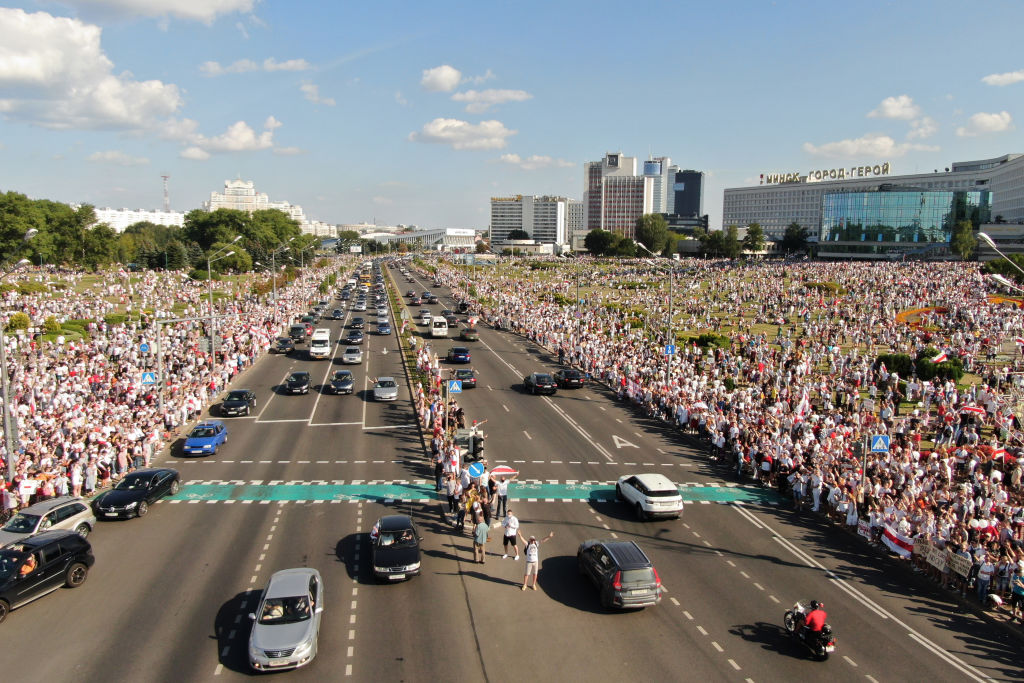
An aerial view of protesters during a demonstration on August 16, 2020 in Minsk, Belarus. Getty Images
The police brutality in Minsk is often said to be without parallel in Europe: something that France’s gilet jaunes protestors would surely deny. Yet something definitely is changing in Belarus, after unprecedented popular support for opposition candidates challenged the twenty-six-year rule of president Alexander Lukashenko. When authorities claimed that he had taken 80 percent of the vote in the August 9 election — and crowds took to the streets to protest — the state unleashed police terror against them.
The street demonstrations were initially dominated by urban youth. Yet, as I have shown in a recent article, the protest has in recent days changed form, expanding into a wider working-class movement involving widespread workplace mobilizations. Actions spanning most of the country’s biggest industrial sites have seen thousands of workers gathering, discussing their demands, and threatening a general shutdown.
So, everything in Belarus is said to be “unprecedented.” Yet one can, indeed, find precedents, in Poland’s Solidarnosc or the miners’ strikes in the late Soviet Union — examples of worker militancy allied to wider protest movements that unwittingly paved the way for neoliberal transformations. The tragic story of labor in the post-Soviet space thus calls for a careful and grounded approach to the recent events in Belarus.