Why the Corporate Media Won’t Call It a Coup
The corporate media stands united in opposition against leftists in Latin America. That’s why it refuses to state the obvious: Bolivian president Evo Morales was deposed over the weekend in a violent coup.
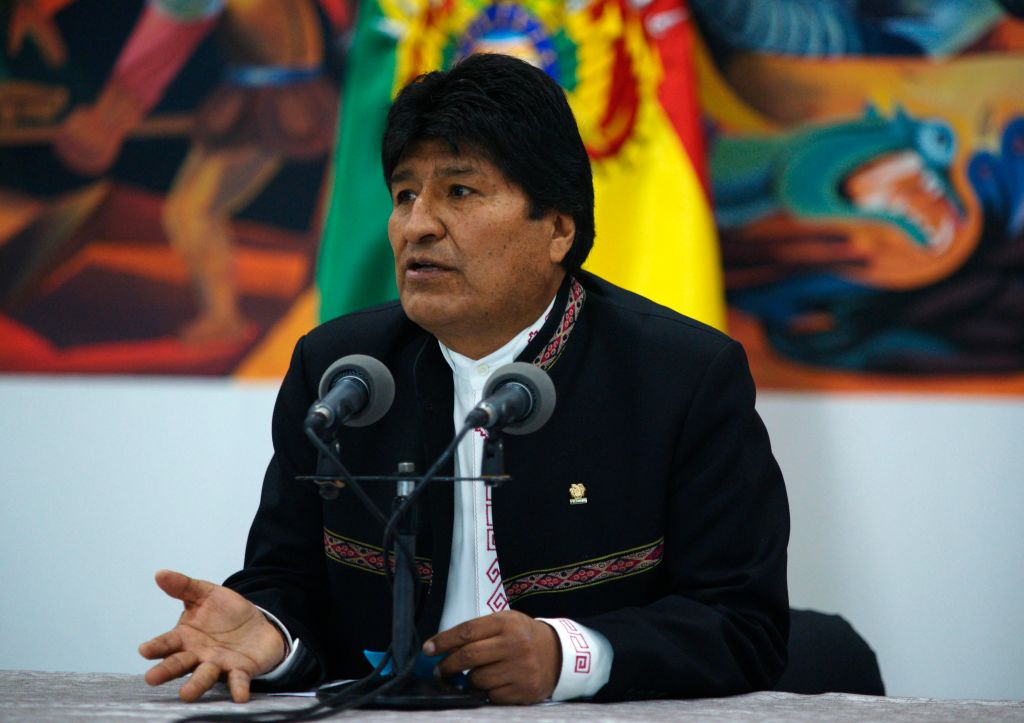
Evo Morales speaks during a press conference on October 23 in La Paz, Bolivia. (Javier Mamani / Getty Images)
Army generals appearing on television to demand the resignation and arrest of an elected civilian head of state seems like a textbook example of a coup. And yet that is certainly not how corporate media is presenting the weekend’s events in Bolivia.
No establishment outlet framed the action as a coup; instead, President Evo Morales “resigned” (ABC News), amid widespread “protests” (CBS News) from an “infuriated population” (New York Times) angry at the “election fraud” (Fox News) of the “full-blown dictatorship” (Miami Herald). When the word “coup” is used at all, it comes only as an accusation from Morales or another official from his government, which corporate media has been demonizing since his election in 2006.
The New York Times did not hide its approval at the events, presenting Morales as a power-hungry despot who had finally “lost his grip on power,” claiming he was “besieged by protests” and “abandoned by allies” like the security services. His authoritarian tendencies, the news article claimed, “worried critics and many supporters for years,” and allowed one source to claim that his overthrow marked “the end of tyranny” for Bolivia. With an apparent nod to balance, it did note that Morales “admitted no wrongdoing” and claimed he was a “victim of a coup.” By that point, however, the well had been thoroughly poisoned.