The Far-Right Coup in Bolivia
In Bolivia, the military, police, and right-wing extremists have carried out a coup against the elected government. They intend to remain in power by violently suppressing the country's indigenous and poor.
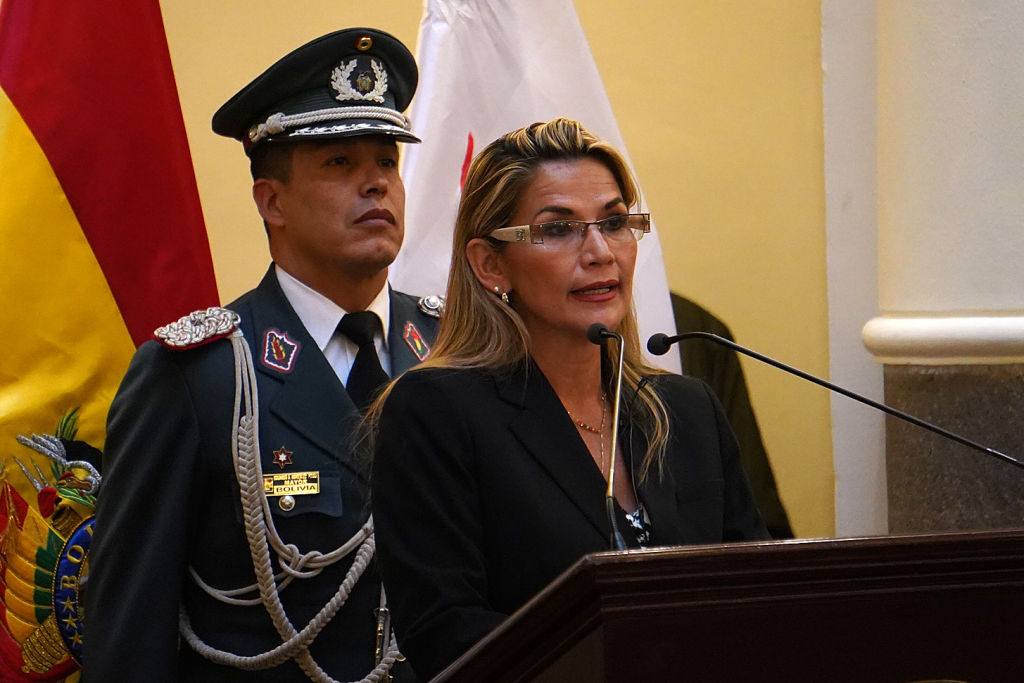
Interim president of Bolivia Jeanine Áñez talks during a conference at the presidential palace on November 13, 2019 in La Paz, Bolivia. Javier Mamani / Getty Images
Recent days have seen the tragic aftermath of the coup against Evo Morales and his government in Bolivia: protestors defending democracy in El Alto shot down, supporters of Morales’s Movement for Socialism (MAS) party rounded up in their homes, public officials paraded in front of television cameras by masked police, and the army sent onto the streets.
At the time of writing, right-wing provocateur Jeanine Áñez has declared herself the president of Bolivia. Áñez is a white supremacist who has tweeted of how she “dreams of a Bolivia free of indigenous satanic rites,” and how the capital city “is not for the Indians — [they] belong in the high plateau or el Chaco.” She was approved yesterday by a parliament without the majority of its elected representatives, meaning it failed to meet constitutional requirements in terms of a quorum. The line of succession was also ignored. But none of this really matters to the army, which now runs Bolivia.
These maneuvers show that, whatever those in the “liberal” media are claiming, recent events in Bolivia amount to a coup. It was a seizure of power against democratic norms organized by a hard-right elite who have rejected any processes of dialogue or even Morales’s offer of a new election. This reality has been recognized by progressive forces across the Western hemisphere, from Mexican foreign minister Marcelo Ebrard to Argentina’s president-elect, Alberto Fernández, from the recently released Lula in Brazil to American politician Ilhan Omar, who chose her words succinctly: “There’s a word for the President of a country being pushed out by the military. It’s called a coup.”