Bolivia’s Coup Government Is Looking for Excuses to Avoid Elections
With Bolivia’s coup government delaying presidential elections for the third time, the country's largest union federation is threatening to launch a general strike this Monday. In an interview with Jacobin, the labor federation's leader explains why trade unions are fighting to ensure the vote goes ahead.
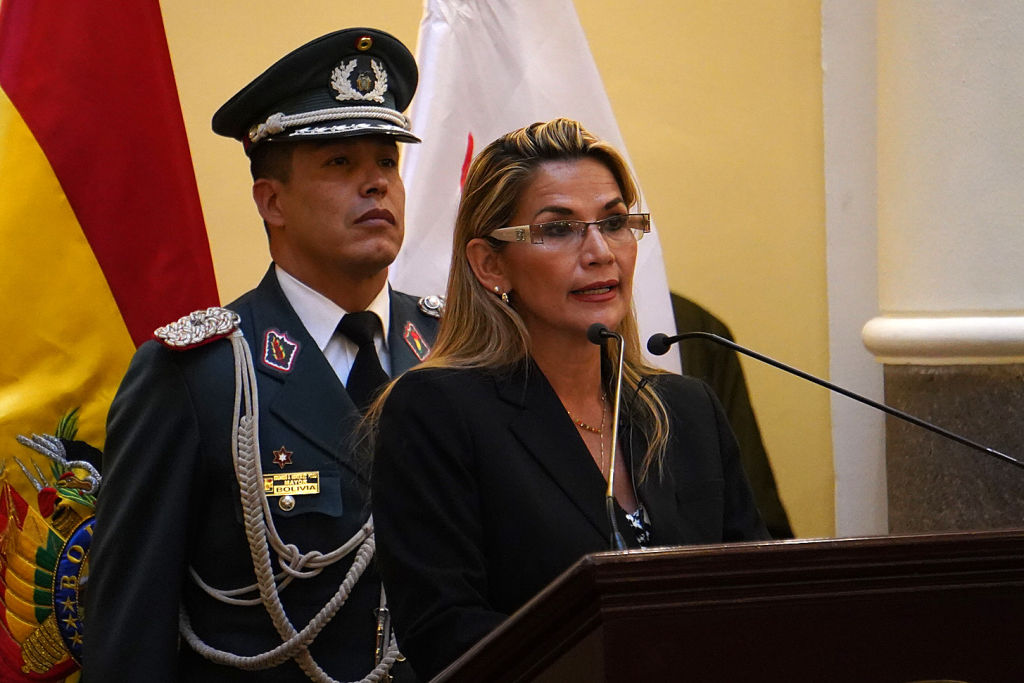
Jeanine Áñez talks during a conference at the presidential palace on November 13, 2019 in La Paz, Bolivia. (Javier Mamani / Getty Images)
Nine months after much of Western media hailed the “return of democracy” in Bolivia, the transitional government led by Jeanine Áñez has again put off the planned presidential elections. Despite the violent military coup that overthrew Evo Morales in November, in recent weeks the candidate for his Movement Toward Socialism (MAS), Luis Arce, had been polling around 40 percent for the first round — triple the score for right-winger Áñez.
MAS supporters feared that the election would be somehow cancelled; and this week, the Áñez regime announced the poll will not take place on September 6 as planned, but October 18. Social movements are furious. Bolivian Workers Central (COB) executive secretary Juan Carlos Huarachi has issued a seventy-two-hour deadline to reverse the decision, or else Bolivia’s largest union organization will begin a general strike, accompanied by nationwide road blockades, on Monday, August 3.
A miner, Huarachi is the highest representative of the country’s trade union movement. He spoke to Jacobin contributor Anton Flaig about the conditions for workers since November’s military coup, the effects of the COVID-19 pandemic on the country, and the Right’s efforts to prevent the MAS from returning to power.