Defense Spending: the Endless Frontier
The military sets the agenda for scientific research, so it's still much easier to get funding to develop new bombs than to get the resources to develop new, potentially life-saving antibiotics.
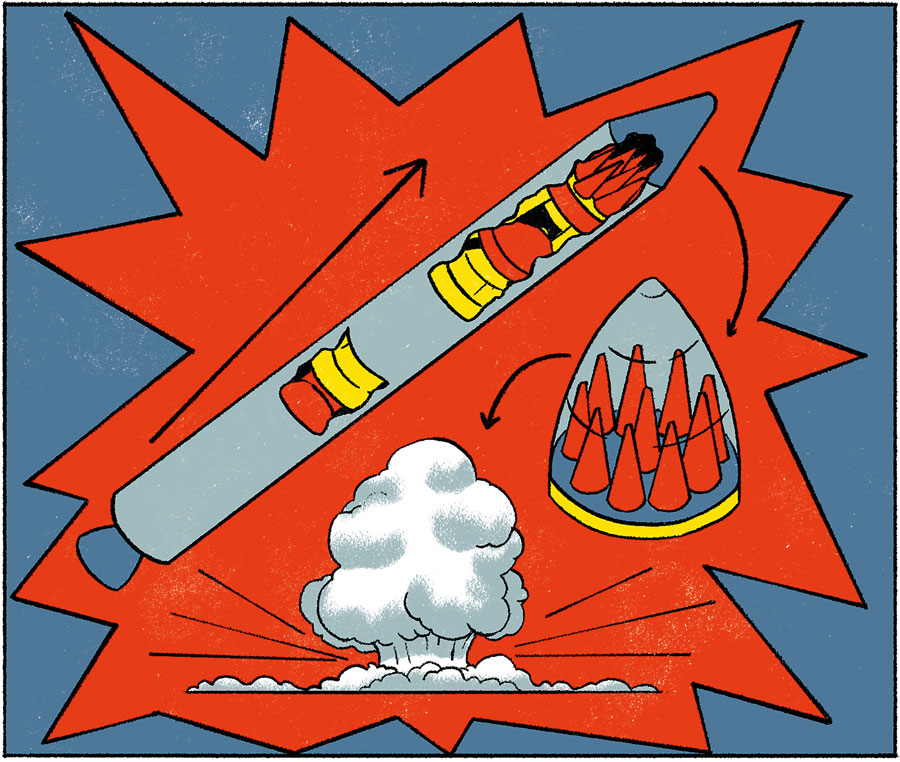
Illustration by Cristina Daura
At any given time, the United States has four hundred W78 and W87 thermonuclear warheads on hair-trigger alert, loaded on intercontinental ballistic missiles that can travel eight thousand miles, capable of destroying every building and living creature within a four-mile radius. Since 2001, unmanned air vehicles piloted from a Nevada airbase have been used to kill ten thousand people on the other side of the world, many of them civilians. General Atomics’s MQ-9 Reaper drone has visual, infrared, and laser-based sensors for targeting, technology for real-time video streaming, multiple types of radar, and supports a range of bombs and missiles to rain death.
Weapons like these did not exist fifty years ago. There is no “natural” scientific or technological progression that accounts for their emergence. They require tremendous amounts of money to develop and immense scientific expertise employed precisely to these ends, highlighting an obvious yet often ignored truth: the military plays a central role in funding and shaping the modern scientific enterprise — an arrangement observers have called the “military-industrial-academic complex.”