Colombia’s Future Is at Stake
With the Right threatening a fragile peace, today's elections are the most important in Colombia’s recent history.
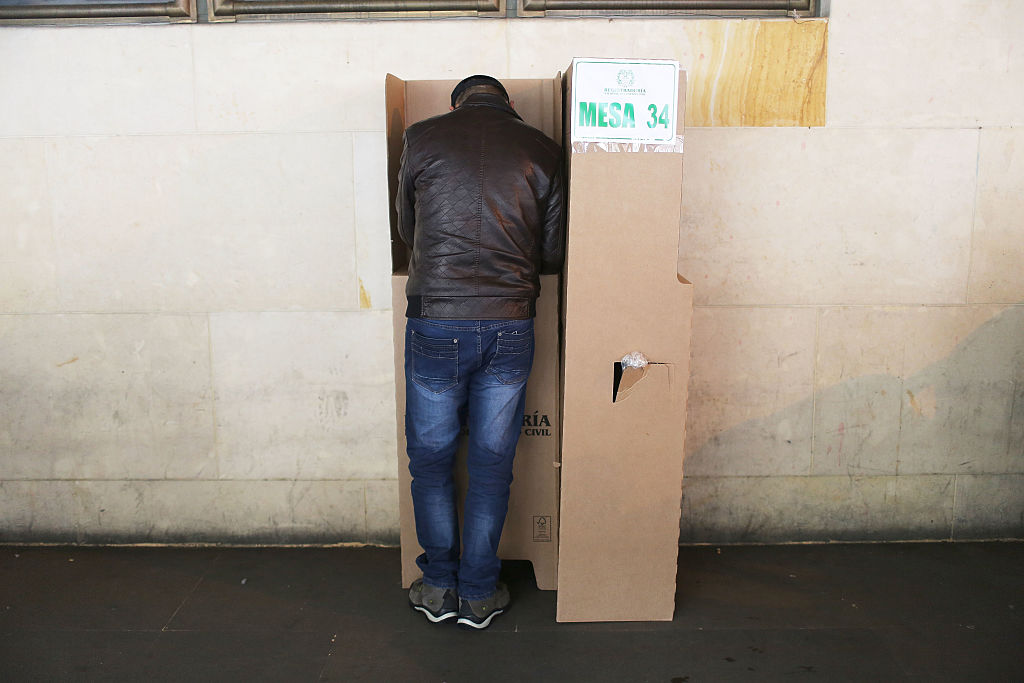
A voting booth during the 2016 peace referendum in Bogotá, Colombia. Mario Tama / Getty Images
A little over one year ago, Colombian president Manuel Santos pushed through a peace deal with the Revolutionary Armed Forces of Colombia-People’s Army (FARC-EP), ending a decades-long war and transitioning FARC from a guerilla army to a legal political party. He did so despite the original deal’s narrow rejection, with 50.2 percent of Colombians voting against it, in a popular referendum earlier that year. The polarization visible in the referendum has only intensified since the deal’s ratification. Human rights advocates and Colombia’s marginalized depend on peace to lessen the violent repression that shapes their political participation, while the Right and sections of the elite prefer the climate of fear and militarization fostered by civil war.
Perhaps unsurprisingly, the deal is far from stable, as right-wing proposals for renewed militarization gain popularity over the commitment to continuing the peace process. It’s in this context that Colombians are asked to go to the polls for several national elections — arguably the country’s most important in recent history — first, today, for parliamentary elections of both houses and then, on May 27, for presidential elections.
After eight years in office, President Santos is constitutionally barred from running again. He is deeply unpopular, both with his traditional right-wing base due to his efforts to achieve peace with the FARC as well as with progressive sectors of society. Moreover, while his National Unity Party is currently the largest fraction in the Senate, it will likely lose the majority of its seats in today’s parliamentary election. The party has also failed to put forward a new presidential candidate despite the drastic fall in Santos’s popularity.