The Monetary Hawks
Federal Reserve policies did more to smash the power of American workers than Ronald Reagan’s union busting.
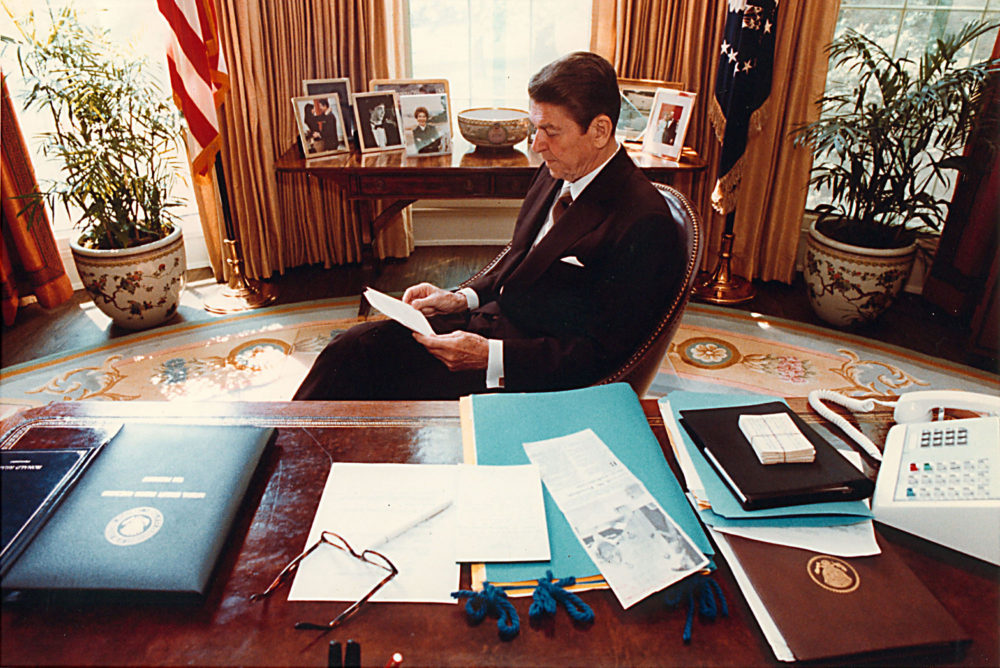
Ronald Reagan prepares a speech at his desk in the Oval Office for a Joint Session of Congress on April 28, 1981. (Photo by Michael Evans/The White House/Getty Images)
Since the mid-1970s, governments have carried out a one-sided class war on behalf of capitalists, which we have come to know as neoliberalism. Nowhere is this easier to see than the United States. Once-thriving manufacturing cities are now ghost towns of decay and unemployment, trade unions have watched their memberships go into decline and have been forced to concede in contract after contract, and wages for workers have stagnated. Most have seen the hope of a secure retirement fade away, and will have to work well into their twilight years just to make ends meet.
This is the result of a deliberate war against the working class. But those winning this war didn’t do so through political force alone, as the story is often told. Even more critically, hawkish policymakers used subterranean tactics to change the constraints that workers, their organizations, and firms confronted on seemingly impersonal and apolitical capitalist markets.
Just weeks after Ronald Reagan fired over eleven thousand striking air traffic controllers, the chairman of the Council of Economic Advisers, Murray Weidenbaum, put the administration’s broader labor policy into perspective. “We are not telling labor and management what to do,” he said, “We are subjecting them to the fundamental force of market pressures.”