Abdul El-Sayed’s Sports Fluency Is a Political Asset
Abdul El-Sayed’s ease in talking sports built rapport with skeptical voters and defies the stereotype of progressives hating what average people find fun. His knack for finding common ground is central to his broad political appeal.
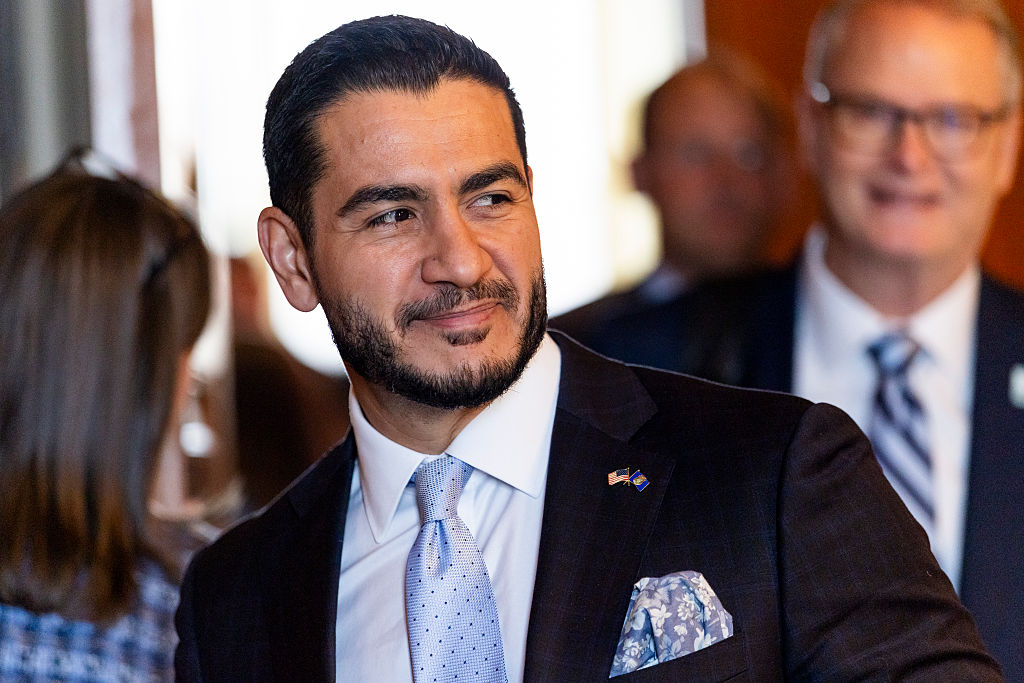
Abdul El-Sayed’s athletic bona fides and fluency in Michigan fandom allow him to reach skeptical audiences and challenge the idea that sports belong to the Right. (Finn Gomez / Getty Images)
One of Abdul El-Sayed’s greatest skills is his ability to deploy the language of sports to make his case. His fluency in sports allows him to find common ground with interlocutors and audiences, complicating the stereotype that progressives are anti-sports.
What makes him convincing and harder for his opponents to dismiss is that he played competitive team sports: El-Sayed was a hockey goalie in middle school. At Bloomfield Hills High School in the suburbs of Detroit, he played football and lacrosse and wrestled, becoming football team captain. These are sports conservatives embrace or consider quintessentially American. At the University of Michigan in Ann Arbor, he continued playing sports at the club level, which is more competitive than intramural sports but separate from varsity athletics. As a Rhodes Scholar, he also played on and captained the University of Oxford men’s lacrosse team.
In a now-viral interview with Fox News’s Jesse Watters, El-Sayed did what so few progressive politicians manage: he disarmed a skeptical, even hostile, interlocutor not with talking points but with sports camaraderie. “We both played football and lacrosse. We both love America. We both love freedom,” he responded to the first question, before bantering about football ticket prices and ribbing his critics. The next night, Watters admitted to viewers, “I actually like Abdul. I probably shouldn’t like him, but I do.”
Hearts and Minds and the Home Team
By leaning into the language of sports, El-Sayed flips the script on the “bro culture,” especially among young men, that has long fueled right-wing politics and Trump-era masculinity. Rather than ceding that terrain, he claims it on his own terms. He repeatedly cast his opponent Mike Rogers as a subordinate “beta” in Donald Trump’s “alpha” orbit, turning the hierarchy of masculine posturing against them. Some skeptics, drawn in by his athletic bona fides, may find themselves unexpectedly receptive. It’s as if El-Sayed is saying: sports don’t belong exclusively to conservatives.
One of his most effective rhetorical strategies was to draw on the local loyalties and rivalries that shape Michigan’s fandom.
El-Sayed repeatedly invoked the long-standing rivalry between the University of Michigan Wolverines and the Ohio State Buckeyes, particularly their annual college football matchup, in which Michigan has the upper hand, sixty-two total wins to Ohio State’s fifty-three wins. His jabs at neighboring Ohio — and at J. D. Vance in particular — may seem strange and personal to outsiders, but they make perfect sense within Michigan’s political and cultural landscape. He was directing the taunt at Vance, an Ohio State alumnus who had repeatedly attacked El-Sayed with inflammatory racist and Islamophobic rhetoric. By turning the rivalry into a political jab, El-Sayed displayed local cultural fluency.
Some athletes agree. One high-profile supporter of El-Sayed is San Diego Padres pitcher Lucas Giolito. Front Office Sports previously reported that Giolito donated $1,250 to El-Sayed’s campaign. On election night, journalist Eli Kronenberg wrote on X that Giolito told him, “Although I don’t live in Michigan, I believe he’ll be a great progressive voice in the US Senate.”
On his book tour, Colin Kaepernick was asked which politicians he was most excited about. He answered quickly: “The ones that are interesting to me are obviously Mamdani in New York . . . [and] Abdul El-Sayed in Michigan. I really like the approaches they’re taking. They’re staying very focused on the needs of the people. They don’t seem to be bought or swayed,” he said, adding that they represent a growing rejection of the establishment.
From the Field to the Campaign Trail
A few days before the election, former Michigan State long snapper Taybor Pepper, who played in the NFL for seven seasons, interviewed El-Sayed. After speaking with El-Sayed, Pepper wrote on X:
I understand why people want sports to be an escape from politics, but the reality is that throughout history, sports and politics have been deeply intertwined. From breaking racial barriers to fighting for equality and civil rights, athletes have played a pivotal role in pushing society toward meaningful social change.
Like New York City Mayor Zohran Mamdani, El-Sayed supports English football club Arsenal FC, whose large, diverse global fan base has much in common with the New York Knicks, another of Mamdani’s passions.
This is not the first time El-Sayed has weighed in on sports’ cultural and political significance. In an April 2021 post on his now private Substack, The Incision, he analyzed the influence of big money on European football and fans’ successful resistance to major clubs’ attempts to commercialize the game further through the European Super League. He drew a parallel to the exploitation of the health care system back home: “If English soccer fans can stand up to fight for their soccer clubs, perhaps we too can fight for our healthcare, our prescription drugs, our schools, and our lives.”
In another post in October 2021, following the firing of former Raiders coach Jon Gruden over racist, homophobic, and misogynistic comments, El-Sayed argued that the problem was more systemic: “The toxic masculinity at the heart of America’s most popular sport — and men’s sports culture more generally — is way deeper than a few emails or a Jay-Z turnaround.”
Finally, about a month ago, El-Sayed’s campaign posted a short video on his social media in which one of his former high school football teammates, Nikita Sanches, speaks about El-Sayed as a teammate. Sanches, who was born in the Soviet Union and was a shy teenager when they first met, recalls how El-Sayed befriended him and took him under his wing. He also described how El-Sayed negotiated Islamophobia in the wake of 9/11. Sanches, now a chef, explains how, a year later, “we elected him our leader and our captain. Not just because he was our friend and our classmate, but because of the way he carried himself.” The same qualities that made El-Sayed a trusted teammate now help him use sports to connect with audiences beyond his political base.