What the Ottomans Tell Us About Plunder and Capitalism
Did colonial plunder create capitalism? Ottoman history suggests not.
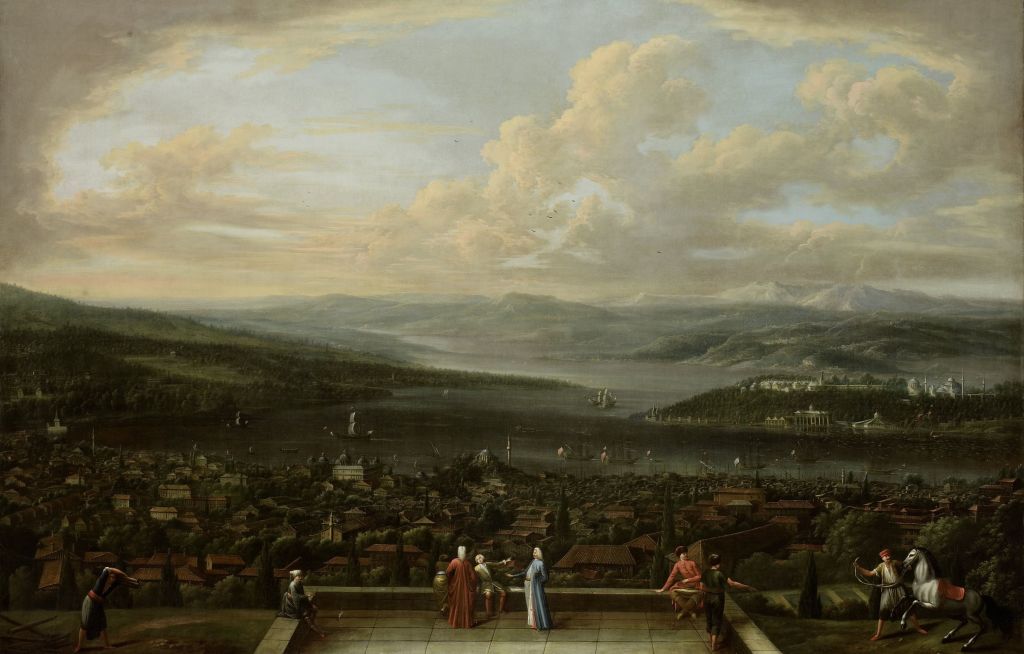
Capitalist relations emerged from within Ottoman feudal society between 1550 and 1650, long before the Industrial Revolution and Western domination. (Heritage Art / Heritage Images via Getty Images)
Vivek Chibber’s recent interview on the Jacobin Radio podcast Confronting Capitalism and Vijay Prashad’s response in Monthly Review have reopened fundamental questions about capitalism’s origins, colonialism, and the transition from feudalism to capitalism in world history. Drawing on my research into Ottoman history, I want to make the case that societies beyond Europe belong in this history not simply for their contributions to the rise of capitalism in the West but for their own internal transformations.
The origins of capitalism and its subsequent development through colonialism are distinct historical problems. Ottoman history allows us to draw this distinction by examining a transition beyond the northwestern European cases at the center of this debate.
On the central question of this debate, I am closer to Chibber: I support his distinction between the emergence of capitalism and colonial plunder, and his insistence on looking to the internal transformation of feudal society for an explanation. I also accept Robert Brenner’s account of the English transition. My disagreement concerns whether capitalist relations could also emerge from within other feudal societies, before Western economic domination and along different historical paths. I agree with some of Prashad’s criticisms of political Marxism, but that agreement does not extend to his account of capitalism’s origins.
In the Ottoman Empire, too, capitalism developed out of the internal dynamics of feudal society without relying on colonial plunder, and before Western economic domination and the Industrial Revolution. This process transformed both society and the state, later laying the groundwork for internal colonization. Ottoman history thus brings into focus the distinctions between capitalism’s emergence, its colonial expansion, and the rise of the West — processes that Prashad folds into a single explanation.
Wealth Is Not Capital
Chibber’s starting point is that the accumulation of wealth and the emergence of capitalist social relations are distinct processes. A society that possesses vast financial resources does not necessarily organize its production along capitalist lines. Nor does the wealth that colonizers plundered create capitalism on its own.
Chibber acknowledges that once capitalist relations have emerged, such wealth can accelerate their development. Supporting his argument about capitalism’s origins therefore does not require denying colonialism’s importance in its subsequent history. On the contrary, it allows us to ask within which social relations, and at what historical stage, colonialism acquired that importance. The crucial advance we need to preserve in the debate over capitalism’s origins is the shift from explaining it through the quantity of wealth to explaining it through the character of the relations of production.
Here the meaning of primitive accumulation becomes clear. Before asking how enough money accumulated to finance investment, we need to explain how producers’ relationships to their means of subsistence and production changed. Capital’s power over production and labor depends on social relations that allow money to function as a social power. The emergence of those relations involves dispossession, coercion, and class struggle.
But we cannot equate all these processes with colonialism. Transformations within feudal society have their own history of dispossession and struggle. To treat colonial plunder as capitalism’s necessary starting point is to subsume the very history we need to explain under a different process. The value of Chibber’s intervention lies in bringing this social transformation back to the center of the debate over capitalism’s origins.
Just as trade existed before capitalism, so did plunder, invasion, and conquest. Their existence alone cannot explain the emergence of capitalist social relations.
We should also note that Chibber does not locate capitalism’s early development exclusively in England. He also includes Holland and other parts of the Low Countries in his account of the transformation of northwestern Europe. I accept Brenner’s account of the emergence of capitalism in England. My objection is not to its validity for England but to ruling out the possibility that capitalist relations could also emerge from feudalism’s internal dynamics in other societies.
Such transitions need not reproduce England’s historical trajectory or institutional forms. Different paths need not contradict political Marxism’s definition of capitalism: the social relations that define capitalism can emerge under different historical conditions and take different forms. This is the case I am making by bringing Ottoman history into the debate. I am not rejecting the explanation of the English transition but challenging the use of its specific forms as a yardstick that excludes other histories of capitalist development.
Chibber also points to northwestern Europe’s stronger growth as one reason to locate capitalism’s early development there. Here too we need to be clear about what the evidence allows us to conclude. It is one thing to explain why certain societies grew faster by pointing to capitalist relations; it is another to claim that capitalist relations existed only in those faster-growing societies. The second proposition does not follow from the first.
A society can become capitalist without becoming a leader in capitalist development. To identify capitalism, we need to establish whether capital accumulation has come to govern production and the conditions under which producers secure their livelihoods. Faster economic growth may be a consequence of capitalist relations, but it is not what defines them.
Nor can we equate the development of productive forces with economic growth or its pace. It involves changes in productive capacity, including productive techniques and the organization of labor, which we cannot reduce to increases in output. Northwestern Europe’s stronger growth therefore cannot by itself establish that slower-growing societies remained feudal or exclude the possibility of capitalist transitions elsewhere. The distinction between capitalism’s emergence and economic supremacy that we defend against Prashad must also hold when we assess Chibber’s account.
Origins and Expansion
Here I agree with Prashad’s critique of political Marxism’s explanatory framework. We cannot confine the history of capitalism to the history of English agriculture. But moving beyond that limit requires more than bringing in societies outside Europe solely for their contributions to Europe’s capitalist development.
In such an account, the rest of the world enters the explanation, but the transformation it sets out to explain remains Europe’s. Changes in those societies’ own relations of production disappear. Overcoming Eurocentrism requires more than adding examples of what the rest of the world supplied to the West. We must also investigate the emergence of capitalism within these societies’ own histories.
Prashad does of course discuss the transformation of labor and social reproduction in colonized societies, so I am not reducing his account to a tally of the wealth that colonizers transferred to Europe. My objection is to making colonial connections the overarching framework for explaining the emergence of capitalism. Explaining transformations under colonial domination does not also explain transitions in which domination played no constitutive role. Colonial relations cannot be the only way we connect societies in a global explanation.
Prashad makes clear that he does not see colonialism as mechanically producing capitalism. His argument is that we cannot understand capitalism as it historically developed — industrial, global, racialized, and imperial — apart from colonial dispossession. Nor does he discuss only accumulation after the Industrial Revolution: he also examines early plantations and transformations in colonial production.
Prashad writes: “If you ignore colonialism and the machine, you do not get the genesis of industrial capitalism, only the emergence of certain social relations.” Yet the Industrial Revolution was itself a historical outcome of capitalist development, and industrial capitalism a further stage in that development. These developments transformed capitalist relations that had already emerged; they cannot serve as the defining criteria for capitalism itself.
Explaining the emergence of those relations therefore addresses the question of capitalism’s origins. It is not simply an incomplete explanation of industrial capitalism. By making a later stage of capitalist development the measure of capitalism itself, Prashad shifts the question from how capitalist relations emerged to how they subsequently developed.
The emergence of those social relations is itself the transformation we need to investigate. We must distinguish their subsequent combination with colonialism, or their development into a new phase through mechanized production, from the causes of their emergence. When that distinction is precisely what is at issue, substituting capitalism’s entire subsequent history for the question of its origins does not resolve the disagreement.
My question for Prashad, then, goes beyond whether capitalism is conceivable without colonialism. The capitalist transformation I identify in the Ottoman Empire is not a thought experiment about what might have happened had colonialism never existed but a historical process we need to explain. Why should capitalist relations that developed without colonialism fall outside an account of “capitalism as it actually emerged”?
Defining the West’s colonial and industrial development as capitalism’s real history, while excluding other paths to capitalism, does not resolve the question of origins. It narrows the history we set out to explain.
The same problem arises in the relationship between primitive accumulation and colonialism. Colonial dispossession can be one means of separating producers from the means of production and accumulating capital. It does not follow that we must define primitive accumulation, as an explanation of the emergence of capitalist relations, through colonialism.
We need to distinguish the establishment of capitalist relations from their subsequent expansion into new areas and their reproduction. Colonialism can play an enormous role in this second process. But projecting that role backward changes the explanation of capitalism’s origins.
My objection to Prashad is not that he discusses colonial dispossession, but that he places this connection at the center of the question of origins. The social conditions under which capitalism emerged without colonialism then drop out of the explanation.
We therefore cannot treat the emergence of capitalism, the West’s global dominance, and the Industrial Revolution as different names for the same problem. The first asks how new relations of production emerged; the second, how the West established its dominance on a world scale; the third, how the technical and social organization of production changed radically. These processes shape one another, but an explanation of one cannot substitute for an explanation of another. Colonialism’s importance to the West’s rise or industrialization does not establish that capitalism originated in colonialism.
We are challenging the use of later developments as founding causes of relations that had already emerged. The early appearance of colonial practices does not establish this causal link either. The fact that two processes unfolded at the same time does not show that one produced the other.
Establishing that requires us to identify the mechanisms through which colonial appropriation brought capitalist relations of production into being. The strength of the Ottoman case lies in shifting the debate from a hypothetical world without colonialism to the question of how these relations actually emerged.
The Ottoman Transition
My argument is that capitalist relations in the Ottoman Empire emerged from within feudal society between roughly 1550 and 1650. After 1650, these relations reinforced one another and became increasingly decisive in shaping social reproduction. This chronology rules out explaining the origins of Ottoman capitalism as a consequence of the West’s later economic domination. It also prevents us from treating the absence of large-scale mechanized industry as proof of capitalism’s absence.
What we need to investigate is the transformation of Ottoman society from within during this period. In this light, we see not a feudal society standing still in the face of a capitalist West but a history in which productive forces developed, relations of production changed, and a new social structure took shape through class struggle.
Recent contributions to Ottoman economic and social history include Mehmet Kuru’s work on Izmir’s regional economy, Mehmet Ali Çelik’s research on çiftliks and agrarian labor, and Önder Eren Akgül’s study of capital accumulation and dispossession in western Anatolia. These studies help illuminate changes in Ottoman production, property, and class relations across different periods.
What drives this transformation is not the first appearance of trade or money, both of which already existed in feudal society. What changes is the relationship between the conditions that allow producers to continue producing and control over the surplus. When merchant capital begins to organize production through credit, the supply of raw materials, and control over output, the movement of capital comes to govern the continuity of production. Producers’ relationship to the market can shift from merely selling what they have left over to depending on it to sustain their livelihoods and production.
The interpretation I am developing in ongoing research concerns how changes in property, credit, and labor relations increasingly placed the continuation of production under capital’s control. Demonstrating this requires more than evidence of expanding trade or growing indebtedness: it requires tracing how class struggle transformed producers’ access to the means of production and subsistence. Competitive pressure is one mechanism to investigate within this process, but we cannot reduce the transformation to producers losing their holdings because they could not compete.
It is in this transformation that I look for the emergence of Ottoman capitalism. The starting point of this explanation is not wealth that colonial plunder brought in from outside but changes within existing social relations. Those changes concern not only who controls the surplus but also how it flows back into reproduction.
As the expansion of production, control over labor, and access to markets intertwine, accumulation begins to determine the conditions of social reproduction. Capital thus confronts producers not simply as a power that buys their output but as a social relation that governs the conditions under which production can continue.
The existence of trade does not prove the existence of capitalism. But it does not follow that merchant capital cannot reorganize production or help transform feudal class relations. An increase in the volume of trade is not the same as the subordination of production to capital. This is not a story of capitalism emerging spontaneously from the continuous expansion of markets but a history of qualitative change in capital’s relationship to production.
The development of productive forces is also part of this transformation. A deeper division of labor, a larger scale of production, connections between different branches of production, and the reorganization of labor all increase society’s productive power even before mechanization. This development proceeds alongside changes in relations of production and struggles over control of the surplus. The conflicting interests of peasants, artisans, merchants, local ruling elites, and the state shape the direction and form of the transformation.
To speak of feudalism’s internal dynamics is not to tell a story of technological progress unfolding on its own. It is to understand capitalism’s emergence as a history in which productive forces and relations of production develop and reshape one another through class struggle. Producers’ efforts to preserve their access to land and means of subsistence come up against the ruling classes’ attempts to extract a larger surplus. The terms of debt, taxation, and control over production take shape through these conflicts.
The outcome of the transition is not a destination that feudal society contained from the outset, but the historical product of struggles to preserve and transform existing relations. The development of productive forces, then, is neither an engine operating independently of class relations nor an outcome that appears only after capitalism has emerged, but part of the social process that explains the transition itself.
The Ottoman Empire’s fiscal transformation is part of this same history. Three changes increasingly tied control over the surplus to relations of capital and credit. The tımar system (rights the state granted to collect agrarian revenues, often in return for military service) changed, tax farming (iltizam) expanded, and the state later introduced lifetime tax farms (malikâne).
None of these institutions, taken on its own, proves the existence of capitalism. But when we examine them alongside changes in production, property, market dependence, and accumulation, they show that the state itself was changing within the same social process. This moves us away from viewing capitalism as a sphere that emerges within society after the state retreats, as much of the literature assumes. The struggles that reorganize relations between producers and those who appropriate the surplus also transform the state’s sources of revenue and its social foundations.
This history does not require the Ottoman Empire to replicate the institutions of the English transition. When we turn England’s specific forms of property and labor into universal criteria for capitalism, we fail to recognize capital’s command over production in other societies.
Treating the transition from feudalism to capitalism as a problem of world history does not mean equating capitalism with trade wherever it occurs. To speak of a transition to the same mode of production is not to insist that every society follow the same historical path. This distinction also challenges the assumption that, once capitalism had emerged, it could take root in other societies only through external diffusion.
Of course, speaking of the Ottoman Empire’s internal dynamics does not mean treating it as a society isolated from the world. Trade, war, and flows of money are part of this history. But the existence of external connections does not show that the West introduced capitalism or that colonial plunder gave birth to it. What we need to explain are the social relations within which those connections operated.
Placing the Ottoman capitalist transformation before the West’s decisive economic influence does not write the outside world out of the story; it changes the direction of causality. The West’s later influence acted on capitalist relations that had already begun to emerge. Nor does their subsequent development under conditions of external dependence prove that their origins lay elsewhere. Dependency cannot substitute for an explanation of origins.
For the same reason, late industrialization is a separate issue. If we measure the existence of capitalism by the prevalence of mechanized production, we end up defining Ottoman relations of production in terms of a technological gap with the West. Yet capitalist societies do not develop at the same pace, occupy the same international position, or enjoy the same opportunities for accumulation. Colonialism can play a decisive role in widening these inequalities and securing the supremacy of particular capitalist states.
Here we move from the question of origins to that of uneven capitalist development, where the colonial accumulation and industrial transformation that Prashad emphasizes acquire explanatory force. But this explanation does not erase histories in which capitalist relations emerged earlier and without colonial plunder. Accepting Prashad’s emphasis on colonialism does not require abandoning Chibber’s distinction concerning capitalism’s origins.
The fact that Ottoman capitalism did not originate in colonial plunder does not mean that the empire stood outside later wars and struggles over the division of the world. Its participation in those struggles and wars as a capitalist state does not show that it owed its transition to capitalism to resources it extracted from colonies abroad. We need to distinguish the state’s later political position from the origins of society’s capitalist transformation.
The same distinction applies to the empire’s long history of conquest. Earlier conquests and relations of taxation do not prove that capitalism emerged from colonial plunder. Empire and capitalist colonialism are not the same historical category. We must reassess the relationship between them as relations of production and the social character of the state change.
From Capitalist Transformation to Internal Colonization
The transformation of the Ottoman state into a capitalist state is therefore the next step in the argument. Capitalism does more than create new sources of profit for particular sections of society. Through control over property, labor, and the surplus, it also changes how the state reproduces itself.
What makes a state capitalist is not that its rulers become merchants or that it builds factories but that social relations become organized around the requirements of capital accumulation, with class struggles unfolding on that basis. Capitalist relations emerging from within Ottoman society deepen alongside the state’s fiscal and administrative transformation. The form of state that emerges from this transformation also begins to view the empire’s vast domains in a new light and to reorganize them accordingly.
It is in the wake of this transformation that I situate internal colonization — the process I call self-colonialism. The Ottoman Empire did not owe its transition to capitalism to the plunder of colonies abroad; as the state became capitalist, it already ruled vast territories and diverse communities toward which it could direct its colonial practices. Its territories in the Balkans, the Middle East, Anatolia, the Caucasus, and North Africa became the terrain on which it established new internal relations of domination. Holding these territories is not the same as reorganizing them as internal colonies, which involved a capitalist state transforming earlier imperial rule to serve new purposes within a new set of social relations.
In this transformation, the state ties civilizing rhetoric to remaking peripheral communities into populations it can govern and tax and whose labor can be controlled. Scholars have explored Ottoman colonialism from different perspectives: Nilay Özok-Gündoğa through resource extraction in Kurdistan, İlkay Yılmaz through security policies in the eastern provinces, and Ella Fratantuono through immigrant settlement. Selim Deringil and Ussama Makdisi examine the colonial outlook and civilizing claims of Ottoman elites. My question here is how these forms of domination relate to capitalism’s origins.
I argue that internal colonization follows the capitalist transformation of society and the state; as it unfolds, it can intensify dispossession and open up new opportunities for accumulation. We can thus establish the causal sequence without denying the relationship between colonialism and capitalism. Internal colonization did not create Ottoman capitalism; a capitalist transformation already underway laid the social and political groundwork that made internal colonization possible.
I am not proposing a single historical sequence valid for all societies, only specifying the direction of the causal relationship we need to explain in the Ottoman case. Here the question is not how colonialism created capitalism but how capitalist transformation reshaped state domination and laid the groundwork for colonial practices.
This sequence does not imply that capitalism emerged without violence. The dissolution of feudal relations and the formation of capitalist relations involved conflicts over producers’ rights to their means of subsistence, their labor, and the surplus they produced. But treating every act of dispossession as colonialism prevents us from distinguishing changes in class relations from the specific history of colonial domination. We need to distinguish capitalism’s origins from colonialism not to downplay colonial violence but to explain the historical connections between different forms of domination.
In the Ottoman case, this distinction allows us to trace the capitalist transformation first, then examine how it extended into internal colonization through state action. Recognizing colonialism’s immense importance to capitalist development does not require locating capitalism’s origins in it. This is the fundamental distinction on which I agree with Chibber and part ways with Prashad.
In the Ottoman Empire, capitalism emerged from within feudal society and transformed both society and the state, and internal colonization followed. This history shows that accepting the analysis of the English transition does not require ruling out capitalism’s origins in other societies.
Writing a world history of capitalism requires us to explain more than the world’s contributions to the making of the West. We must also explain how the world itself changed. We therefore cannot reduce the transition from feudalism to capitalism to an English or European story. Capitalism’s origins belong to a world history broader than the history of Western domination.