Don’t Mourn Hakeem Jeffries’s Speakership. Organize.
Hakeem Jeffries was elected the next Speaker of the House because the Left simply does not currently have the power to elect a speaker who reflects the progressive mandate we saw in the midterms. Changing that reality, however, is possible.
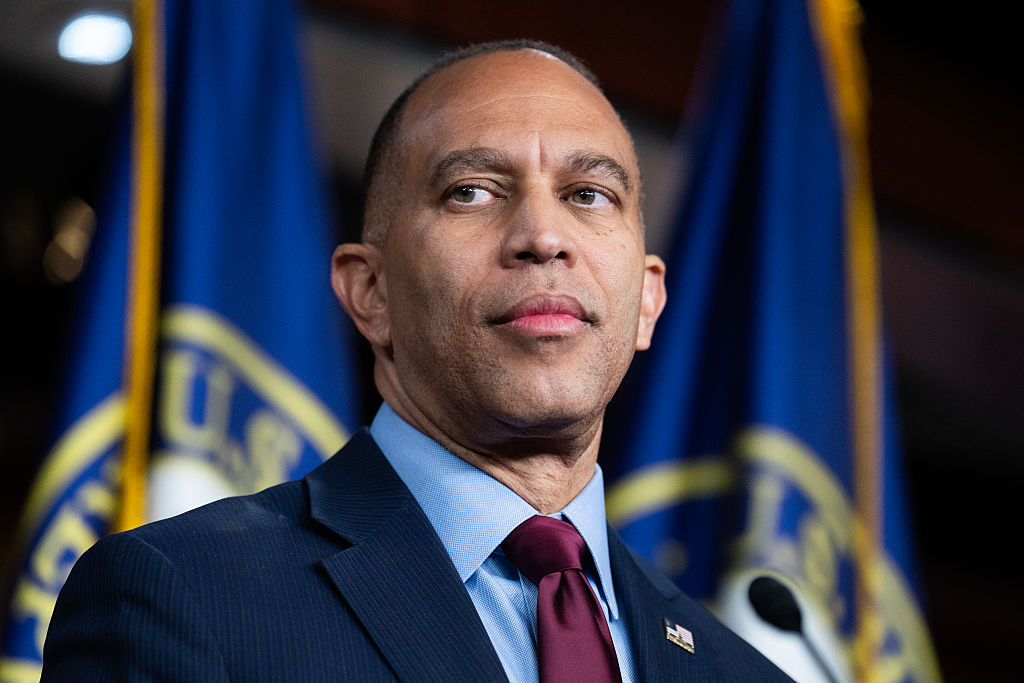
Socialists grappling with increasing power in government have to think long-term about how to create the conditions where a majority of House Democrats can back a socialist speaker. (Tom Williams / CQ-Roll Call, Inc via Getty Images)
In the wake of the midterms, the entirety of left-liberal America was jubilant. Democrats won majorities in the House and Senate, outperforming even the most idealistic predictions. But it was not only the Democratic victories that shocked observers — it was the kind of candidates who won. Democratic socialists had their strongest showing of any election in recent history, winning 169 endorsed ballot measures and seats at the local, state, and federal levels — their strongest showing of any general election in recent history. And the wins by nonsocialist progressives and even many centrists affirmed an agenda championed by democratic socialists, centering economic populism, wealth redistribution, and universal health care.
But then a harsh reality set in: the near inevitability of Rep. Hakeem Jeffries as the next Speaker of the House, a result that seemed to fly in the face of the progressive results we’d just seen. On Wednesday, just eleven Democrats voted against Jeffries in an internal nonbinding vote, including a bloc of five newly elected democratic socialists, joined by two additional Democrats. In a statement on their decision, the no voters cited ongoing negotiations around “Medicare for All, stopping [Immigration and Customs Enforcment (ICE)] terror, getting money out of politics, [and] ending the genocide in Gaza.” Rep. Alexandria Ocasio-Cortez notably did not join the no votes.
Jeffries is decidedly not a leftist nor a progressive. He is a pro-corporate Democrat who defends Israel and readily takes American Israel Public Affairs Committee money and corporate money. How, in the face of such a resounding progressive message from voters, could there be no clear alternative?
It’s understandable that some on the Left might feel deflated by this outcome. But we can also see the speaker conundrum as exposing an organizing void in Congress, one that the broadly left-leaning forces that felt so heartened by the midterm results have to confront soberly: we simply do not currently have the power, leverage, or internal relationships to elect a speaker that reflects the mandate we just witnessed. Changing that reality will need to start with an honest evaluation of the conditions surrounding the speakership race.
Jeffries has spent years building up to this moment. The relationships he’s nurtured with his careful, deliberate style and results he’s delivered to the Democratic caucus — negotiating important earmarks for Democrats in a Republican-controlled House, leading a multistate campaign to neutralize Republicans’ gerrymandering efforts, and steering increasingly large fundraising hauls to the Democratic Congressional Campaign Committee — were all leading to this moment. Any challenger, particularly one from a rising Left that is at its very beginnings in the halls of power, would be at a massive disadvantage.
Not only that, but any defectors willing to stick their necks out to back an alternative would be putting a target on their back, as Jeffries plays a key role in committee assignments and setting the agenda for the floor. Asking our electeds to risk their ability to successfully carry out their jobs and advance our priorities would be irresponsible without a viable path to success.
Socialists grappling with increasing power in government have to think long-term about how to create the conditions where a majority of House Democrats can back a socialist speaker. The time to start building toward that outcome is now, in Democratic Socialists of America (DSA) working groups and organizing committees across the country. Our bench of socialist electeds needs to be deeper in a way that can build buy-in for our goals among the general public, and we need to continue the work of relationship-building with our existing socialist electeds.
Deepening our bench of electeds happens at every level of government and requires a clear-eyed assessment of what it takes to win races, which usually centers on an ambitious fundraising plan. Designated candidate recruitment organizers can begin by identifying prospective candidates and taking meetings now in anticipation of 2028; ideal candidates have preexisting ties to DSA or a labor union, direct organizing experience, a demonstrated commitment to advancing socialist policies, and a willingness to work collaboratively and meet regularly with chapter leaders once elected.
Creating buy-in and demonstrating the popularity of our agenda among the public requires frequent and honest communication with the public. Rep. Ocasio-Cortez excels at this, making the often opaque operations of Congress accessible to millions through social media. To elect a socialist speaker, we would need to launch a campaign early, educating the public on the mechanisms as well as the stakes of the speaker’s race and building consensus around a candidate. A successful campaign will put us in a strong position when it is time for members to vote, where we can flex our organizing muscle to exert pressure using all of the support we’ve built throughout the course of the campaign.
Most importantly, we will need to continue the work of building relationships with our bloc of socialist electeds across the country. This work is carried out by trusted organizing leaders in regularly scheduled group meetings. It necessitates strong interpersonal skills on both ends, including the ability to manage conflict healthily and negotiate. Chapters with maturing socialist coalitions should connect with the architects of more established programs to take some of the many lessons that have emerged over the years.
What distinguishes democratic socialists from other politicians is that strategizing and organizing don’t stop after election day. The project of building power is year-round and relies on the active participation of skilled organizers working with elected officials. In the past two weeks, Representatives-elect Claire Valdez and Darializa Avila Chevalier have organized canvasses of their constituents, asking them directly what they should prioritize in Congress and who they should back as speaker. This ongoing dialogue with constituents represents a new kind of strategy — one in which elected officials meet people where they’re at to continue the work of organizing outside of an electoral context, facilitating dialogue at the doors and creating trust and buy-in.
This is only a small piece of what it will take to win our agenda, but it is an important and meaningful step toward the kind of politics we should always be practicing: one that centers the needs of working people and ensures their voices echo in the halls of power.