The Rising Congressional Left Is Positioned Well
Hakeem Jeffries will be the next House speaker, a depressing fact for many angry at the Democratic Party status quo. But there is a strong case that the Left is well positioned for fights with Jeffries and the party establishment in the near future.
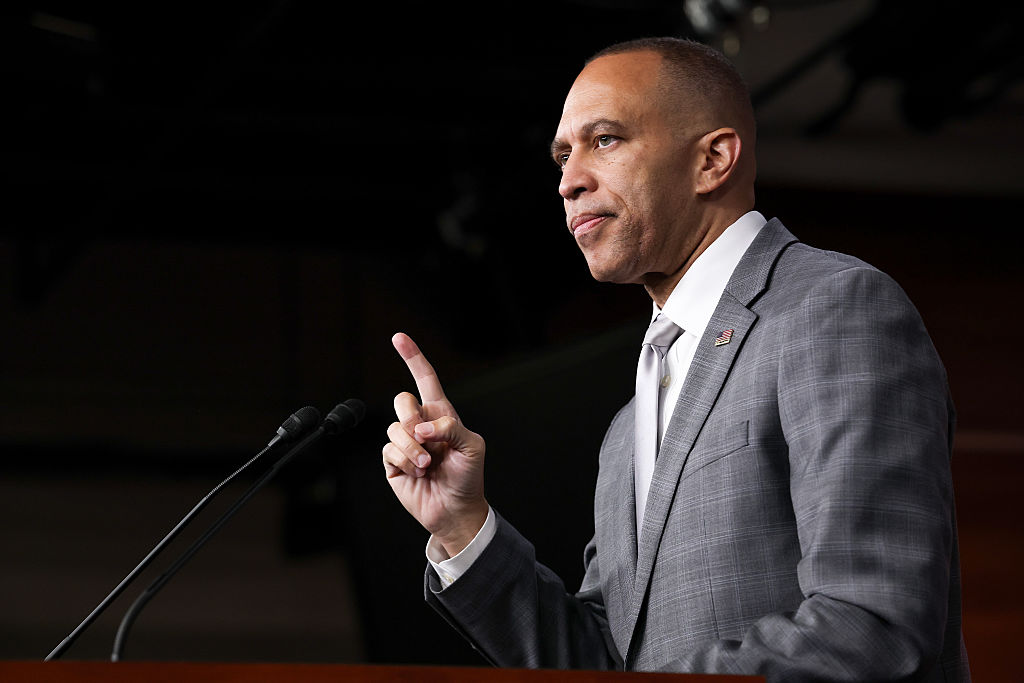
There is good reason not to swallow wholesale Democratic pro-corporate centrists’ triumphalism over Hakeem Jeffries’s election as speaker. He will have to keep a close eye on the forces to his left. (Anna Moneymaker / Getty Images)
In a bitter disappointment for the Left, Hakeem Jeffries — the vehemently pro-Israel Wall Street darling who once, bizarrely, did a version of George Wallace’s infamous “segregation forever” speech, only subbing in “Israel” for “segregation” — will be the next speaker of the House of Representatives. The vote wasn’t even close: 251–11, with two members abstaining, something Jeffries’s allies are already celebrating as a sign of his domination of the Democratic caucus.
Going into this election, the members of the expanded Squad — the twenty or so progressives and socialists elected to Congress who may or may not now be known as “The Bloc” — viewed the two years between now and 2028 as a vital, possibly final, chance for Democrats to deliver some actual results for working people and avert future political disaster. Jeffries’s ascension to the speaker’s gavel drastically reduces the chances of that happening.
That’s the pessimistic way to look at it, at least. There is also a rosier perspective.
But to start with, there’s a lot to be pessimistic about. Hakeem Jeffries is a champion of political and economic elites. He and the rest of the House leadership are largely funded by the exact industries — finance, defense, health insurers and pharmaceuticals, the crypto industry, and firms like Palantir — that are militantly against the kind of change that people voted his party into power to see.
His ambitious agenda if Democrats won was to reverse a handful of policies Donald Trump had enacted last year, including ending the Iran war, and simply bring us back to the intolerable status quo ante that produced Trump’s election in the first place. Jeffries is already punting on the budding plan to end the war by defunding it. He has refused to commit to even holding a vote on US aid to Israel, putting him at odds with not just a large supermajority of his party’s own voters but most of the American public.
Jeffries is, in other words, an embodiment of everything people do not like about the Democratic Party, which is more or less what incoming Ohio Rep. Don Leonard told him in a closed-door meeting, a sentiment Jeffries apparently gets. Upon telling the speaker-to-be to his face that his name was “synonymous” with the “low quality” of today’s Democratic Party brand, Jeffries, according to Leonard, nodded.
Socialists and progressives did not even try to mount a challenge to Jeffries, seemingly confirming fears that the blowout margin of the Democrats’ midterm win would, paradoxically, produce a more conservative outcome by shrinking the Left’s leverage. The party’s left-populist wing made the calculation that Jeffries simply had unassailable numbers, thanks in no small part to his lockstep support from the powerful Congressional Black Caucus (CBC), which views the history-making aspect of the first black House speaker as critically important, regardless of that speaker’s actual politics.
Some progressives have also pointed to the lack of viable (or really, any) challenger to Jeffries to explain the failure to move against him, which is partially true. They still could have tried to muster enough members to oppose him that it would make his eventual path to the speakership (for which the actual, full House vote will take place next year) more difficult and eventually wring concessions out of him, as the GOP’s Freedom Caucus did to Kevin McCarthy three years ago.
The counterargument to this is that Republicans in 2023 had a far slimmer majority than the Democrats will have — just nine seats, compared to the Democrats’ eighty-five seats and counting next year — and that they did this on the back of a GOP midterm performance widely viewed as a flop compared to the Democrats’ historic overperformance this year, which Jeffries’s allies like the CBC wasted no time in crediting him personally with.
In any case, the party’s left bloc — which, of course, is still getting its bearings and hasn’t even been sworn in yet in Congress — decided the slim chances of rolling Jeffries wasn’t worth the risk of drawing his ire. The strongest, “steel man” argument for this is that they have done something similar to Zohran Mamdani in New York, who likewise calculated that, given his relatively weak position as a newly elected insurgent mayor, there was no plausible pathway to challenging centrist Democrats in New York, and he would be more successful if he avoided spending political capital on what he viewed as a suicide mission.
That decision saw Mamdani effectively quash a Democratic Socialists of America (DSA) primary endorsement against Jeffries last year, both to keep the powerful Democratic leader out of his hair as he got his nascent mayoralty going and because he assessed that such a challenge could not win, and ally himself with centrist governor Kathy Hochul, betting he could accomplish the kinds of legislative victories he needed to succeed as mayor by cozying up to the governor (who holds significantly more power across multiple fronts) than by antagonizing her. Both of those proved to be successful bets for Mamdani.
We’ve gotten some idea of what the consequences for crossing Jeffries could look like from Leonard, who last week revealed party leadership had threatened to make him lose reelection in two years time if he didn’t get behind the Brooklyn Democrat. Other than Leonard, from what we know so far, the others who voted against Jeffries were almost all socialist freshmen in safe blue districts — or, in the case of incoming Reps. Frederick Haynes III and Adam Hamawy, Medicare for All–supporting progressives in safe blue districts.
In other words, the votes against Jeffries are from members who have nothing to lose and in fact could benefit politically in the long run from going on the record opposing someone expected to be a disappointing speaker.
By one view, this failure to block Jeffries will be fatal to the party and to any hope of it pursuing a pro-working-class agenda. Shortly after the result, Corbin Trent, cofounder of Justice Democrats and former staffer to both the Bernie Sanders presidential campaigns and Alexandria Ocasio-Cortez, had told me his fears that the Democrats would fail “if the same people who drove this bus of the party into the hands of Donald Trump twice” stayed in place, meaning Jeffries and his Senate counterpart, Chuck Schumer. Trent has spread that message elsewhere, including on Fox News, where he appeared to not-so-subtly prod his former boss, Ocasio-Cortez, to be more outspoken in this fight, saying that anyone planning to run for president in 2028 “should be voicing up now.”
As a number of incumbent and incoming left-insurgent lawmakers told me in the process of reporting a forthcoming In These Times piece on the midterm result, a Democratic failure to deliver results, or even to appear to be trying to deliver them, could spark another Obama era–like mass disillusionment that could end up empowering someone much worse than Trump not far down the line. According to the pessimistic view of where things currently stand, we are well on the way to that future right now.
But again, that’s not the only way to assess what happened here.
Jeffries Isn’t Out of the Woods
There is good reason not to swallow wholesale the corporate center’s triumphalism over the vote margin, which the corruption-tainted Rep. Henry Cuellar gloated showed the opposition to Jeffries is just “a small number of votes that are marginalized” and that “this small little group cannot tell the caucus where we need to be at.” Those reasons go beyond the fact that some version of this line is what this crowd has constantly been telling themselves as their grip on the party has slowly faded the past ten years.
In advance of the vote, Jeffries had already moved on his initial, tepid program of Trump reversals by publicly endorsing Bernie Sanders’s Medicare expansion plan over the weekend. Sanders’s proposal — lowering the Medicare eligibility age to fifty-five, including dental, vision, and hearing in the program, and covering all children with it until they turn nineteen — was not something any Democrat brought up or ran on during the midterms. Yet Jeffries’s adoption of it means it’s quickly becoming a consensus position among both the Democrats’ populist and corporate wings since the Vermont senator first brought it up two days after the election.
This would not be a minor reform. It would extend free public health insurance to 3.45 million adults and anywhere from four–seven million kids, depending on exactly how many children are thrown off health insurance in the years ahead by Trump’s Medicaid cuts. It would go much further than the Medicare-related parts of Joe Biden’s popular but never-passed Build Back Better bill, which merely added hearing to the program’s coverage, and would go a long way toward alleviating voters’ cost-of-living concerns, since health care is one of the biggest, most stress-inducing, and sometimes life-ruining costs anyone can deal with in today’s United States.
Left-insurgent lawmakers view the next two years as a unique opportunity: either they pass something that Trump actually ends up signing into law, making good on their election promises and tangibly making voters’ lives better, or Trump vetoes a bunch of things they pass, letting them make the argument to voters in 2028 that they need a Democratic president in the White House. If Jeffries’s movement on this matter holds, it will put socialists and progressives in a decent position to actually pursue this strategy.
Meanwhile, the fact that Jeffries has moved suggests he’s more vulnerable than the numbers today make it seem. Jeffries has, incredibly, a worse approval rating than outgoing Republican House speaker Mike Johnson, and while he at least gets overall positive marks from Kamala Harris voters, liberals, and Democrats — three of the paltry four groups he’s not underwater with — he gets them just barely, unable to muster majority support from any of those three.
More worrying for Jeffries, his congressional district, New York’s 8th, where he will have to contest a primary election in just two years’ time, is deep in DSA territory, in a state and city where the socialist organization has emerged over the past year as a leading political power.
To its immediate north is the 7th district, where DSA member and Mamdani ally Claire Valdez (who just voted against Jeffries) easily bested the Brooklyn borough president for the seat, and at whose watch party DSA members chanted “You’re next!” when Jeffries came on the screen. Bordering its panhandle to the west is the heavily Jewish 10th district, where another Mamdani ally, Brad Lander, comfortably ousted one of the Democrats’ most well-financed and most ardently pro-Israel members of Congress by taking direct aim at his unconditional support for Israel’s genocide. A little further up, and you get to the kingdom of another Mamdani ally and DSA member, Ocasio-Cortez, who eight years ago made her 14th district the final resting place for the career of a different corporate Democrat once tipped to be a future speaker.
In other words, for the sake of his career, Jeffries has to watch his left flank for the next couple years. A misstep, or a series of them, where he ends up looking like the singular roadblock to Democrats’ progressive ambitions, will be a weakness that a future primary challenger will eagerly exploit.
Piling on the pressure is the fact that next year’s Democrat-led Senate is now looking like a far more progressive chamber than usual. Besides Sanders, the country’s most prominent and well-liked socialist, it will feature three of his endorsees (Abdul El-Sayed, Troy Jackson, and Peggy Flanagan), all of whom campaigned on Medicare for All, and sixteen others who — however disingenuously — endorsed Sanders’s legislation on the program last year, as well as one other — Ron Wyden — who has come around to the idea in the past year, and vowed to use his coming chairmanship of the Senate Finance Committee to push through an expansion of the program.
It’s notable that the bold idea to risk a government shutdown in order to force Trump to end the Iran war originated from the Senate, and so far has the sign-on of not just Sanders and Chris Van Hollen — who has spent the past twenty-two months courting progressive support for a potential 2028 run — but centrists Michael Bennet and Tammy Duckworth. It’s notable, too, that Jeffries felt he had to go along with the Medicare expansion proposal, another progressive idea that came out of the Senate.
What happens in the Senate majority leadership race could intensify this dynamic. If Schumer — who is more vulnerable than Jeffries and underwater with the left-leaning demographics that still give the future speaker a slim positive approval rating — really is replaced by the more progressive Van Hollen, it may add further pressure on Jeffries, given that he can’t politically afford to look like he’s stymieing the party’s agenda or undermining its resistance to Trump.
None of this is guaranteed, and it’s possible in a few months to a year, this will all read as wildly overoptimistic.
But the opposite, pessimistic case isn’t guaranteed either, and there are reasons to think that the Democrats’ populist wing of socialists and progressives has cards it’s yet to play, as it once more thanklessly drags the party into saving itself. Jeffries’s victory yesterday is certainly a blow for the Left. But it’s not out of the question that in hindsight, it looks more like losing a battle while winning the war.