Socialists Are Out-Organizing the Democratic Establishment

The Democratic establishment’s hysteria over the Democratic Socialists of America’s organizing methods has it exactly backward: the Democratic Party has almost no ability to democratically organize voters, while DSA is reviving grassroots campaigning.
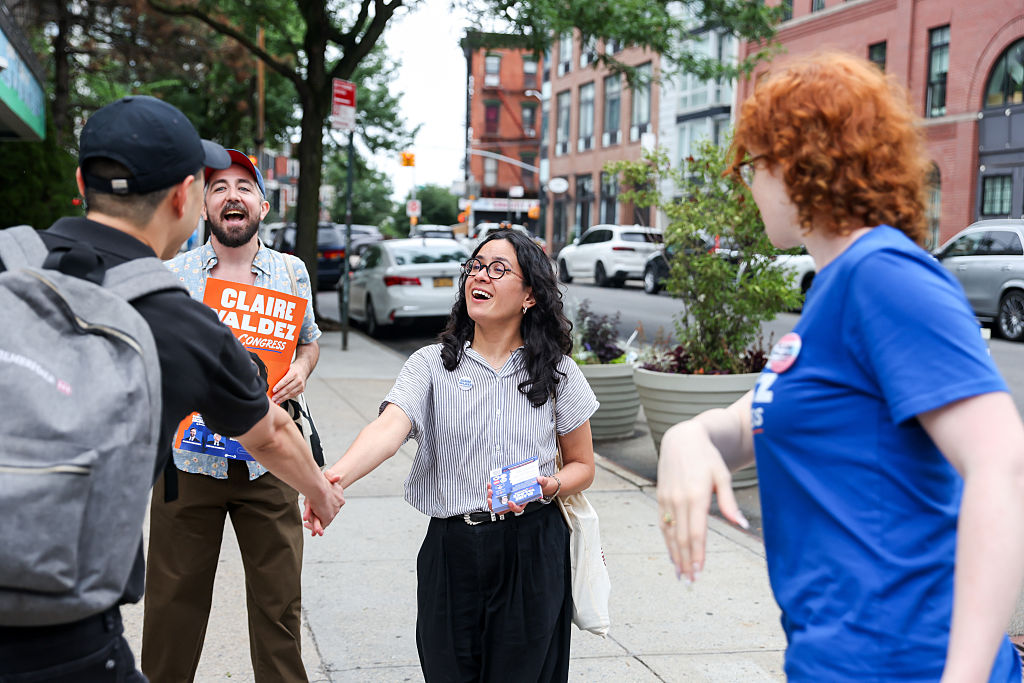
State Representative Claire Valdez, a Democrat from New York and US House candidate, center, speaks with voters outside a polling location at PS 84 during a primary election in New York City on Tuesday, June 23, 2026.

Much Democratic establishment whining about socialists accuses the Left of dark, underhanded methods. The opposite is true: socialists are winning because of a commitment to democratic organizing that centrists are unwilling or unable to do. (Michael Nagle / Bloomberg)


In the weeks following the resounding electoral victory of the New York City Democratic Socialists of America (NYC-DSA) this past June, the Democratic establishment’s complaints appeared right on schedule. This time, in addition to the expected accusations of radicalism, antisemitism, and, of course, anti-Americanism, came a new line of attack: the organization is taking advantage of the Democratic Party.

Former Democratic National Committee chair Jaime Harrison, best known for twice setting new election campaign spending records only to lose both times, had this to say:

If you hate the Democratic Party, then please don’t run for our nomination. Don’t use our resources. Don’t rely on our volunteers. Don’t use our infrastructure. Don’t ask Democrats to invest their time, money, and energy in your campaign. Focus on building the party you actually support. Political parties aren’t perfect, but they’re built by millions of people who knock doors, make calls, organize meetings, and fight for the values they believe in. If you don’t believe in the party, then don’t ask its members to carry you across the finish line.

For anyone who has experienced working with the Democratic Party, some confusion is more than justified. Which volunteers does Harrison refer to? And what infrastructure?

Does he mean the few software resources that NYC-DSA campaigns pay to use (and face frequent delays and interruptions using)? Or maybe access to ActBlue, the Democratic fundraising platform? I struggle to think of any national or local Democratic organizations we could plunder for volunteers.

In fact, Harrison’s descriptions of “people who knock doors, make calls, organize meetings, and fight for the values they believe in” is a far more fitting descriptor of NYC-DSA’s electoral program than anything to be found among the Democratic Party’s establishment and its elected officials and candidates.

In this critique, DSA’s success running on the Democratic ballot line is commonly framed through the metaphor of “parasite and host,” recently by the Atlantic’s James Kirchik. The comparison, however, rests on the assumption of an organism that can be preyed upon.

At the state level, where NYC-DSA has found most success, it is unclear what the party, whose weak efforts in 2022 arguably caused Democrats to lose the House, could offer. And Harrison’s diatribe implies an easily susceptible voter base who have been duped by hateful actors. Nowhere do these polemicists against socialism ever admit the possibility that thevoters themselves may have made a decision to support NYC-DSA candidates, based on agreeing with those candidates on the issues.

This casual disregard for the general populace is what many in NYC-DSA’s Electoral Working Group consider a key point of divergence from the mainstream establishment. The project was born not through lack of access to large donor checks (although that does play a part) but instead a desire to build a political system that is in fact, genuinely small-‘d’ democratic.

The core of this is that, to quote NYC-DSA cochair Grace Mausser, “volunteers [are] the centerpiece” of these campaigns. Staff provide the infrastructural support and consistent presence to build a volunteer program so that anyone from the community can walk into a campaign office and not only have their voice heard but become an active player in setting the political direction of that campaign. As a result, these campaigns do not simply reflect communities but actively construct them.

This is in stark contrast to the traditional methods of Democratic campaigns. As Tascha van Auken, one of the architects of NYC-DSA’s electoral program, told Jacobin: “You can talk to people who’ve worked on run-of-the-mill, mainstream campaigns outside of DSA; the culture is really bad. People don’t feel respected.” In these campaigns, door-knocking and other voter contact is seen as irrelevant, a sideshow; television and digital advertising are considered the campaigns’ main functions.

This situation benefits consultants while leaving those without the means to donate the increasingly enormous amounts required to run an ad-heavy campaign out in the lurch. As a result, working people become further removed from those that seek to represent them; increasing levels of mediation contribute to a political culture that is alienated from anyone but the very wealthy, who are able to access politicians in person, not just through a screen.

This leads to the Democratic Party as it exists today, out of step and out of contact with its voter base. In this environment, NYC-DSA’s electoral project has the opportunity not simply to score some victories but to build the kind of organizing networks that will be necessary to create the just and equitable society that we envision.

This is not an easy feat, as the Electoral Working Group discovered this year in coordinating across many overlapping campaigns: creating cohesive messaging, field programs, and downballot door-knocking that does not leave any candidate underrepresented is extremely difficult work.

In particular, our campaign for Claire Valdez in New York’s Seventh Congressional District, required coordination across five insurgent state campaigns and a similar number of incumbents running for reelection. A typical Democratic party operation would have run these campaigns separately, with a party committee allocating resources (on a federal, state, or countywide level) and otherwise stepping back and letting staff run their operations or outsourcing to political action committees (PACs).

Instead, we did the hard legwork of making decisions across those campaigns that would benefit us all, resulting in a slate that won handily across Brooklyn and Queens. (Our single loss, Conrad Blackburn in Harlem, faced extraordinary outside spending and coordination challenges early on.) While congressional candidates more easily gain media attention, NYC-DSA’s approach allows those media appearances to function as an entry point, to learn more about downballot candidates and get involved in their races.

Among our campaigns, the level of skills acquired and practiced, along with the extensive spectrum of electoral work that numerous volunteers took part in, was humbling. In one assembly race, David Orkin’s, the candidate’s team filed a petitioning challenge against an opponent. The campaign staff encouraged volunteers — many of whom had never worked on an electoral campaign previously — to learn the ins and outs of electoral regulation, becoming experts in the procedures.

During this process, we came to a realization: we were not somehow “hacking” the country’s electoral system. On the contrary, we were the only ones actually doing the work properly, following the rules and regulations to the letter and winning without the help of billionaires, professional consultants, or connections to the judicial or electoral institutions.

NYC-DSA has never won a race simply by duping a shallow-minded electorate, as the commentariat would have you believe. Rather, we have consistently practiced the hard work of building a democratic coalition, a volunteer base, digital and physical infrastructure, and the institutional knowledge required to win elections and form a politically engaged populace. We did not steal these techniques from the Democratic Party, for there is nothing there to steal (if there ever was, it has not existed since 2008). The alliances we built, with working-class community organizations such as Desis Rising Up and Moving and CAAAV: Organizing Asian Communities, were built upon mutual trust that had to be won, not transacted.

The way campaigns are run can reflect the politics they aim to produce to the world. The professionalized campaigns considered the norm by the Democratic Party elites conceive of the voting blocs of their alliance as top-down bodies, where single voices can command distinct demographic blocs; these elites are the medium through which voters are reached.

I experienced this myself during a season working on a mainstream Democratic campaign. More than half a decade on, I cannot get out of my head the words of my boss, a consultant who ran field campaigns for mainstream Dems: “They’re going to do everything they can to avoid knocking doors.” With a field operation run on advanced surveillance rather than generosity, what message were they putting out to the world?

NYC-DSA’s campaigns are built on repetition of our smallest unit: the conversation at the door. Our society encourages isolation and seeing others either as potential dangers or potential consumers; with every conversation, our volunteers are not only helping the campaign achieve victory but breaking down the barriers that keep us apart. Our tight volunteer infrastructure program is not only a model for the future of left-electoral campaigns but a part of the path toward winning the world we want to build.

The Democratic Party’s alienation from their voters is both cause and effect of the party’s capture by elites. In its current form, it not only lacks large volunteer networks and infrastructure — it is fundamentally unable to create them. Doing so would require advancing a form of politics that would reconnect not only with the needs of working people but also with working people themselves. That would mean, essentially, becoming DSA.