Billionaires Always Want to Maintain Control
California’s billionaire tax was defeated this time. But Mark Zuckerberg’s deal with Meta in anticipation of Proposition 40 teaches us two things: billionaire wealth can be converted into cash, and tech elites value control even more than wealth.
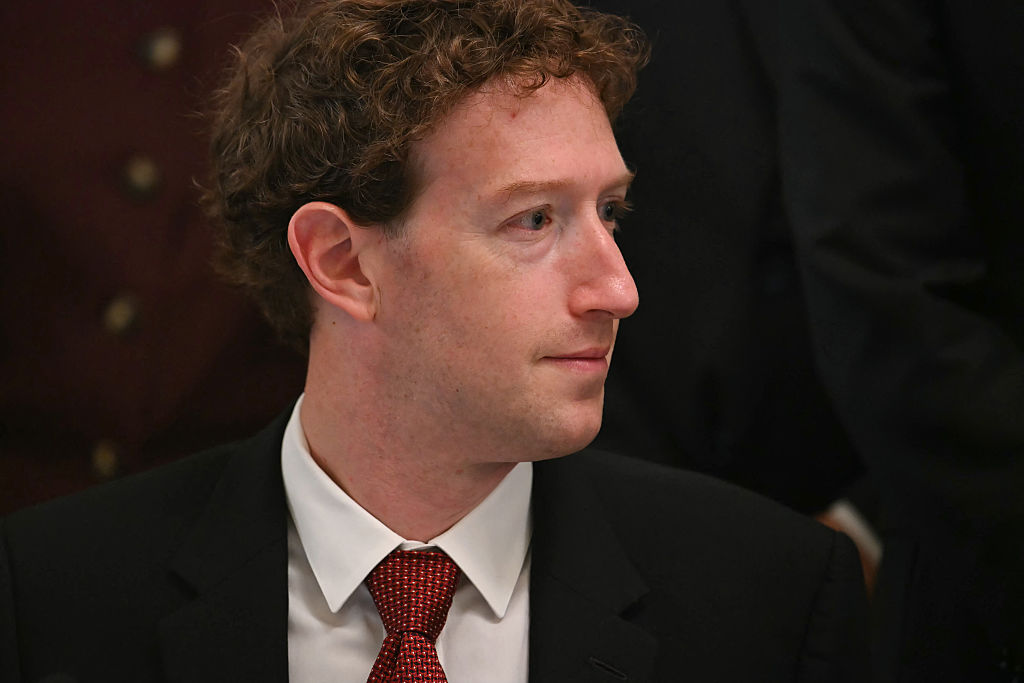
The Meta deal struck by Mark Zuckerberg in the face of California’s proposed billionaire tax can help us understand the obstacles that the movement to tax the ultrarich’s wealth faces, beyond even their massive spending against Proposition 40. (Kent Nishimura / AFP via Getty Images)
In October, Meta released a filing saying that Mark Zuckerberg had threatened to leave California in anticipation of Proposition 40, the billionaire wealth tax on the 2026 state ballot, which was defeated 53 to 47 percent. According to the document, Zuckerberg told the board he was “evaluating relocating his primary residence outside California,” and that any steps toward doing so, including listing his residential real estate on the market, “would be public and inevitably noted and commented upon by company employees.”
In response, the board quickly mobilized to negotiate a deal: Meta agreed to issue a new class of nonvoting (“Class C”) stock, which will be distributed to all shareholders in January 2027. This would have allowed Zuckerberg to sell his shares to convert a portion of his wealth into the billions in cash he would need to meet his potential tax liability, without losing his near-supermajority voting share. In exchange, he agreed to stay in the state for at least eight years and keep his $1 annual salary.
Conveniently, the new stock will also allow Meta to raise capital for artificial intelligence investments without changing the decision-making composition of the company. In the fallout of the proposition’s defeat, it’s useful to reflect on what the Meta deal can help us understand for the long-term movement to tax the ultrarich’s wealth.
What Proposition 40 Was
Prop 40 was designed as a onetime 5 percent tax, payable over five years, on the net worth of California residents with over $1 billion who lived in the state as of January 1, 2026. The proposition was written by legal and economics faculty and introduced by the health care workers’ union Service Employees International Union-United Healthcare Workers (SEIU-UHW). The goal of the tax was to raise around $100 billion, which would offset roughly 90 percent of the federal budget cuts to health programs, including Medi-Cal, since the beginning of the second Trump administration — and in particular, since the passing of the 2025 “Big Beautiful Bill,” which takes effect this January.
According to research by economists Emmanuel Saez and Gabriel Zucman, California’s billionaire wealth reached around $2.3 trillion by mid-2026, which is roughly equal to the total income reported by every Californian in a year. This wealth is both extremely concentrated and recent: it’s increased by 144 percent in just three years. The approximately 250 billionaires who would qualify only pay about 0.2 percent of their wealth in California income tax each year, representing 2.4 percent of total California income tax revenue. The four richest billionaires, Larry Page, Sergey Brin, Mark Zuckerberg, and Jensen Huang, pay only 0.07 percent of their wealth.
If Proposition 40 had passed, it would have been the first tax of its kind and the culmination of decades of advocacy by policymakers and researchers across the world working to expose how dramatically economic inequality has grown and the degree of billionaires’ tax avoidance. This is particularly salient in California, the fourth-largest economy in the world and home to fifty-eight of the Fortune 500 companies. Companies in the Bay Area alone represent 35 percent of the market cap of the world’s top hundred companies. This makes the state an ideal place to experiment with taxing the ultrawealthy.
Why It Failed
The initiative failed for myriad, well-documented reasons. Primarily, it faced a concerted and incredibly well-funded opposition campaign. Its opponents, mostly ultrawealthy donors, spent $378.4 million against the measure (compared to the yes campaign’s budget of $33.5 million). Google cofounder and Donald Trump supporter Sergey Brin alone donated $102 million, and also funded two additional Propositions (41 and 42) designed to block the tax if it passed. California Governor Gavin Newsom opposed the measure and endorsed Proposition 42, stating, “Wealth is movable, and it shops for the state with the lowest taxes. The fight belongs at the federal level.”
According to Rigel Robinson, former Berkeley city councilmember and Democratic public policy consultant,
It would be a mistake to see the electoral outcome of Proposition 40 as a clear rejection of its goal from voters. There was the enormous and well-funded opposition campaign, and competing and confusing ballot measures designed to nullify the measure. Proposition 42, which was put on the ballot to prevent Proposition 40 (and future versions of it) from taking effect even if it did pass, was sold to voters as a protection for retirement savings.
However, in California and across the country, candidates won on a message of seizing power from billionaires and championing affordability. In many ways, this is the sort of message Bernie Sanders tried to bring to the Democratic agenda a decade ago.
Voters across the country have demonstrated that redistribution and economic justice are clear priorities, and we cannot let the outcome of this proposition diminish the ground won.
There were also concerns about the legality and mechanics of the legislation — in particular, that it was introduced as a onetime proposition, was not national, and was technically a retroactive tax, since it applied to anyone living in the state as of January 2026. And as Fred Glass explained in Jacobin, California’s labor and progressive forces were unable to form a unified front in support of the measure.
While disappointing, it’s helpful to historicize the initiative and the broader movement to tax the assets of the ultrawealthy alongside other fights for redistribution. The federal income tax, for example, took several attempts before successfully passing. It took the Sixteenth Amendment passing in 1913 to make it permanent. SEIU-UHW has already said it plans to try again in 2028, and Bernie Sanders and Ro Khanna have introduced a bill at the federal level this spring.
Billionaire Wealth Is Money Today
From the Meta deal, we can learn two things. First, it is possible for tech leadership to convert their wealth into liquidity. One of the most persistent arguments against taxing the ultrawealthy is that their money isn’t “real,” since it’s mostly in shares of companies whose value rises and falls with the market. Because of this, it shouldn’t be treated as income.
Stocks are legal claims on future production whose prices are set by expected returns. It is not uncommon for the companies who issue them to have not yet produced anything profitable or concrete. SpaceX’s shares were the most valuable in history at the time of their initial public offering (IPO), even though its AI division had lost $2 for every dollar of revenue it earned in 2025.
In other words, a stock is a title of ownership to a slice of the surplus value a company will produce. In the Marxian sense, this is an example of fictitious capital and inherently speculative. However, “speculative” does not mean unreal. As Dimitris P. Sotiropoulos, John Milios, and Spyros Lapatsioras write in A Political Economy of Contemporary Capitalism and its Crisis: Demystifying Finance, fictitious capital is not detached from real production but a necessary phase within its totality, and claims on future income can become commodities in their own right. These can be traded, priced, and converted into money at any time. A stock is not just a promise of future wealth; it is wealth (and command over the labor of others) today.
Modern finance for the AI sector also has a remarkable capacity to innovate and reinvent itself, and the financial engineering to create the Class C share is another demonstration of the sector’s remarkable capacity to adapt to secure endless capital for the AI rush.
Another Front of Contestation
Second, tech executives are most concerned with losing control of their companies. As economist and tax expert Gabriel Zucman told me, “the existence of super-voting shares and the Zuckerberg and Proposition 40 episode more generally highlight that what matters most to billionaires, even more than their wealth, is their power to exert control over the giant businesses they own. This is indeed their greatest power.” He also commented on X that the opposition to the wealth tax could not be driven by concerns about losing money, since the onetime 5 percent liability would “merely bring billionaire’s fortunes back to where they stood a few weeks ago, at the beginning of September.”
Meta is not an isolated case, and a dual-class share system (which allows companies to sell shares to the public, while a small group keeps most of the votes) has been on the rise. When SpaceX went public, Elon Musk floated only 3–4 percent of the company and retained 42 percent of its shares, but 85 percent of its voting share through his “super-voting stock.” Anthropic’s IPO includes five types of stock, which specifically gives the cofounders the ability to keep a say over the controlling vote even if they give away 98 percent of their shares. The most valuable companies in the world are increasingly owned by a handful of individuals insulated from markets, shareholders, and other public mechanisms of accountability.
As Fred Glass wrote, Proposition 40 is a lost battle, not a lost war. Amid the manufactured panic over the tax, Zuckerberg seized the political moment to negotiate a deal with his company. The outcome of their agreement deepens our understanding of how to anticipate and oppose the coordinated class response against taxing extreme wealth. First, the shares of future value held by tech billionaires are not just abstractions but real money today, necessary to the current cycle of reproduction. And second, billionaires will fight hardest to protect not their fortune but their control.
The Left’s political project has to include a new front of contestation beyond fighting for shares of the returns tech companies produce. Countering the enclosure of the AI economy will require reclaiming democratic control over the infrastructures of this intelligence in the first place.