SpaceX’s IPO: Enriching the Few, Harming the Many

Investors and Elon Musk insiders have captured the massive gains of SpaceX’s record-breaking IPO, while ordinary households are left holding risk they never chose to take on — and facing the downstream consequences of extreme inequality.
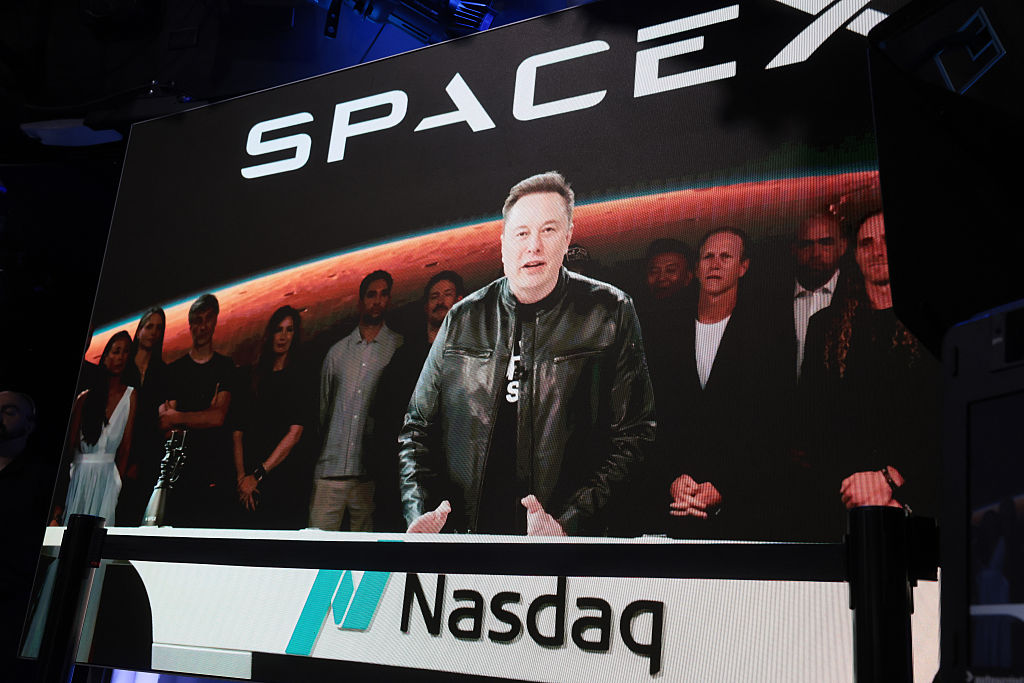
Elon Musk, founder and CEO of SpaceX, speaks via video before the ringing of opening bell at the Nasdaq Marketsite at the launch of the company’s initial public offering (IPO) on June 12, 2026, in New York City.

SpaceX’s IPO is evidence that modern finance has become extraordinarily effective at concentrating massive rewards upward, transferring risk downward, and exacerbating inequality under the guise of “progress.” (Spencer Platt / Getty Images)


On June 12, Elon Musk’s company SpaceX went public. The company was the largest initial public offering (IPO) in history, hitting a public market valuation of $2.1 trillion and becoming the sixth-most valuable US firm overnight, later rising even higher to fourth. As of now, SpaceX has raised nearly $86 billion, or triple the size of the previous IPO record of commerce company Alibaba’s in 2014. Musk became the world’s first trillionaire, more than four thousand current and former SpaceX employees became millionaires, and over twenty institutional investors held stakes worth more than $1 billion.

This is despite the company accumulating a $4.9 billion net loss last year and more than $41 billion in losses since its founding. Roughly $75 billion of the firm’s balance sheet represents a Trojan horse of debt inherited from xAI and X, other companies owned by Musk that he transferred onto SpaceX’s books just a few months before the IPO. For every dollar of revenue the AI segment earned in 2025, it lost two dollars. To use finance industry metrics, SpaceX shares currently have a price-to-earning ratio of -61.09 (compared to an industry average of 11.51).

The scale of the SpaceX IPO is not the result of the free market’s boundless possibilities or remarkable feats in innovation but a complex, sophisticated initiative in financial engineering and upward wealth redistribution. The deal was structured, at every level, to let financial insiders and longtime Musk supporters capture the gains and exit well before the valuation has a chance to come back down to Earth, while ordinary households are left holding risk they never chose to take on and facing the consequences of deepening inequality.

What Is “SpaceX”? 

As of recently, SpaceX has been organized around three operating segments. The first is Starlink and Starshield, which launch satellites to provide broadband internet access and communication services for defense. With around ten thousand satellites in orbit, Starlink is the company’s most profitable operation, but it faces significant technical and regulatory challenges if it hopes to scale to the size Musk envisions.

The second segment is the actual space part of the company, which designs and launches rockets. Much of its future depends on Starship, a reusable launch vehicle that is still in development. The third is xAI, which, following Musk’s all-stock acquisition of X, comprises the social media platform (and advertising business), Grok (the infamous chatbot), and AI data centers. In Elizabeth Warren’s words, “Elon Musk got into a room with Elon Musk and negotiated how much the merger should be worth.” xAI is hemorrhaging money (it lost $6.4 billion last year alone) but also represents the company’s biggest bet.

Mired behind far-fetched declarations of Mars colonies and free shuttles to the moon, SpaceX’s primary plan to live up to its valuation is actually “orbital AI infrastructure.” Data centers, which train and run inference for AI models, are the most environmentally and financially intensive part of the technology. Musk wants to address this by creating a constellation of up to one million satellites in space that would run AI workloads on solar power.

Based on the roadblocks faced by Starlink so far, researchers have concerns about both the complexity and scale of this endeavor. Rice University physics professor Doug Natelson said the centers made “no sense to him” and called them “magical thinking.” But questions of scientific feasibility, economic viability, and social priority (do we even want a military contractor to build gravity-less data centers when millions of Americans struggle to pay for food and gas?) seem to be cast aside.

The Unique Financial Engineering of the SpaceX IPO 

Historically, a new public company has to prove itself for months, sometimes years, before it is added to a major stock market index fund. Index funds, which are a type of passive “autopilot” investor that automatically tracks a particular index, are then obligated to purchase the stock. Musk negotiated for an unusually rapid path to index inclusion. The Securities and Exchange Commission (SEC) agreed to waive this consumer protection requirement, and two major indexes, the Nasdaq-100 and the Russell fund, compressed their timeline to only fifteen days (the S&P 500 declined).

This means that by July, the funds will be required to buy SpaceX shares regardless of valuation. This will directly expose millions of American stockholders and pension holders to the company’s volatility while manufacturing $22–27 billion worth of automatic demand in the stock market.

On top of that, Musk only floated 3–4 percent of the company publicly, keeping the vast majority of shares for himself or other insiders who are locked up and unable to sell (a standard rule for those who purchase parts of a company pre-IPO). He also rewarded longtime supporters (which Mihir Desai, a Harvard Business School professor, has called his “financial cult”) by allocating around 30 percent of the offering to retail investors, around three times more than usual. These shareholders are less likely or able to sell or short the stock compared to their institutional counterparts (e.g., hedge funds).

All in all, this creates scarce supply and forced demand. The sellers will outnumber the buyers for quite some time, and stock prices won’t fall when or if they should. This extends the runway for the buyers who got in early and will enable them to sell while the automatic index fund purchases are still insulating the value from coming back down to Earth. In the meantime, a large part of American’s pension accounts, retirement savings, university endowments, and more will be tied to SpaceX’s long-run value.

Also notable is Musk’s outsized control. He retained 42 percent of the SpaceX shares and 85 percent of voting power through his “super-voting stock.” Experts have said they “have never heard of” a structure so concentrated and called it “insane.” In comparison, the second largest owner is Valor Management, a venture capital firm belonging to Fidelity Investments (which coincidentally also lowered its risk management requirements for the IPO for retail investors) at 3.8 percent.

Usually for an IPO, there is also no price or size range to allow market forces to have flexibility on the day of public valuation, but Musk decided SpaceX would sell its shares at $135 no matter what. In other words, take it or leave it. When SpaceX released its filing documents last week, revealing the $75 billion in old debt from xAI and X, investors got an early taste of what exactly this could mean.

Circular Financing 

The filing documents also revealed the extent of the circular financing between SpaceX and its peers that characterizes the AI sector and makes its actual value even more difficult to determine. Anthropic pays SpaceX $1.25 billion per month through May 2029 (or $15 billion per year) for access to computing capacity, particularly for SpaceX’s supercomputer data center Colossus in Memphis, Tennessee (which, at its peak, uses over 5 million gallons of water per day), and for over 220,000 GPUs from Nvidia. It plans to invest in Musk’s space data centers. Google has signed on to pay $920 million a month, also through 2029, for access to computer resources and 111,000 GPUs. In theory, both companies are direct competitors to xAI, but due to the insatiable need for computing resources, they are also financing the infrastructure on which SpaceX’s AI ambitions depend.

Days after its IPO, Musk used the shares to buy a “direct competitor” to OpenAI and Anthropic, Cursor (a platform that also lets users toggle between models), for $60 billion. Anthropic and OpenAI are also preparing for an IPO in 2026. Here is a central contradiction: the same firms increasingly compete with one another while also funding, supplying, and selling to each other in an enclosed loop. The result is an interconnected web of mutually reinforcing capital.

Then there is Wall Street. The banks underwriting the IPO collected $500 million in fees and then were given the right to purchase additional shares through what is known as the “greenshoe” option. Goldman Sachs and Morgan Stanley got the biggest slice in this deal and bought $8.3 million more shares a few days later, which increased the initial IPO value by $10 billion. While greenshoe arrangements are relatively standard, the scale was extraordinary. In the words of a Wells Fargo representative, banks see this deal as the opening of an “AI-driven capital markets supercycle” and a “wave of sizable IPOs to come.” Goldman Sachs and Morgan Stanley also hold leading positions for the anticipated Anthropic and OpenAI IPOs. Investment firms will continue to serve as architects of the AI gold rush by facilitating massive financial transactions, creating innovative vehicles, and providing liquidity for this self-fortifying AI financial structure.

Progress for Who? 

To Elizabeth Warren, this IPO has “enough red flags that it should stop anyone.” Mainstream coverage glorifying the SpaceX welder or cafeteria worker who became millionaires overnight, or lauding Elon Musk as a genius visionary and incomparable salesman, are doing critical ideological work to sell the IPO as evidence that, in America, anyone who dreams and works hard enough can win.

In reality, SpaceX is just evidence that modern finance has become extraordinarily effective at concentrating massive rewards upward, transferring risk downward, and exacerbating inequality under the guise of “progress.”