Britain’s Military-Industrial Complex Is Promoting War Fever
Senior figures from Britain’s armed forces, serving or retired, are openly intervening in national politics to demand a massive increase in military spending. The media rarely mentions their ties to private firms that stand to profit from the bonanza.
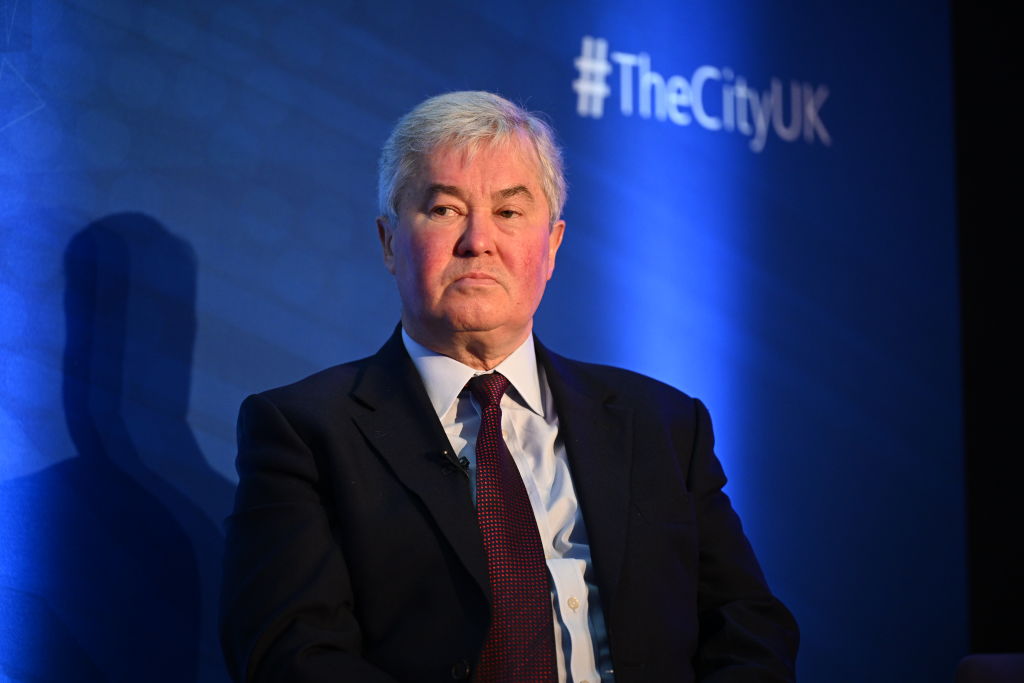
The former commander of the Joint Forces Command, Sir Richard Barrons, has frequently made media appearances in the last twelve months. This year, he has been arguing publicly for substantially higher UK defense expenditure, with an extra £10 billion a year. (Leon Neal / Getty Images)
War fever has gripped the European political establishment. War in Ukraine and rumors of continent-wide conflict with Russia are now the staple justification for rearmament, ballooning arms budgets, and the reintroduction of conscription across Europe.
Popular consent for this lurch to militarization is very limited indeed, so the political establishment is deploying military and security service officers, past and present, in an unprecedented propaganda blitz to make the case for war. Astounding statistics underline how far this process has gone.
In the last twelve months, there have been approximately nine hundred appearances by serving or former military or security service officers on Britain’s mainstream media. That’s roughly seventy-five contributions every month, or seventeen a week. The figure would be much higher if pro-war politicians were included.
In other words, the military and the secret services have been broadcasting on, or writing in, British media outlets more than twice a day, every day, for a full year.
Khaki Media
Let’s look at some specific cases. Former Air Vice-Marshal Sean Bell alone has appeared multiple times, partly as a result of being employed as Sky News’ military analyst. His defense consultancy, rarely acknowledged, provides strategic defense advice to national and international clients, leveraging his senior Royal Air Force (RAF) experience — which included overseeing military contracts and projects with Saudi Arabia.
Sir Patrick Sanders, former chief of the General Staff, has appeared repeatedly in the last year, including on Channel 4 News and in The Times. He’s a defense adviser to Santander Bank and chair of strategic intelligence at Herminius.
Last year, the government Advisory Committee on Business Appointments had to issue a warning letter imposing restrictions on Sanders’s work. This was because it found that, in view of his military background, there was a “significant risk that he could offer Herminius unfair access and influence” should it or its clients “wish to influence policy decisions and/or work with government.”
Major General Rupert Jones, former Standing Joint Force commander, is a media regular, including serial appearances on Sky News. He is an adviser to Skyral, which builds artificial intelligence technology for the defense, national security, and enterprise sectors. The firm has contracts with the UK and US governments and with NATO.
The major general has further commitments as a partner and head of strategy execution at Strategia Worldwide, which conducts business risk assessment, and a consultant at Berwicks Consultants, which manages risk and crisis response. He also works for Pallas Advisors, which advises tech companies on national security — not to mention the fact that three years ago, he became a senior adviser at IBM.
The former commander of the Joint Forces Command, Sir Richard Barrons, has frequently made media appearances in the last twelve months. This year, he has been arguing publicly for substantially higher UK defense expenditure, with an extra £10 billion a year. He is also founder and cochairman of Universal Defence and Security Solutions (UDSS), a defense and security consultancy. This affiliation was not disclosed alongside his commentary.
While Bell, Jones, Sanders, and Barrons are the most frequent TV and press military advocates of arms production, they are far from alone. Lord David Richards, Sir Mark Carleton-Smith, Sir Peter Wall, and Sir Nick Carter, all of whom are former chiefs of the Defence Staff or the General Staff, have made multiple appearances. They have been joined in this propaganda effort by figures like Sir Richard Shirreff, a former senior NATO officer; Sir Chris Deverell, former commander of the Joint Forces Command; and a host of others.
Spooks on Air
We can find a legion of senior secret service bosses right alongside these military figures. Until recently, it would have been unheard of for the public even to know the names of serving or retired security chiefs. It was only in 2010 that Sir John Sawers became the first “C” — the head of MI6 — to deliver a public speech.
Now leading spooks are all over the airwaves bolstering the new militarism. The UK intelligence chiefs use a strategy described as “more open to stay secret.” Instead of staying completely in the shadows, modern spy chiefs treat public relations as a strategic tool to propagandize for government policy, recruit, and maintain public trust.
The current head of MI6 and three former heads of MI6, the current director general of MI5, the former CEO of the National Cyber Security Centre, and the former director of Government Communications Headquarters (GCHQ) have all made public interventions and appeared on media outlets that include the BBC, Sky News, and The Guardian.
The director general of MI5, Sir Ken McCallum, delivers televised annual addresses from MI5 headquarters. In September 2026, he took to the pages of the Independent to publish a high-profile “call to arms,” warning the public of state-sponsored threats from Russia and China.
In December 2025, the newly appointed chief of MI6, Blaise Metreweli, used her inaugural public speech to explicitly warn that the UK is operating in “a space between peace and war,” directly identifying cyber threats and information warfare from Russia and China. In 2022, the spy-media love-in went so far that the BBC invited GCHQ Director Jeremy Fleming to guest edit Radio 4’s flagship news program Today.
The media blitz by the security services is so extensive that even some people deep in the political establishment are worried it may all be too much. The UK’s intelligence watchdog, the Intelligence and Security Committee of Parliament, has said the media work by senior spies has gotten out of hand. Such media appearances were becoming so frequent that “they risk trivialising the important work of the Agencies” and could end up “diverting their focus from national security priorities.”
It also seems to have worried about the spymasters getting sucked into spats on social media with bots, since “social media is also known to be a battleground for covert hostile state action.” This warning came from a committee whose members include Lord Alan West, himself a frequent military media pundit.
Parade Ground Academics
The generals and the spooks have a (much smaller) supporting chorus of academics. Some academics appearing in the media are critical of the new drive to war, like Paul Rogers of Bradford University’s School of Peace Studies. But they are a small minority. Most academic commentators do not come from universities but from establishment think tanks with close links to the military and security apparatus, like Chatham House and the Royal United Services Institute (RUSI).
Matthew Savill, director of military sciences at the RUSI, spent over twenty years at the Ministry of Defence. He began his career in 2003 as an Iraq analyst and was seconded to the Cabinet Office National Security Secretariat. Emily Ferris, senior associate fellow at RUSI, is a senior Russia analyst for Control Risks, a major corporate intelligence and security firm.
Nicholas Hopton, chairman of the Advisory Board for the Middle East strand and Mediterranean program at the Centre for Geopolitics at the University of Cambridge, served as the British ambassador in a series of Middle Eastern and North African countries — Yemen, Qatar, Libya, and Iran — between 2012 and 2021. Crucially, he worked in the UK Cabinet Office, where he drafted the UK’s first-ever National Security Strategy in 2008. Dr H. A. Hellyer, senior associate fellow in international security studies at RUSI, was appointed deputy convenor of the UK government’s Task Force on Tackling Radicalisation and Extremism after the 2005 London bombings.
The contrast with the much more limited mainstream media presence of antiwar voices is stark. The combined media footprint of the military and security spokespeople, plus the think tankers, accounts for roughly 90 percent of all appearances about war and security issues. Representatives of antiwar organizations have to make do with the remaining 10 percent.
Even when antiwar activists get a hearing, the interviews are often not about government policy, military threats, or the politics of ongoing conflicts but about the nature, or policing, of the protests they help organize. If the comparison is restricted to occasions where contributors are invited specifically to interpret war, defense, or foreign policy, as opposed to being interviewed about a protest, the disparity is even starker — something in the region of thirty to one.
Hard Power
The state’s mission creep into the media is not the only way that increasingly politicized arms of the state are shaping events. Sir Mark Rowley, perhaps the most overtly ideological commissioner London’s Metropolitan Police has ever had, is playing the role of a politician as much as that of a policeman, without having gone through the tedious bother of being elected.
Recently, he effectively overrode London Mayor Sadiq Khan by pushing to get Palantir reinstated in a tech trial for the Met Police, despite the mayor’s very real fears about the notorious corporation. Rowley is spearheading the Met’s crackdown on Palestine protesters, arresting more than two thousand people for acts of solidarity with Palestinians, many of whom have been detained under terrorism legislation that was never supposed to be used against civil political protest.
Rowley himself is a very politically engaged figure, especially in his dealings with supporters of Israel. He has held private meetings with Israeli Ambassador Tzipi Hotovely, and he has spoken at the annual conference of an Israeli think tank linked to the country’s military and intelligence services.
In March this year, Rowley attended a dinner hosted by the Community Security Trust (CST), a group that equates anti-Zionism with antisemitism and aggressively targets critics of Israel. On his watch, the Met has invited the CST into its special operations room during the monitoring of pro-Palestine protests.
The Starmer government’s ban on Palestine Action under terrorism legislation has triggered a 660 percent increase in arrests for “terrorism,” mostly involving people who were nabbed for holding a sign expressing support for the proscribed group. If these arrestees are actually convicted — and many are being tried in no-jury courts — there will be more political prisoners in the UK than in Vladimir Putin’s Russia.
The Military-Industrial Complex
US President Dwight Eisenhower coined the term “military-industrial complex” in his 1961 farewell address. Who can deny the contemporary relevance of Eisenhower’s description of this “immense military establishment,” whose influence was “felt in every city, every state house, every office of the federal government” and that affected “the very structure of our society”? Eisenhower’s warning that “the potential for the disastrous rise of misplaced power exists and will persist,” and that such power could “endanger our liberties or democratic processes,” also feels strikingly topical.
Eisenhower certainly did not want an end to US military power — he simply wanted it to be more carefully managed. But the term has outlived him, and it remains useful in describing how militarism and capitalism work in the imperial core of the system.
There is some danger that the term can be misused if it diminishes our ability to see how other very powerful capitalist interests, such as Big Oil or Big Pharma, wield power in the state. But there are phases of imperial development where the military-industrial complex becomes the dominant driver of events.
The current massive rearmament drive in Europe looks very much like such a moment. Advocates of austerity, who previously justified it in terms of the supposed need to “balance the books” on the good-housekeeping model, now tend to present it as a way to free up resources so we can rearm for a European war that is only years away. European leaders copy Donald Trump’s rearmament binge, not least because they fear that Washington’s “pivot to the Pacific” is leaving them militarily exposed to a greater degree than at any time since World War II.
The propaganda war is a major part of this development. It is necessary precisely because the whole war preparation project is hitting a wall of public skepticism. In one poll, 50 percent of young people aged sixteen to twenty-nine in the UK said they would never fight for Britain under any circumstances. An additional 38 percent would do so only “under some circumstances.”
This is part of a wider disillusionment with the way society is structured. Only 36 percent believe their lives will be better than those of their parents (down from 63 percent the previous year), while 38 percent believe their lives will be worse. Just 25 percent feel the political system treats them fairly, and 56 percent agree that democracy in Britain is in trouble.
Popular consciousness is always formed by three contradictory factors: what the establishment tells people is true, what their own experience tells them is true, and what the experience of struggle teaches them is true. In Britain and its European neighbors, the establishment is telling people things about war that conflict with their own experience of its effects in the period since the invasion of Iraq.
From the anti-conscription demonstrations in Germany involving hundreds of thousands of high school students to the blockades by students in France, the mass protests over housing in Spain, and the international Palestine solidarity movement, there are plenty of signs that the ruling bombocracy will not find it easy to march us all down the road to war.