Your Wars Just Aren’t Worth It
The Belgian Workers’ Party is the strongest rising force on Europe’s radical left. Its general secretary, Peter Mertens, writes for Jacobin on his party’s fight against the EU’s rearmament plans.
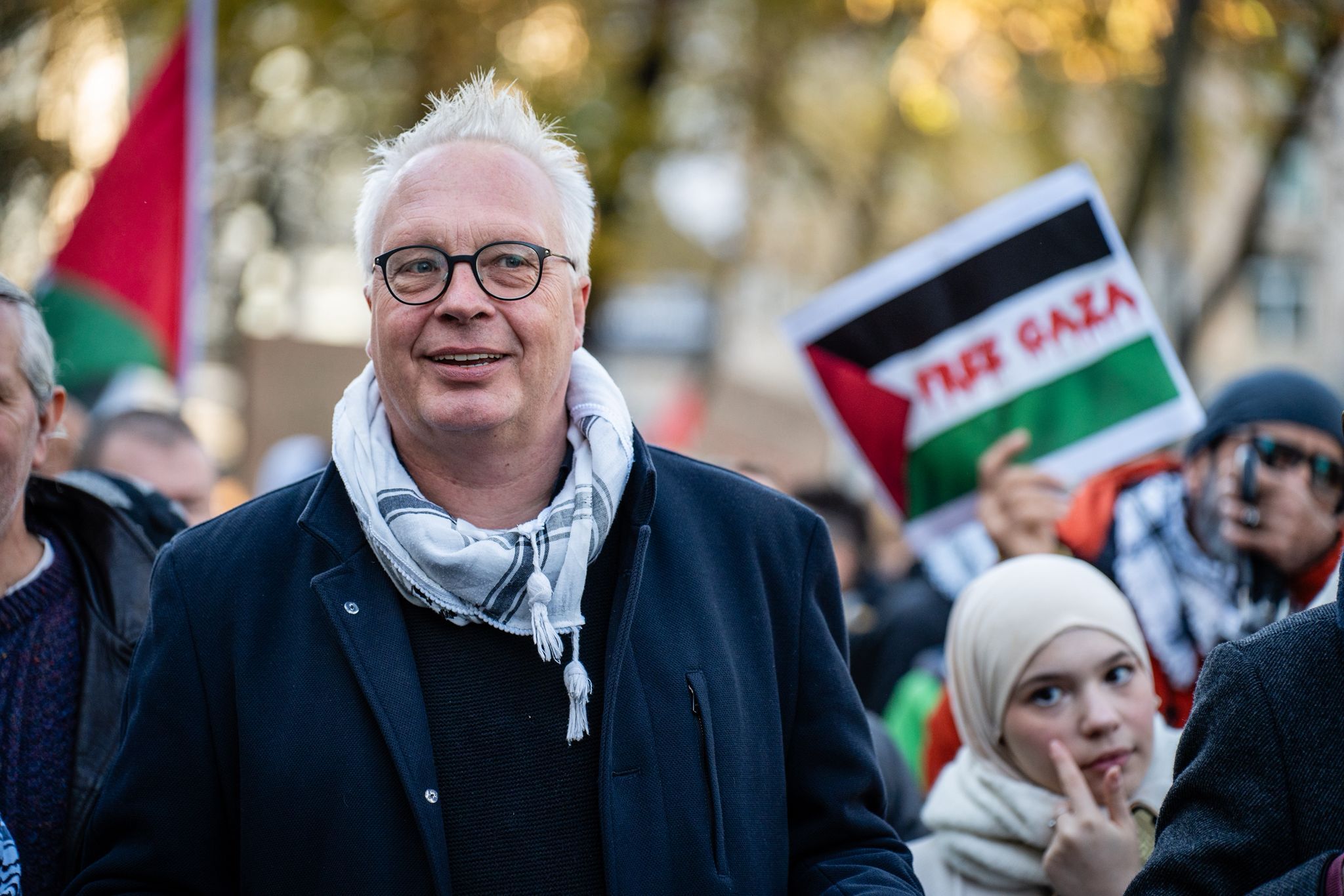
This Sunday, June 14, Belgian trade unionists will protest a government that is slashing welfare while stepping up military spending. Even as European leaders distance themselves from Donald Trump, they are imitating his agenda at home. (Emile Windal / Belga / AFP via Getty Images)
This coming Sunday, we will take to the streets of Brussels. Not for a minor issue but for a fundamental choice: “Welfare, not warfare.” For today Europe seems determined to massively rearm, making it increasingly resemble Donald Trump’s militarized United States.
Europe’s ruling class loves nothing more than to separate social justice and peace, as if the war economy were a foreign policy issue far removed from questions like what fills our children’s lunch boxes, how we will pay our hospital bills, or the retirement age. That, at any rate, is the lie they’d have us believe.
The truth is simpler. The same governments that claim there is no money for our social security can suddenly find billions for weapons. The same political leaders who want people to work longer roll out the red carpet for Lockheed Martin, Rheinmetall, and other arms dealers. The same ministers who cut spending on the sick, unemployed, and pensioners write blank checks for the war economy.
Empty Coffers, Except When It’s for Weapons
Of course, the two struggles are interconnected. Belgian Minister of Defence Theo Francken doesn’t even hide his intentions of funding militarization by cutting social security and public services. Anyone advocating for decent pensions, affordable education, strong health care, or reliable public services will inevitably clash with the war fever that wants to divert public funds toward exorbitantly expensive military orders.
For years we’ve been told the coffers are empty. There’s no money for more health care staff, no money for affordable energy, no money to eliminate waiting lists, no money to strengthen pensions. There’s no money for schools where the rain doesn’t fall indoors, for trains that run on time, or for wages that keep up with inflation. But as soon as militarization is on the table, the tone changes. Suddenly, the coffers aren’t empty, and taking on debt is no longer reckless but courageous. One billion euros is no problem, €10 billion is no taboo, and €30 billion is just the beginning.
In Belgium, the military budget has skyrocketed in just a few years. While almost all departments are forced to make cutbacks, the war cabinet receives massive funding. Over coming years, tens of billions of euros are being earmarked for fighter jets, frigates, missiles, and armored vehicles. Meanwhile, the population is expected to make sacrifices: the new pension penalty for those whose careers are said to be too short forces people to work ever more; the long-term sick are hounded; the unemployed are sanctioned; patients pay more for medication; and automatic indexation of wages and bonuses are under attack. This is the budgetary logic of the war economy.
They say: Security has a price. That’s true. But the question is: What kind of security, for whom, and who pays? Is a single mother safer when her energy bill becomes unaffordable, but a new frigate is ordered? Is a construction worker safer when he has to work until age sixty-seven or seventy while the government spends billions on offensive weapons? Is a nurse safer when her ward remains understaffed while hospitals are being prepared for war scenarios?
War Abroad, Militarization at Home
War fever does not make society safer — quite the opposite. Fear and panic are stoked to push the weapons buildup and prepare a new generation for war. Militarization is creeping into society: in schools, universities, hospitals, media, and living rooms. Young people are addressed as future soldiers. Military campaigns promise discipline, adventure, and a salary while remaining silent about the brutality of war and death. University research is increasingly steered toward the military industry. Hospitals are presented with plans where health care logic is subordinated to military emergency scenarios. The line between civilian and military is blurring.
This is dangerous. A society preparing for war changes from within. It grows accustomed to orders, distrusts criticism, and applauds to the rhythm of the war drum. Pacifists are dismissed as naive, trade union members as irresponsible, and opposition parties as allies of the enemy. Militarization abroad always goes hand in hand with militarization at home: with the creation of a domestic enemy, the restriction of democratic space, and the normalization of authoritarian reflexes.
We refuse this blackmail. We refuse the dismantling of pensions, social security, and democratic rights that have been built up through more than a century of workers’ struggle. We refuse to accept that young people are cannon fodder and the elderly are budgetary line items. We refuse a future that consists of more weapons and more war, paid for by longer working hours, less health care, and higher bills.
Europe Is Arming Itself to Ruin
It is naive to think that a militarized, tense, and over-armed Europe will bring us closer to peace. Europe is arming itself to ruin: not to build defense but primarily to intervene abroad. Frigates for the Red Sea, armored vehicles for the Sahel, and a European military presence around resource routes have little to do with national defense and everything to do with the interests of big corporations.
It’s about cobalt, lithium, uranium, gas, oil, and supply chains. It’s about the old colonial reflex in a new uniform. The names change and the technology evolves, but the power structures remain recognizable: Europe is building a new imperialism led by an ever-growing German military apparatus.
You don’t become safer by stepping up threats against others. This leads to a security dilemma: what one side calls defensive, the other sees as offensive, and so everyone arms themselves further. The outcome is predictable: instead of security, the situation becomes more dangerous. What we need is common security, where the security of one does not come at the expense of the other. Those who want peace must prepare for peace. This means diplomacy, disarmament, international cooperation, respect for international law, and security structures where even enemies talk to each other. This is not naivety — it’s the only realism that works. The vast majority of conflicts ultimately end at the negotiating table.
Social Justice and Peace: One Struggle
The labor movement cannot remain silent about militarization and war. The peace movement cannot remain silent about social justice. Welfare goes hand in hand with rejecting warfare. Our strength lies precisely in connecting these struggles: the nurse who wants more hands at the bedside, the teacher who wants smaller classes, the worker who wants a dignified pension, the young person who doesn’t want a future of war, the climate activist who knows that militarization also means ecological destruction, the peace activist who demands diplomacy, and the trade union activist who refuses to let social security be plundered.
Feminist, anti-racist, and international solidarity movements are also part of the same movement. They are not just standing side by side, but give each other strength. For the war economy affects everyone: it diverts resources from health care, pushes young people toward militarization, threatens democratic rights, fuels racism and images of the “enemy within,” accelerates the climate crisis, and turns Europe into a power bloc that wants to “secure” the economic interests of major European monopolies worldwide through military means.
The organizers of this Sunday’s demonstration have succeeded in bringing together a unique and broad coalition. The country’s two largest unions, ABVV-FGTB (General Labor Federation) and ACV-CSC (Confederation of Christian Trade Unions), have included the march in their plan of action against the antisocial “Arizona” government (so named after its parties’ colors). They understand that the fight for decent wages, strong public services, and good pensions is inextricably linked to resistance against the war cabinet.
Resistance Across Europe
But the June 14 demonstration will also be a crossroads of European resistance. From Italy comes the experience of unions and peace movements that have organized major actions in recent years against war, arms deliveries, and military escalation. Dockworkers, trade unionists, peace activists, and social movements have repeatedly refused to let the Mediterranean become a logistical corridor for war.
From the United Kingdom comes the strength of a peace movement that, together with unions and anti-racist organizations, has brought masses of people onto the streets against war policy, against the genocide in Gaza, and against the complicity of European governments.
From Germany come the youth who quit their classrooms to reject a future as cannon fodder. Their school strikes against conscription and militarization show a generation that refuses to accept that their schools are deteriorating while the Bundeswehr advertises everywhere. The resistance of German health care workers, doctors, and hospital staff against the militarization of the health sector is also an important signal: hospitals should heal people, not be transformed into components of a war infrastructure.
Alongside the world of labor, young people are on the barricades, shoulder to shoulder with the climate movement, women’s movements, anti-racist organizations, NGOs like Oxfam and 11.11.11, peace organizations, and international networks such as Stop ReArm Europe. It is precisely this breadth that makes June 14 so important. The demonstration brings together what they are trying to divide: social struggle and peace struggle, unions and youth, climate activists and health care workers, Belgian movements and European networks like the parties and organizations of the European left.
This Sunday, we will not only take to the streets against war but for life itself. “Welfare, not warfare” is not just a slogan for one day. It is a compass, saying that our society should not be built around fear, competition, and armament but around solidarity, social rights, and peace. It says that the engine of the country does not run thanks to generals and shareholders, but thanks to the people who work, care, learn, teach, transport, heal, and build.