France’s Police Unions Are Throwing Their Weight Around
Amid protests in France, police unions are pushing for wage hikes and special legal privileges to cash in on the political capital they’ve built under Emmanuel Macron’s rule.
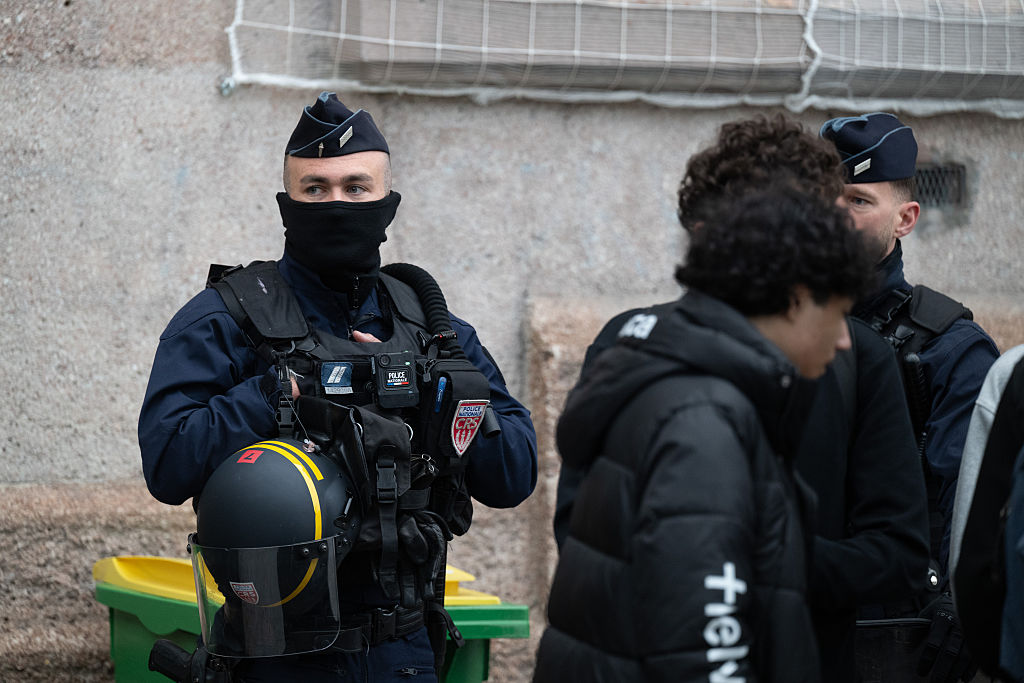
In France, many trade unions have lost their traditional strength. But hard-right police unions are wielding more leverage than ever, as they demand the government give them more powers to suppress protests. (Guy Smallman / Getty Images)
“The proportionate use of force should never be an obstacle to the job of restoring order,” French Interior Minister Laurent Nuñez wrote in a September 30 message to police chiefs. High schoolers across the country had only just launched a wave of campus blockages over poor learning conditions, in demonstrations that would soon morph into a full-fledged social crisis. In an October 6 government questions session, Prime Minister Sébastien Lecornu dismissed as “slander” any claims of systemic violence in policing and crowd-control tactics.
In the weeks since then, little has punctured the pressure for similar deference to the police. Certainly not the persistence of intense protests — and, in some cases, rioting — which have instead strengthened the reflex among France’s political class to celebrate muscular policing as the lone rampart against disorder. Nor have the numerous examples of people, often minors, being maimed or otherwise severely injured by the arsenal of “nonlethal” weapons at the police’s disposal.
Then again, political authorities have ample reason to be wary. “I accuse!” wrote Fabien Vanhemelryk in a statement published after the most intense day of protests and looting on October 17, reprising the famous declaration from Émile Zola’s 1898 public letter on the Dreyfus affair. For Vanhemelryk — leader of France’s largest police union by membership, the hard-right Alliance Police Nationale — the deepening crisis was the result of “years of permissiveness, political cowardice, and concessions.”
From the police’s point of view, the turbulence of recent weeks will most likely stand as a reminder that the state’s reliance on them gives them leverage. As Emmanuel Macron’s presidency enters its twilight, police unions are waging their own offensive, demanding salary increases and bonuses and looking to secure a raft of other pet projects. They hope to reap the rewards of their importance not only within the powerful Interior Ministry but also in the practice of government that has come to define Macron’s near-decade in office, as policing has become a key crutch during critical periods of political and social tension.
It’s an understatement to say that French organized labor has seen better days. Police unions offer perhaps the most notable exception. But the Interior Ministry is not your average employer, and police unions aren’t your average professional constituency.
Material Demands, Symbolic Rewards
In a dramatic show of force this past September 15, upward of ten thousand off-duty police officers descended Paris’s Champs-Élysées to the National Assembly, with protesters hauling dummy coffins along the capital’s central artery in protest of low wages and strenuous work conditions. The demonstration was called by the hard-right Alliance Police Nationale and UN1TÉ, the two largest unions among rank-and-file officers. They are pushing for some €500 million in new funding, allowing for salary increases and bonuses in addition to around a thousand new hires.
The Interior Ministry has already been among the winners of the Macron years in financing terms.
In 2023, police unions won special carve-outs in Macron’s unpopular increase in the pension age to sixty-four, a reform suspended during last winter’s budget negotiations in parliament. Adopted in 2023 and designed to extend over five years, a special budgeting law earmarked €15 billion extra funding to the Interior Ministry, adding to the baseline annual appropriations, which rose from some €22 billion in 2022 to over €34 billion in 2026. (Compare that to the €4 billion in low-rate loans to local authorities for school renovations, which the government rolled out in late October as a concession to student protests.)
Still, with Macronist Premier Lecornu vying for tens of billions of euros worth of savings for the 2027 budget, Interior Minister Nuñez can only go so far in his attempt to satisfy police unions’ demands.
But the police want more than just financial concessions. In a controversial bill currently awaiting final approval from parliament, police unions hope to claim a strategic win in one of their long-running campaigns: erecting legal shields to protect police officers who use their firearms from investigation and eventual criminal scrutiny.
The title of the proposed law calls it a “presumption of legitimate defense,” but to the bill’s critics it’s better known as the “permit to kill.” According to the legislation, which sailed through the lower-house National Assembly in July, police who use their firearms “are presumed to have acted” in accordance with the law, unless evidence can be shown to justify an investigation. To critics, that amounts to a tautology opening major holes in the rule of law, hamstringing oversight by putting the onus on victims of police violence to prove possible wrongdoing.
For Laurent Bonelli, a sociologist of security policy, the government finds itself in a genuine structural dilemma, caught between stretched resources, an acquired dependence on stiff policing in moments of social unrest, and palpable frustration among average troopers.
“There’s only so much money to give, so what can be done?” Bonelli told Jacobin. “That’s where symbolic rewards come in. And a classic example of that is this bill on so-called legitimate self-defense.”
Presumed Guilty
Will a “legitimate defense” bill be rolled into an eventual postcrisis compromise for a police force exhausted as this fall’s social unrest stretches on? The current push for greater immunity for the police first gained momentum during a series of events not wholly unlike the current one. Over summer 2023, the fatal police shooting of seventeen-year-old Nahel Merzouk in the Paris suburb of Nanterre kicked off days of protests and rioting that fanned accusations of systemic racism and violence among the police.
In several respects, the Nahel crisis provided the template for this fall’s conflict over law and order. In an incendiary public declaration that summer, the Alliance Police Nationale and UNSA police unions referred to rioters as “wild hordes” and “pests,” demanding a swift restoration of order. In less-than-veiled threats to political authorities, they also called for “concrete measures of legal protection” for the officer responsible for Merzouk’s killing.
While the legislation does not make an explicit principle of police irresponsibility, Nathalie Tehio, president of the Ligue des droits de l’Homme, warns that the greater risk is in raising the threshold needed to obtain an investigation into police wrongdoing. “So long as the [use of a firearm] is presumed to be legal, there will quite simply be no investigation,” she told Jacobin. “What that means is that the victim, or the family of the victim, will have to bring proof to the contrary.”
Shielding police from scrutiny has been a leitmotif of security policy for some time. During Macron’s first term, his government tried to ban the filming and photographing of active-duty police officers. Legislation approved this past spring authorizes turning off video cameras during temporary police custody, a change that legal observers fear could weaken oversight over interrogation practices. The law also sought to anonymize the identities of police officers appearing in judicial proceedings, though that was struck down by the Constitutional Council.
All signs are pointing toward what Tehio called the “construction of police immunity.” The contrast could not be more striking when compared to the evolution of the law as it applies for everyone else.
One piece of legislation to emerge out of this fall’s social crisis is the “rioters-pay” law, which is currently being fast-tracked through parliament thanks to consensus support between the Macronist center and the far right. The bill stipulates legal responsibility — and potential financial liabilities — for individuals accused of having “wittingly participated” in a grouping that including acts of rioting and vandalism. A presumption of guilt, you might say, for participating in demonstrations that turn awry.
Magical Solutions
One-upmanship between the police forces and political authorities eager to satisfy a critical arm of the state is a dynamic that long predates Macron’s presidency.
Part of this power is due to the nature of the force itself. France’s National Police is rigidly centralized, making it practically immune to local control and oversight. Concrete practices have also helped drill in the clientelist influence of police unions with a staunch ideological bent. “Comanagement,” granting unions considerable say over things like internal promotions, hardens their influence over the workforce — and marks the Interior Ministry off from many other state administrations.
One immediate bugbear among the lower echelons is that superiors were granted a considerable salary increase this year. Police unions are looking to shore up support among their bases before public sector workers hold professional elections in December, with the police counting among the most unionized workforces in the country.
But the greatest leverage that hard-line police unions have is structural, drawing on their position as a critical state service in a society on edge. Macron and his predecessors have long developed a dependence on muscular policing to contain conflicts over political decisions, whether the labor law reforms of the mid-2010s, the 2023 pension drive, or the anger with the education system that erupted these last few weeks. From enforcing immigration law to handling more quotidian social problems like drug use and extreme mental health cases, the “forces of order,” as France’s police are often called, offer a one-size-fits-all solution.
“To many in the political class, the police has come to appear as something of a magic solution for resolving the consequences of an increasingly unequal society,” said Bonelli, the sociologist. “It should come as little surprise that the police as an institution would try to capitalize on its weight in the ongoing battles within the state itself.”
Tensions over policing are so fraught that it’s barely ever asked whether an institution that separates itself so dramatically from the surrounding society is acting in its own best interests.
“Promising impunity is in reality to abandon the police — which is indeed in need of many urgent reforms — to those who are pushing for permanent confrontation with the general public,” the minority Interior Ministry branch of the national Confédération Générale du Travail (CGT) union warned in a January press release, when the government threw its support behind the “legitimate defense” law.
Doubts like these are increasingly inaudible, however, as a radicalized majority goes on the offensive. In doing so, they’re also pulling back the veil on what is starting to look to many like a state within the state.