Emmanuel Macron Has Boosted France’s Corporate Welfare State

French capitalism has been underperforming for decades, but its companies still expect to receive generous state support without giving much in return. Emmanuel Macron has carried this policy of corporate welfare to new heights.
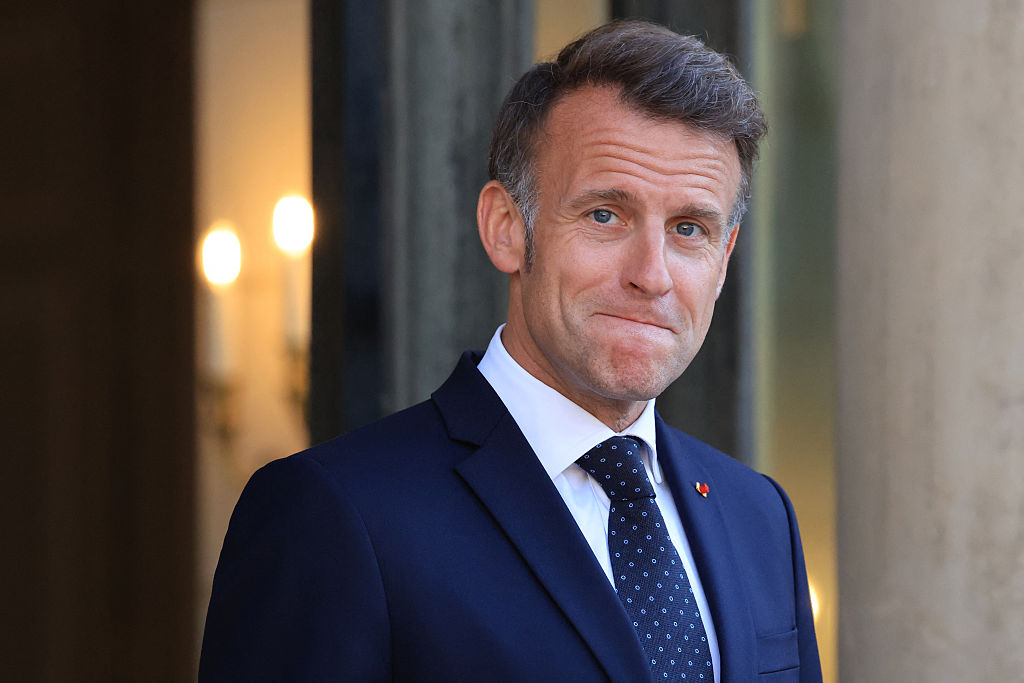
French President Emmanuel Macron is photographed at the ÉlyséAccustomed to receiving constant inflows of public money, French firms seem to be acting more and more like rentiers. To secure the persistence of their privileges, they are willing to embrace an authoritarian shift in the country’s politics.e Presidential Palace in Paris on May 20, 2026.

Accustomed to receiving constant inflows of public money, French firms are and more like rentiers. To secure the persistence of their privileges, they are willing to embrace an authoritarian shift in the country’s politics. (Ludovic Marin / AFP via Getty Images)


The French economy is underperforming. Over the last twenty years, its level of growth has been consistently below the EU average. In cumulative terms, the EU grew by 27 percent between 2005 and 2024, whereas France stood at 23 percent. Only Greece, Italy, Portugal, and Finland fared worse.

These figures stand in sharp contrast with the expectations raised by the election of Emmanuel Macron in 2017. The Economist marked this event by claiming that “corporate Europe is giddy with optimism.” The magazine’s cover depicted the newly elected French president, who had held the position of finance minister from 2014 to 2016, as a man walking on water who was carrying the hopes of “France, Europe and centrists everywhere” on his shoulders.

While his neoliberal program was hardly original, Macron’s victory still represented a powerful signal: The supposedly French anti-business exception would come to a definitive end and provide momentum to centrist policies that had come under strain elsewhere since the global financial crisis. This narrative could not be further from the truth: Under Macron’s presidency, French corporate welfare reached new heights while the country became increasingly authoritarian.

Corporate Welfare

With the rise of neoliberalism, French state capitalism has experienced a far-reaching transformation. While postwar dirigisme, based on nationalized firms, state-controlled credit, and expansive regulatory policies, has been thoroughly dismantled, the French state did not retreat from the economy. Rather, its interventions evolved toward forms of corporate welfare. This phenomenon clearly stands out from delving into the country’s public finances.

First of all, we can see that the contributions of firms and their owners sharply dropped. Between 1985 and 2017, the corporate income tax rate was slashed from 50 percent to 33.3 percent, and even further to 25 percent under Macron. At the same time, the wealthiest households now contribute less, as the top marginal rate of income tax was cut from 65 percent in 1985 to 45 percent today. In order to partially compensate for these losses of income, public resources increasingly come from indirect taxes such as the value-added tax (VAT), which have a disproportionate impact on the poorest households.

2005201420192024
European Union average100107.88120.27126.96
Germany100113.40123.72123.77
Greece10081.1285.7093.03
France100109.46118.12123.21
Italy10094.1398.91104.69
Portugal10096.89109.72119.87
Finland100104.04113.59113.54

Focusing solely on tax policy is not enough for us to grasp the nature of corporate welfare. One useful definition of the term describes it as “the transfer of public funds and benefits to corporate actors with weak or no conditionality.” State spending needs to be taken into account, too. In a recently published paper coauthored with Nicolas Pinsard, we show the growing amount of financial support French authorities are offering to private business.

In order to measure the importance of this phenomenon, we calculate a ratio of public support for the private economy by relating the transfers of public money to investment spending by non-financial firms. Postwar Fordism was characterized by a high investment rate and a low public-support ratio, whereas French neoliberalism turns this pattern on its head with low investment and high public financial support.

Until the end of the 1980s, public support represented less than 10 percent of investment spending by firms. The ratio had already risen substantially before the 2008 crisis, fluctuating between 15 percent and 19 percent. Since then, the figure has climbed well above the 20 percent threshold, and even reached 33 percent in 2020.

During the dirigiste period of Fordism, the state could direct economic activity through the nationalized sector, and firms had high investment rates despite low public funding. In contrast, today’s economy is marked by low public macroeconomic control despite unprecedented state funding.

There has thus been a shift in power and resources. During the dirigiste period, the state could partially direct economic activity while maintaining higher tax levels without transferring massive amounts of public money to business. Today the power to decide on the allocation of capital is entirely in the hands of corporate boards, even though the state provides them with unprecedented funding and significantly lower taxes. Belying the rhetoric of “unleashing market forces,” the neoliberal period thus stands out as a time of ever-growing corporate welfare.

Political Accumulation

In order to understand the transformation of French state capitalism from dirigisme into corporate welfare, one needs a closer understanding of the links between public authorities and private business. There is a long-standing sociology of French elites demonstrating close connections between managers and high-ranking civil servants. Their links stem from a shared social and educational background, lobbying, and the revolving doors that carry public officials into private-sector jobs.

These connections play a role in determining the groups for whose benefit the state constructs capitalism and contribute to explain how the ruling class maintains itself as such. However, it is puzzling to find that this scientific literature does not show a significant increase in business activism and influence over the years of the rise of corporate welfare.

At this point, the ideas of Nicos Poulantzas are invaluable. Poulantzas argued that conventional understandings of the relationship between capital and the state had to be reversed: “The direct participation of members of the ruling class in the State apparatus is not the cause but the effect.”

Inspired by this thought, Fred Block observed that “those who manage the state apparatus — regardless of their political ideology — are dependent on the maintenance of some reasonable level of economic activity.” Indeed, the material reproduction of the state itself relies on resources whose level is directly determined by the economic conjuncture, most notably taxes and debt. In addition, public support for any given government is likely to collapse if economic activity stalls and unemployment soars.

Given that economic activity is primarily determined by private investment decisions, Block insisted, “capitalists, in their collective role as investors, have a veto over state policies in that their failure to invest at adequate levels can create major political problems for the state managers.” This would still be the case even if there were no sociological affinity or overlap between state and corporate elites.

The crucial contribution of this structural state theory is thus to show that, fundamentally, the capitalist state does not promote profits simply because of pressure from business lobbies, but because it is in its own interest as an institution whose primary goal is self-reproduction. This constraint on state activity can be referred to as political accumulation.

French Capital’s Growing Structural Power

While its material conditions of existence drive the state toward implementing business-friendly policies, this does not mean that corporate demands are always fully satisfied. For instance, if the labor movement wields strong bargaining power, this can have a counterbalancing effect. As a matter of fact, the rise of French corporate welfare resulted from a substantial strengthening of capital’s structural power over the state.

Three key mechanisms stand out. First, capital’s most effective bargaining tool is the capital strike, which amounts to a politically motivated slowdown of investment. Since not every slowdown of investment is purposefully political, we need to specify how to recognize a capital strike.

There is evidence of a capital strike during the first years of the François Mitterrand presidency, when the Left had a parliamentary majority between 1981 and 1986. Although the Conseil national du patronat français (CNPF), the main employers’ organization at that time, never officially promoted capital strikes in its own right, much of its leadership did advocate this policy.

Instead of officially calling for a capital strike, CNPF leader Yvon Gattaz chose to use structural power in his talks with the government. As Bruno Amable writes in his history of neoliberalism in France, Gattaz sought to convince Socialist Prime Minister Pierre Mauroy that lower employment would require investments, “which were only possible if profitability was restored.” Gattaz kept up the pressure for lower taxes and labor costs, in response to which Finance Minister Jacques Delors “declared in 1982 that firms’ taxes and contributions should no longer increase.”

In fact, taxes and contributions did not merely stop increasing: Contributions decreased in relative terms, and public funding for private firms started to rise. As a result, profit margin rates steeply increased from 24.8 percent in 1981, when the left-wing government was elected, to 31.6 percent in 1986 when it lost the following parliamentary elections. Neither before nor afterward have French national statistics recorded such a steep rise.

However, business did not keep its side of the bargain: Over the same period, the investment rate declined from 21.6 percent to 20.3 percent. Those five consecutive years were the worst on historical record. Despite soaring gross operating surpluses, French capital refrained from investing until the first left-wing government of the Fifth Republic was replaced by a right-wing one in 1986.

The compression of aggregate demand, linked to the end of wage indexation to inflation in 1983, certainly contributed to the investment rate slowdown. However, this does not explain the sudden rise in the investment rate in 1986, or the disconnection between the margin rate and the investment rate between 1981 and 1986. The only way to account for this disconnection is by reference to an investment strike.

Show of Strength

French capital put on a crucial show of strength, and, as highlighted by Tarun Banerjee, Michael Schwartz, and Kevin A. Young, “once the disruptive power of the capital strike has been demonstrated, mere threats often do the trick.” During the following decades, representatives from CNPF and its successor, the Mouvement des Entreprises de France (MEDEF), reminded governments of the Left from time to time of their dependence on investment.

The Mitterrand years were also decisive in another sense: They prompted the intellectual unification of French capital around the neoliberal narrative. However, this ideological unification did not lead to total homogenization: Instead, we saw the emergence of two visions of neoliberalism. Within the CNPF, and later within its successor MEDEF, the dividing line between these two camps has been their relationship to the state and international competition.

The liberalization of the 1980s and ’90s affected French firms unevenly. One tendency arose from traditional manufacturing firms that were oriented toward national demand and rather protected from international competition. Those who were aligned with this tendency feared increased foreign competition.

The second camp, rooted in finance and more competitive industries, saw new business opportunities in globalization. While this camp was gaining strength, it was unable to impose its more liberal preferences without making concessions. Public financial aid is precisely what embodies this compromise.

The first, more nationally oriented camp saw such aid as a necessary complement to liberalization. The second, more internationally directed camp also welcomed it so long as it would not come with conditionalities related to its use, which would have enabled the state to influence the allocation of resources. General non-targeted public support for private firms thus became the perfect solution.

Over the same years, French capital also strengthened its structural power over the state through two additional mechanisms. On the one hand, capital concentration increased. As a result, a smaller number of firms command an increasing part of the national wealth. They thus exercise greater control over the economy and over the state’s material conditions of existence.

Secondly, capital mobility increased. Financial and trade liberalization, especially but not exclusively linked to the formation of the EU, offer new exit options for capital. Any time a government considers implementing policies opposed by capital, the latter can raise the specter of capital flight. In order to attract foreign capital under conditions of interstate fiscal competition, public authorities are all the more incentivized to offer public funding.

The Contradictions of French Corporate Welfare

The combination of ever-increasing fiscal transfers to private firms on the one hand and tax reductions for businesses and their owners on the other hand increases the likelihood of unbalanced budgets. Since EU fiscal rules impose strict limits on budget deficits, successive governments have attempted to shift the burden to the working population. Taxation has thus become a central battleground of class struggle.

With real wages today still below the pre-inflation level of 2019, the major protest movements that have shaken the country over the last few years have directly fed on the uneven distributive consequences of corporate welfare. The Gilets jaunes resulted from opposition to a new tax, and the strikes against the 2023 pension reform targeted a policy that the Macron government implemented to compensate for the abolition of a tax paid by firms.

Facing persistent social movements, the French state increases coercion. These authoritarian tendencies mean greater public spending on crowd control — the exception to a generalized policy of austerity — and an eruption of police brutality. Corporate welfare may eventually destabilize political accumulation.

Beyond the danger of social unrest, the policy of corporate welfare also appears to be a failure on its own terms. Firms in France did not increase investment in proportion to the public money they received, which explains France’s particularly poor macroeconomic performance.

Accustomed to receiving constant inflows of public money, French firms seem to be acting more and more like rentiers. To secure the persistence of their privileges, they are willing to embrace an authoritarian shift.