The Foundations of Turkey’s Peace With the Kurds Are Shaky
The disarmament of the Kurdistan Workers’ Party and promised release of its prisoners offers a path to pacifying conflict in Turkey. It’s less clear if the Turkish state is ready to compromise with Kurds’ democratic demands.
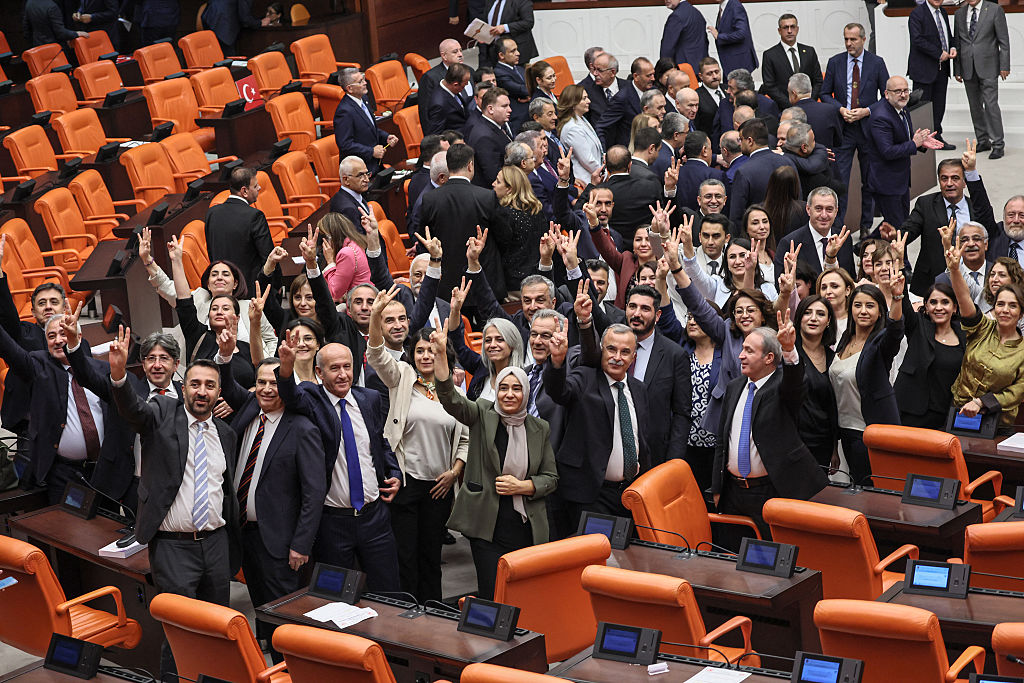
A new Turkish law promises to end the decades-long armed conflict with the Kurdistan Workers’ Party. While recognizing jailed Kurdish leader Abdullah Öcalan as a negotiating partner is welcome, the plan leaves many fundamental issues unsolved. (Adem Altan / AFP via Getty Images)
Turkey’s political scene is moving. The recently passed Framework Law redirects the Kurdish question — the principal fault line in the country’s imagined national unity — from armed confrontation to regulated pacification. This has political consequences far beyond its narrow legal scope. More than bringing one period of the Kurdish conflict to a close, it opens a new phase in Turkey’s class struggles by reshaping the balance between the state, the Kurdish movement, and the political opposition.
The August 10 Framework Law — officially the Law on Strengthening National Solidarity and Social Cohesion — is a genuine rupture in Turkey’s handling of the Kurdish conflict. More than an administratively dressed-up executive concession, it crowns a parliamentary process initiated by an all-party commission, excluding only the ultranationalist Good Party (İyi Parti). This commission was mandated to recommend measures to end the armed conflict, including talks with the guerrilla Kurdistan Workers’ Party (PKK) and its imprisoned leader, Abdullah Öcalan.
The law passed with an exceptionally broad parliamentary majority: 467 votes in favor, eighty-seven against, and seven abstentions. Alongside the governing Justice and Development Party (AKP) and Devlet Bahçeli’s Nationalist Action Party (MHP), the coalition behind the text included the Kurdish-based Peoples’ Democracy and Equality Party (DEM Party), the newly formed Yeni Parti, the Workers’ Party of Turkey (TİP), the Labor Party (EMEP), several independents, and a small minority of Republican People’s Party (CHP) deputies. Despite radically different narratives on the Kurdish question, these parties converged on the legal framework regulating the consequences of the PKK disarming.