The Politics of Kurdish-Palestinian Solidarity
The Kurdish and Palestinian movements were forged in a common anti-colonial tradition. Their different political trajectories now reveal two competing models of liberation in the 21st century.
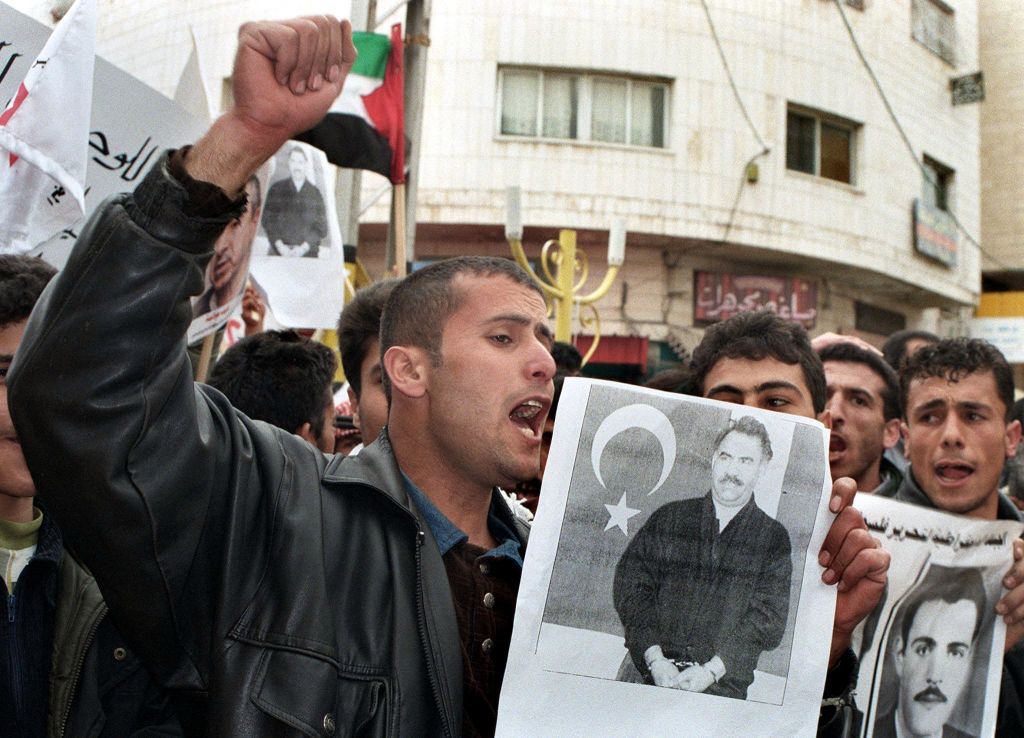
Palestinian members of the Democratic Front for the Liberation of Palestine demonstrate in the West Bank town of Jenin on February 20, 1999, against the arrest of Kurdistan Workers’ Party leader Abdullah Öcalan. (Jaafar Ashtiyeh / AFP via Getty Images)
The Kurd has nothing but the wind
To dwell in him and he in it
To get addicted to him
And he gets addicted to it
To be saved from the adjectives of the land
And of the things
The wind is the testament
Of one Kurd to another Kurd in exile.
When the Palestinian poet Mahmoud Darwish wrote this poem more than twenty years ago, he was not claiming that the Kurdish and Palestinian experiences were identical. Rather, he was writing from a shared experience of displacement, exile, and decades of denial. In these verses, the Kurds are not another Palestine. They are a people carried by the same wind: sustained by hope, battered by colonial and regional powers, and repeatedly forced to redefine their place in the world.
The kinship Darwish describes was more than a poetic gesture. Both the Kurdish and Palestinian national movements emerged from the collapse of the Ottoman Empire, when neither people achieved self-determination. Instead, they were occupied, annexed, or divided among rival powers.