Mike Rogers Pushed for War With Iran for Two Decades

Media coverage around Michigan’s Senate race and Abdul El-Sayed’s ties to Hasan Piker has become constant and hysterical. Less discussed: Michigan Republican Mike Rogers’s career-long advocacy for an Iran war now wreaking economic havoc on Michigan.
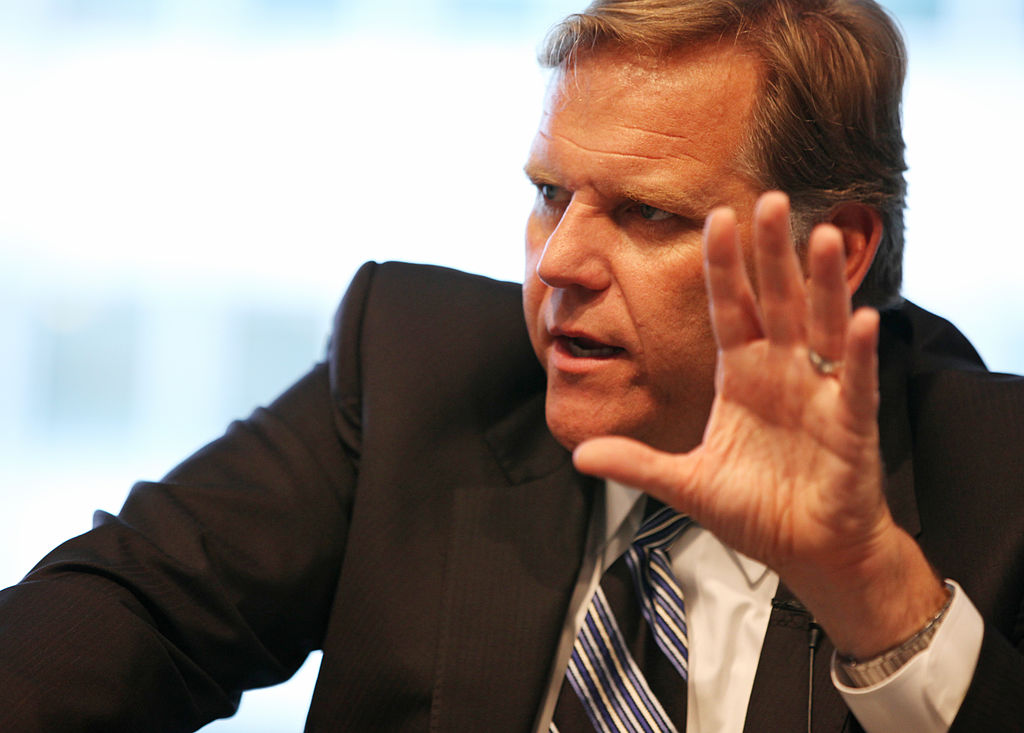
Mike Rogers, a Republican from Michigan and former chairman of the House Intelligence Committee, speaks during an interview in Washington, DC, on  September 6, 2011.

For decades, Michigan Republican Senate candidate Mike Rogers has ceaselessly advocated for war with Iran — a record far more relevant to the struggles Michiganders are facing than much of the conversation dominating his race against Abdul El-Sayed. (Rich Clement / Bloomberg via Getty Images)


It’s not a secret that Mike Rogers supports the Iran war. Since Donald Trump launched the war six months ago, the Michigan Republican candidate for Senate called Iran “an imminent threat to our country” that “must not have a nuclear weapon,” said the war was “absolutely right” and “a win-win-win for us,” believes “we are better off today than we were when it started,” and has said he “doesn’t mind” the idea of giving Trump congressional authorization to keep the war going.

“I was for all of this when it wasn’t very cool to be for all of this,” he boasted last year, after Trump launched his first attack on the country.

Rogers wasn’t exaggerating. A review of the public record shows that Rogers has been pushing for war with Iran for at least two decades, since all the way back when George W. Bush was mulling it. Rogers used his perch on the House Select Committee on Intelligence, which he chaired from 2011 to 2015, to make a host of dubious claims about Iran’s nuclear ambitions and capabilities, hype the threat it posed to the United States, and undermine efforts at diplomacy that could have prevented the current conflict.

At one point, when Israeli Prime Minister Benjamin Netanyahu launched a pro-war pressure campaign virtually identical to the one in the lead-up to this year, Rogers chided then-President Barack Obama for his refusal to bend to it, and he later supported the Israeli leader’s attempt to undermine the US president’s successful attempt at diplomacy to resolve the standoff with Iran. At one point, his advocacy for an aggressive approach toward Iran saw him make common cause with a terrorist group responsible for killing Americans. The Rogers campaign has not responded to a request for comment.

Rogers’s decades-long hawkish record could prove a liability in his Michigan Senate bid, his second tilt at the seat after falling just short in 2024. The Iran war’s ripple effects have hit the state hard, with the economic impact expected to top $2 billion. West Michigan families are paying an average of $15–$20 a week more for gas, while the state’s farmers, nearly half of whom already can’t afford the fertilizer they need, are looking at paying as much as $22,000 more this season on average.

This history has largely escaped notice in the midst of an election season that has been intensely focused on politicians’ past statements and associations, even as officials’ support for the current war has become a major election issue in other races. Yet Rogers’s lengthy record on Iran is far more directly relevant to the struggles Michiganders are facing than old tweets or associations with Twitch streamer Hasan Piker.

Mike Rogers Has a Difficult Relationship With Facts

While serving in Congress, Rogers was repeatedly criticized for spreading misinformation to the effect that Iran was making or dangerously close to having a nuclear bomb, misinformation that was likened to the Bush administration’s fraudulent case for war with Iraq.

In 2006, as chair of the House Subcommittee on Intelligence, Rogers signed off on a staff report charging that “Iran is seeking nuclear weapons,” and that it even “likely” had research capability into chemical weapons and “probably” had a biological weapons program. Painting Iran as a direct threat to the United States, the report stated that Iran would have a nuke “sometime in the beginning to the middle of the next decade,” and cast doubt on the sincerity of Iran’s outreach, made just a day before, for “serious negotiations” with the United States.

“It’s beyond a shadow of doubt for me that they are trying to stall for more time to continue their uranium enrichment and the building of their nuclear program,” Rogers said in the wake of the report. Intelligence agencies were just being “cautious” because of the “public beating they took” over Iraq, he told Fox News the same day. In reality, he said, across the intelligence world, “we’re all pretty much coming to the conclusion that they are aggressively pursuing that technology.”

With hindsight, we know none of these claims were true. Just a year after Rogers’s report made headlines, the office of the Director of National Intelligence (DNI) flatly contradicted it, releasing its own National Intelligence Estimate (NIE) that America’s collective intelligence agencies “judge with high confidence that in fall 2003, Tehran halted its nuclear weapons program.”

Nearly twenty years later, and at least a decade after the year that Rogers’s report predicted Iran would produce a nuke, Trump’s own DNI testified that US intelligence “continues to assess that Iran is not building a nuclear weapon” and that its suspended nuclear weapons program had not been reauthorized. After six months of war with the United States and counting, there’s been no evidence that Iran has deployed chemical or biological weapons.

Yet this didn’t stop Rogers from claiming otherwise. Between 2006 and 2026, Rogers publicly referred to Iran’s “nuclear weapons program” or charged that it was pursuing or close to having a nuclear weapon dozens of times, according to Jacobin’s review of the public record. His four-year tenure as House intelligence chair lent these dubious claims added weight, including after he left Congress in 2015, when he continued to make such claims on networks like CNN.

At times, he came under heavy criticism for playing fast and loose with the facts.

The International Atomic Energy Agency (IAEA), the United Nations’ nuclear watchdog responsible for monitoring Iran’s nuclear program, wrote to the intelligence committee’s then-chairman “to set the record straight” about the claims in Rogers’s 2006 report. It called “outrageous and dishonest” the report’s charge that an IAEA inspector had been removed for violating what the report alleged was an unofficial IAEA policy to hide the truth of Iran’s nuclear program. And it objected in particular to a caption claiming Iran was “currently enriching uranium to weapons grade,” which the IAEA said was flatly untrue. Rogers was forced to acknowledge to CNN that the claim in the caption was false.

The Associated Press compared it to the way the IAEA and Washington had clashed just a few years earlier over the Bush White House’s phony allegations about “weapons of mass destruction,” made to justify invading Iraq. “The last thing the United States needs,” went a New York Times editorial, “is another attempt to push the intelligence agencies to hype their conclusions about the threat from a Middle Eastern state.” (He “strongly disagree[d]” with the editorial, Rogers wrote back, noting that he had cosigned the report’s release).

Rogers cited that flawed report anyway in an op-ed he penned the following September, which warned that “the nuclear threat from Iran has strengthened, not diminished” since the report’s release and charged that “Iran pursues nuclear weapons.” When the NIE made clear this was false three months later, Rogers changed his tune, suddenly saying that “the good news is they did, in fact, suspend it,” but they had done so because of US pressure.

But neither this admission nor more US intelligence assessments contradicting him stopped Rogers from going right back to repeating the same dubious claim a few years later.

A year after intelligence officials briefed Congress in 2011 that Iran had not decided to build a nuke but was keeping its options open, Rogers, now House intelligence chair, told CNN that “we know that [Iran is] aggressively pursuing a nuclear weapon program.” US officials told the Los Angeles Times that month that they hadn’t seen evidence, since that would make them change their conclusion, and that even Israel hadn’t disputed their findings. Nevertheless, a year after that, Rogers again claimed to CNN that “everybody agrees that Iran is pursuing a nuclear weapon program.”

Rogers’s reliance on factually challenged claims to push war with Iran isn’t ancient history. He repeatedly charged after October 7 that Iran had “helped plan” Hamas’s attack on Israel that day, a claim so dubious not even Israel supported it. Citing his decade-old experience on the House intelligence committee, he said last year that Iran was close to assembling a nuke, even though US intelligence had concluded the opposite. He has repeatedly justified Trump’s current war on the grounds of preventing the nuclear weapon he had said Trump’s war last year had put Iran “far, far away from,” and Rogers even claimed that Iran was “building an intercontinental ballistic missile,” something disputed by US intelligence and experts.

The Only Option on the Table

While hyping the Iran threat, Rogers made frequent calls for military action against the country, usually framed around the circular logic that the US president had to be willing to attack Iran because its leaders supposedly didn’t believe Washington was serious about war.

“I don’t think you should take it off the table,” he told ABC about military strikes in 2011.

The most dangerous point came in 2012 when, with Obama facing reelection, Israeli Prime Minister Benjamin Netanyahu ratcheted up pressure on the White House to attack Iran. In both public and private, Netanyahu and other Israeli officials insisted on the urgent need to strike, even threatening to do so alone, while Obama discouraged any such idea and urged diplomacy.

As both Obama and his secretary of state at the time John Kerry have recently said, it was an identical situation to the one Trump found himself at the start of this year, with Netanyahu using identical arguments and similarly threatening to attack Iran on his own, potentially dragging the United States into the conflict. Unlike Trump, Obama resisted the pressure campaign — but Rogers at the time repeatedly criticized him for it.

In a February 2012 appearance on Fox News, Rogers chided the Obama administration for not being on the same page as Israel — in other words, for not supporting war with Iran. Making reference to a “nuclear weapon program” that US intelligence had made repeatedly clear didn’t exist, Rogers suggested that Israel might have to start the war itself:

There is this misunderstanding about where would the United States would be if Iran – excuse me, if Israel believes they have to do something about Iran’s nuclear weapon program. Remember, this is an existential threat to Iran – excuse me, Israel. . . .  They believe they have to do something. Where it’s gotten, I think, a little askew here is, the message coming out of the administration and Israel is a little different. So they’re worried. They’re worried that they may have to do this by themselves.

In Rogers’s formulation, the cost of Israel “doing it by themselves” could be high for the United States: he repeatedly stated at the time that the United States and Israel have a defense pact that meant “we will defend them if attacked under any circumstances,” and affirmed that “we will live up to that.” No such defense treaty exists between the two countries, which means that Rogers was in effect preemptively pledging the United States to fight a war with Iran on Israel’s behalf if it started one.

Despite this, Rogers appeared to repeatedly justify just such an unilateral Israeli attack. Though he at first characterized it as “not good” “not helpful,” and “a problem,” he reiterated at the same time that “military options have to be laid on the table” and that “Israel does need to take into factor that this is a country that said if they get a nuclear bomb, they’ll use it on Israel.” Over time, these initial reservations seemed to evaporate.

“I believe that if this is going to work we have to have a credible military option,” Rogers told CNN the following month in March. “We can’t say all options on the table, oh, by the way, Israel, we don’t want you to do anything. That’s not very credible.”

“The administration has spent a lot of effort trying to convince Israel not to do it, and what I was hoping is a better example toward the Iranians that listen, if you continue to push this nuclear — to try to get a nuclear weapon, there are real consequences,” he told MSNBC in September.

“Right now, the Israelis don’t believe that this administration is serious when they say all options are on the table, and more importantly, neither do the Iranians,” Rogers told Fox News the same month. “That’s why the program is progressing.”

Rogers repeatedly griped about the Israeli leadership’s frustration with Obama, due to, he said, the lack of “certainty from the United States on where we are” on war with Iran. Yet reporting made clear the Obama-Netanyahu rift was not driven by a lack of clarity in the US position, but because the US president was all too clear — that he opposed the war Netanyahu was pushing for with Iran.

As the Israeli campaign reached a fever pitch months from the election, when asked directly by MSNBC’s Andrea Mitchell if time had indeed run out for diplomacy, Rogers replied that Israel believed Iran had “already crossed their line.” Sanctions weren’t working, he said, and “that’s when the real threat of military option has to be on the table.”

He continued to push the same line even after Obama was reelected, and this pressure campaign ended. In March 2013, Rogers warned again that unnamed “analysts” believed it “could be a year” before Iran had a nuclear weapon and that “the Israelis believe it’s going to be sooner than that, and that’s why the pressure is mounting for some action, maybe other than sanctions for Iran so they get the signal.”

Rogers’s hawkishness on Iran at times made for strange bedfellows. A 2012 Guardian investigation found that Rogers had been monetarily backed by individuals and groups affiliated with the Mojahedin-e-Khalq (MEK), a fringe group of Iranian exiles who lobbied for regime change in Iran and had played a leading role in pushing the Washington narrative on Iranian nuclear weapons, but were for years an officially US-designated terrorist organization.

Rogers cosponsored legislation requesting Obama’s State Department to remove the MEK from the terror list, a fact that raised eyebrows given Rogers’s position on the House Intelligence Committee. The legislation was considered a major step toward their eventual delisting in 2012. This kind of thing was controversial even on the Right, given the group’s anti-American rhetoric, and the fact that it had been responsible for the deaths of Americans — the same things Rogers said justified military action against Iran.

“It is astounding, given the evidence that the MEK has planned if not continues to plan terror . . .  that so many American politicians willingly share a stage and launder such behavior for a paycheck,” the neoconservative Michael Rubin wrote for the right-wing American Enterprise Institute in 2023. “It is a barometer of corruption and should disqualify from further public policy roles.” (Rogers was not reported to have been paid directly by the MEK.)

When Trump, with Rogers’s backing, finally launched the regime change war on Iran earlier this year, Politico reported that “no one in Washington has prepared for this day as long as the [MEK].”

Deal or No Deal

Rogers paired this with a long-running hostility to diplomatic solutions that, if they had been kept in place, would likely have prevented the current war.

When Obama announced an accord with Iran in November 2013 that would lay the groundwork for the later Joint Comprehensive Plan of Action (JCPOA) agreement, also known as the Iran nuclear deal, Rogers savaged it. “I think this was a deal for the sake of a deal. I think that’s dangerous,” he told MSNBC’s Morning Joe.

Rogers’s problem with the agreement, he claimed, was that the Obama administration had said “Hey, we really want a deal.” What the White House should have done instead, he said, was “set the table” for talks and have “the Iranians come to you and say, ‘I am ready for a deal.’”

In fact, this was more or less how the accord had been forged, with newly elected reformist President Hassan Rouhani publicly calling for serious negotiations to restart in his first postelection news conference that August. Even so, Rogers became one of the diplomatic effort’s most prominent critics. It was “a permission slip to continue enrichment” that simply “rewarded very bad and dangerous behavior,” and “a terrible deal” that he falsely claimed was opposed by US allies in Europe.

As talks went on the following year and brought the JCPOA closer to fruition, Rogers continued to fearmonger about diplomacy. “Iran will get explicit approval to continue a nuclear program — allowing them to quickly develop a nuclear weapon if they decide to do so,” he claimed. The talks “have benefited Iran,” which only “strengthens its hand” as they go on, while the United States had nothing to show for it, he charged.

This continued even after Rogers departed Congress in January 2015, and was brought on by CNN and other liberal-leaning networks as an expert voice. He praised one of his former Senate colleagues for “trying to put a bipartisan group together to oppose the Iranian deal,” and said that the amount of enrichment allowed in the final agreement “should have been zero” — a long-standing poison-pill demand of Iran hawks wanting to derail diplomacy.

The deal “guided the path to their nuclear program . . .  and in there [are] provisions to pay for it,” he told CBS’s Face the Nation. “You get in bed with Iran and somebody’s not going to get a good night’s sleep,” he told Al-Monitor. “Iran has no interest in turning a new leaf.”

When Netanyahu infamously attempted to derail the JCPOA by attacking it in a speech before the US Congress — widely viewed as an outrageous and disrespectful instance of foreign meddling in US domestic politics — Rogers took the Israeli leader’s side. In an op-ed for Politico, Rogers criticized Obama for trying “to hobble the prime minister,” and called Netanyahu’s speech “the act of a true and courageous friend” that would “spark a vital debate about more than just the nuclear deal, which is only one aspect of a broader policy of outreach to Iran.”

“These apparent intentions are deeply troubling to the Israeli government,” he lamented.

Rogers likewise continued attacking the deal on what was then known as Twitter, where he put out a steady stream of attacks on the agreement from 2015 onward. “Every day ‘talks’ go on is a day they get closer to a nuclear bomb,” he wrote that January. “Some say Iran doesn’t want a bomb, they want a peaceful nuclear program. I’m not sure about you, but I don’t want to see if they are wrong,” he wrote the following month.

This went all the way up to and after Trump’s 2016 election win, at which point Rogers helped lead the president-elect’s transition team on national security. “Obama has bent over backwards to help Iran comply with a bad nuclear deal, which won’t happen in a Trump [administration],” he tweeted. “I think what you’re seeing is a deal maker who comes in and says, I’m going to reset the negotiation table,” Rogers told CNN in December. Within a year and a half, Trump tore up what he, like Rogers, referred to as the “terrible deal.” (The following summer, Rogers would claim on CNN he opposed the unilateral withdrawal.)

Rogers’s gung-ho advocacy against the JCPOA put him on the other side of not just most US allies, but even serving national security officials and dozens of US national security experts across the political spectrum. Writing in August 2014, Greg Thielmann, a respected twenty-five-year foreign service official who had retired under the Bush administration, specifically name-checked Rogers as one of a number of Iran deal critics who were flatly “wrong” about it. “Iran has rolled back its enrichment program in accordance with those limits” in the deal, he wrote, solving the problem of the fact that it had stockpiled significant amounts of near-weapons-grade uranium.

Rather than facilitating Iran to build a bomb, as Rogers alleged, diplomacy and the eventual JCPOA led its uranium stockpiles to plunge to nothing. Trump’s decision to withdraw from the deal saw those stockpiles spike back up and the time Iran would need to produce a bomb sharply narrow, and wound up being a key step on the road to the current war. Likewise with Trump’s adoption of the demand that any agreement involve “zero enrichment” on Iran’s part, as Rogers had advocated, a demand that has continued to thwart talks to end the current war.

Nevertheless, Rogers remained firmly against reentering the JCPOA once Joe Biden was in the White House. “I would not run into this let’s rewind the tape for four years,” he said shortly after Biden won the election in 2020.

“Rather than pursuing a deal that was wrong then and even more wrong now, the administration should be deepening our partnerships in the region to contain and deter Iran,” he wrote two years later. “It’s an agreement that should never have been made in the first place and withdrawing from it made sense,” he added.

Even as Trump’s current war has disrupted the global economy and caused havoc for American consumers and Michiganders in particular, Rogers has remained leery of a diplomatic way out. He was critical of the negotiation framework that came with the April ceasefire (“Some of the things I’ve seen reported, I can’t imagine the president would agree to,” he said at the time), and told the Detroit News he did not “100 percent support” the memorandum of understanding agreed to in June.

“I think it would be helpful to the country to have it go before the Senate,” he told the outlet about any final deal to end the war. It was a far cry from his criticism six years earlier of the Senate effort, led in part by Republicans, to prevent war by passing a War Powers Resolution to rein in Trump after his assassination of Iran’s top military figure.

Costs That Are Hard to Live With

It took twenty years, but Rogers’s patient work against diplomacy with, and in favor of war on, Iran has finally come to fruition in Trump’s second term. The US president and the entire country are now caught in the very trap that Rogers criticized Obama for avoiding, after Trump gave in to Israeli pressure to attack Iran and eschewed diplomacy in favor of coercion at the point of a gun, just as the former House intelligence chair had long counseled.

Rogers has been a vocal backer of the current war, despite being fully aware it could result in economic blowback. As early as 2019, he had warned on CNN that Iran’s leaders “have the ability to shut the Straits [sic] of Hormuz, 20 percent of the world’s oil — you can see where this thing is getting ugly in a hurry.” But Rogers appears less concerned about the impact on Americans’ pocketbooks these days, telling a Michigan voter back in March that “we’re gonna be fine” in the face of rising gas prices, because “we got plenty of oil.” For Rogers, as he told a local reporter earlier this year, it was critical that the United States launch this war to prevent an Iranian nuke — a nuke that he had spent virtually his entire political career insisting was real and ignoring the US intelligence that concluded it wasn’t.

“Obviously that brought some costs that are hard to live with, you know, when you’re trying to pay your higher electric rate that’s gone up the last eight years,” he added with a chuckle.