Centrist Democrats Are Trying to Throw the Michigan Race
Abdul El-Sayed’s Senate race could decide control of the chamber. Yet some centrist Democrats are openly working to sink his campaign — because they’d rather hand the seat to a Trump-backed Republican than let the Left gain a foothold in their party.
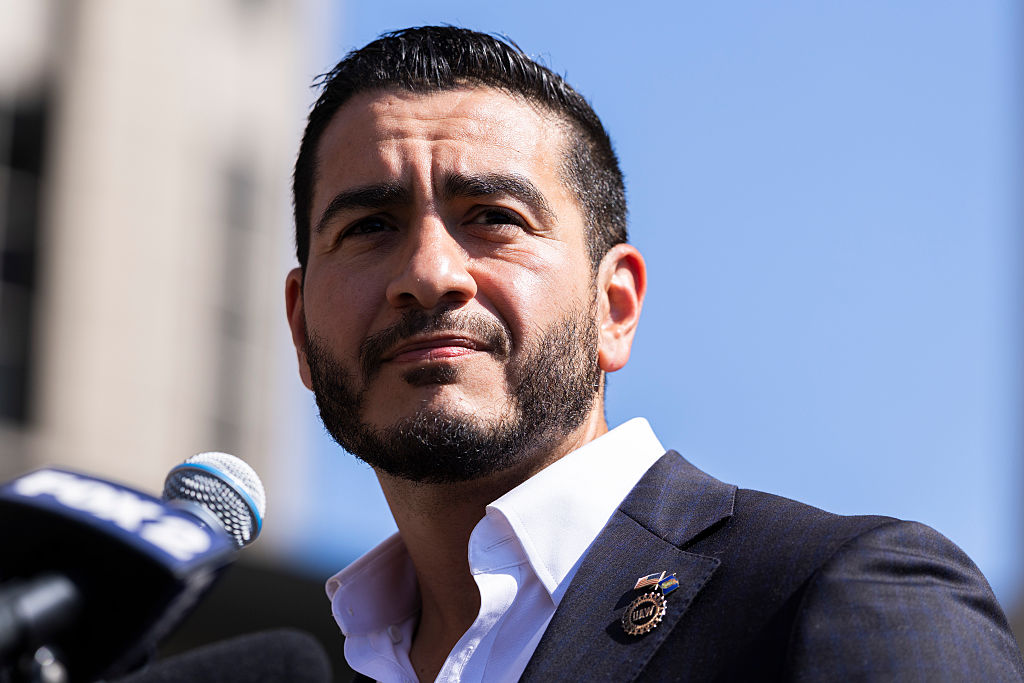
To some voters, it will sound far-fetched that centrist Democrats would deliberately tank a winnable Senate race to keep the Left down. But it’s hardly unprecedented. And in Michigan, a handful of them are saying it outright. (Finn Gomez / Getty Images)
In Michigan, where progressive Abdul El-Sayed is facing off for the must-win Senate seat against Donald Trump–backed Mike Rogers, Democrats have a problem. How to reconcile their distaste for their own party’s nominee with the imperative to care about winning?
Attorney General Dana Nessel modeled a way out of the bind with a comically backhanded endorsement. Tasked with trying to convince Jewish Democrats that they should vote for El-Sayed despite the blizzard of smears charging he’s a dangerous antisemite, Attorney General Dana Nessel offered the most unappetizing of unappetizing pitches. Referencing the biblical story of Queen Esther, who chose to put her life on the line to save many others, she implored those in the room to do the same.
“It is perhaps up to us now to follow in her path and sacrifice the comfort, safety and security and even the very future of our own people in exchange for the opportunity to save the rest of humanity,” she told them.
It’s hard to think of a more counterproductive call to action than this. In fact, it might even make you think that the speaker didn’t even want her audience to vote for the endorsed candidate, greater good be damned.
You’d be in good company. Bernie Sanders, the country’s most prominent Jewish politician, recently told Politico he believed that some Democratic officials actively want El-Sayed to lose the race to the Republican Rogers. These Democrats, Sanders said, viewed progressive candidates like El-Sayed as “a threat” to continued “oligarchy,” to “neverending wars,” and to “continued support for the extremist [Benjamin] Netanyahu government in Israel,” and so figure, “maybe we should let them lose.”
“You’re talking about a small number of people who are at the head of the Democratic Party. You’re talking about the donor class,” Sanders said.
If, like Sanders, you’re also getting the sneaking suspicion that centrist Democrats are trying to throw the Michigan Senate race, you’re not crazy. Some of them are actually outright admitting it.
No Bones About It
Last week, a group of Michigan Democrats began circulating a letter announcing they would be voting for Rogers in November, because, in their words, “if El-Sayed were to win the general election in this important swing state, we fear the far left and anti-Jewish elements in the Democratic Party would become dominant, including in the imminent 2028 presidential race.” That letter has 412 signatures as of the time of writing.
Another pro-Israel Michigander who usually votes Democrat, Ann Arbor Rabbi Asher Lopatin, put it even more starkly in an op-ed for Israeli newspaper Haaretz.
“Some will argue, as I personally do, that the best thing for the Democrats and the progressive cause, in the long run, is to show that anti-Israel candidates like El-Sayed can’t win, thus bringing the Democratic Party back to its more traditional and pro-Israel stance,” he wrote. “A loss for the Democratic Socialists of America (DSA) in November could save the Democratic Party from a hostile takeover ahead of the 2028 presidential election.”
Another lifelong Democrat in the state, Detroit journalist Stacy Gittleman, made a similar declaration.
“I will NOT be voting for Abdul, because he poses to me and many others as an extremist who, if he gets into office as a US senator, will spend all his time not pursuing ‘Medicare for all’ but bashing Israel and pursuing every energy to sever the alliance between the United States and Israel,” she wrote last week. (Gittleman recently complained to Fox News about all the Palestinian flags she saw at a party convention in April.)
Meanwhile, former backers of El-Sayed’s centrist primary rival have reportedly appeared on a donor call with Rogers and his pollster, while three Democratic bundlers have hosted a fundraiser for the pro-Israel Rogers.
It’s refreshing, in many ways, that these Democrats are just coming out and saying it: Yes, we would prefer that Democrats lose this key race so that our side stays in control of the party and maintains the party’s lockstep support for Israel, and we are actively working to make that happen.
Given that this stance is totally contrary to the interests of Democrats’ own voters, who overwhelmingly share El-Sayed’s criticisms of Israeli policy and see their biggest priority as constraining Trump and the GOP, most centrist Democrats are not openly making these kinds of claims. But one gets the sense that some of them, like Nessel, are quietly on board.
Before making her anti-pitch to the state’s Jewish Democrats, Nessel — maybe best known for trying to charge a group of antiwar student protesters with felonies last year before crying “antisemitism” when she faced pushback — had not exactly been helpful to her party’s candidate’s campaign. Last week, Nessel sat down for a conversation with former Iraq War propagandist David Frum, in which she paid lip service to the need to win the race against Rogers, but then spent the bulk of the interview attacking El-Sayed. Among other things, she charged that his criticism of Israel was “turning up the anti-Semitism,” and that he was “making excuses” for terrorism. In that same interview, she implied she might one day leave the party over its growing criticism of Israel.
Similarly eyebrow-raising has been a host of centrist Democrats’ orientation toward Twitch streamer Hasan Piker, whom they allege to be a dangerous radical allied with El-Sayed. Over the past few weeks, Piker has been at the center of a somehow-still-ongoing news cycle that has entirely consumed coverage of the race — in turn driving up El-Sayed’s negatives, and benefiting his Republican opponent, who has avoided any similar scrutiny over a host of antisemitic and other unsavory associations and serious scandals, not least the fact that he actually did advocacy for an officially designated terrorist group while taking donations from its supporters.
All of this is, to say the least, extremely unusual. Typically, when a party’s candidate comes under attack, members of that party will try their best to avoid the inciting issue and pivot to something else, like criticizing their opponent. Consider Rep. Debbie Dingell’s response to questions about Piker, whom she has said is irrelevant to the election and has declared she will refuse to answer questions about. When challenged on this during a CNN appearance, Dingell immediately pivoted to talking about affordability and to Trump and the GOP’s cuts to health care and food stamps before calling the Piker obsession a Republican attempt to distract and divide voters. This is the standard behavior of a politician who wants their candidate to win.
By contrast, in Michigan, centrist Democrats and those aligned with them have seemed determined to do as much as they can to keep Piker front and center in the race, while appearing totally uninterested in training any fire on their rival party’s candidate.
Just look at the ratio of tweets about Piker compared to tweets about Rogers from some of the Democrats most hostile to the Left. For Rep. Josh Gottheimer — the centrist Democrat aligned with the Wall Street–funded group Third Way who, following El-Sayed’s primary win, launched a campaign explicitly about attacking him and progressives like him — it’s a five-to-zero ratio. For Hillary Scholten, the Michigan Democrat refusing to back Piker after trying to sink him with accusations of misogyny in the primary, it’s two-to-zero. For Brad Sherman, cochair of the Congressional Israel Allies Caucus, it’s three-to-zero.
But none of them hold a candle to Center for American Progress President Neera Tanden, who has notched up a four-to-one ratio of Piker-to-Rogers tweets since the primary, while also tweeting by far the most about him than any of these other figures. Bear in mind that this is a conservative count: it doesn’t include any of Tanden’s many replies to her own tweets and to others’. Additionally, none of the tweets about Rogers are actually criticisms of the candidate — two are about how El-Sayed’s defeated centrist opponent polled better against him, while the other is an attack on the Left.
Tweets are not by any means a scientific measure of someone’s thoughts or public utterances. But these numbers do give us a sense of some centrist Democrats’ overwhelming public fixation on Piker, and their lack of focus on the GOP candidate who potentially stands to beat their nominee.
Meanwhile, as explicit calls to sabotage El-Sayed’s campaign get louder, those who a little over a month ago were wailing about the dangers of self-defeating “factionalism” suddenly don’t care. Matthew Yglesias, the centrist blogger aligned with the party’s corporate wing, has literally dozens of tweets bemoaning how the Left was engaged in a dangerous “factional” mission that put beating centrist Democrats ahead of defeating Trump and the GOP. Mind you, this was about left-wing candidates simply competing against centrist Democrats in primaries, when Trump and other Republicans weren’t even on the ballot.
But now that it’s centrist, pro-Israel Democrats who are outright saying that they want the Republican to win the whole thing so they can come out on top in the factional intraparty war, even if it endangers a Democratic majority in the Senate, what is Yglesias’ response? He thinks “the whole leftist sabotage narrative is way overblown,” and that the Left should simply stop “lying” about this and point to all the centrist Democrats who are supporting El-Sayed instead.
Far From Unprecedented
If it sounds far-fetched that a contingent of centrist Democrats would try to deliberately tank the Michigan race, even at the cost of a Senate majority, it shouldn’t. After all, as Senate leader Chuck Schumer recently acknowledged, the Democrats can technically still win control of the upper chamber even if they lose that seat.
It would also be far from unprecedented. In fact, it’s exactly what happened with the United Kingdom’s Labour Party at the end of last decade. It’s now a matter of public record that a group of centrist UK Labour officials concocted a well-funded plan to undermine the party’s leftist leader Jeremy Corbyn; that they manufactured an “antisemitism crisis” as one of the principal ways to do so; that they explicitly listed a future Labour government under Corbyn as an obstacle to their plans; and that their chosen strategy to do this was to try to take back control of the party after he lost a general election.
An inquiry into the matter later found that, in the UK’s 2017 elections, centrist Labour officials secretly diverted resources away from Corbyn-aligned candidates fighting for “winnable seats.” When the party ended up having a much better showing on election night than expected, these officials were “silent and grey-faced,” with one senior Labour official describing the strong result as the “opposite to what I had been working towards for the last couple of years.”
These kinds of calculations are hardly unique to British politics. As Amie Parnes and Jonathan Allen reported in their insiders’ account of the 2020 US election, centrist Democrats were torn about who they would vote for if that race came down to Bernie Sanders and Donald Trump, since “their fears of losing their party to socialism competed with their fears of Trump winning a second term.”
Many Democratic voters would likely find it hard to believe prominent figures within their party are cynical enough to intentionally favor Trump and his allies if it meant winning the party’s faction fight. At least some have done them the favor of saying it explicitly, so there can be no mistake.