The Iran War Will Probably Increase Nuclear Weapons Globally
Donald Trump justified his war on Iran under the pretext of preventing nuclear proliferation. But as the US’s allies consider developing nuclear arsenals, he’s set a dangerous precedent for their enemies.
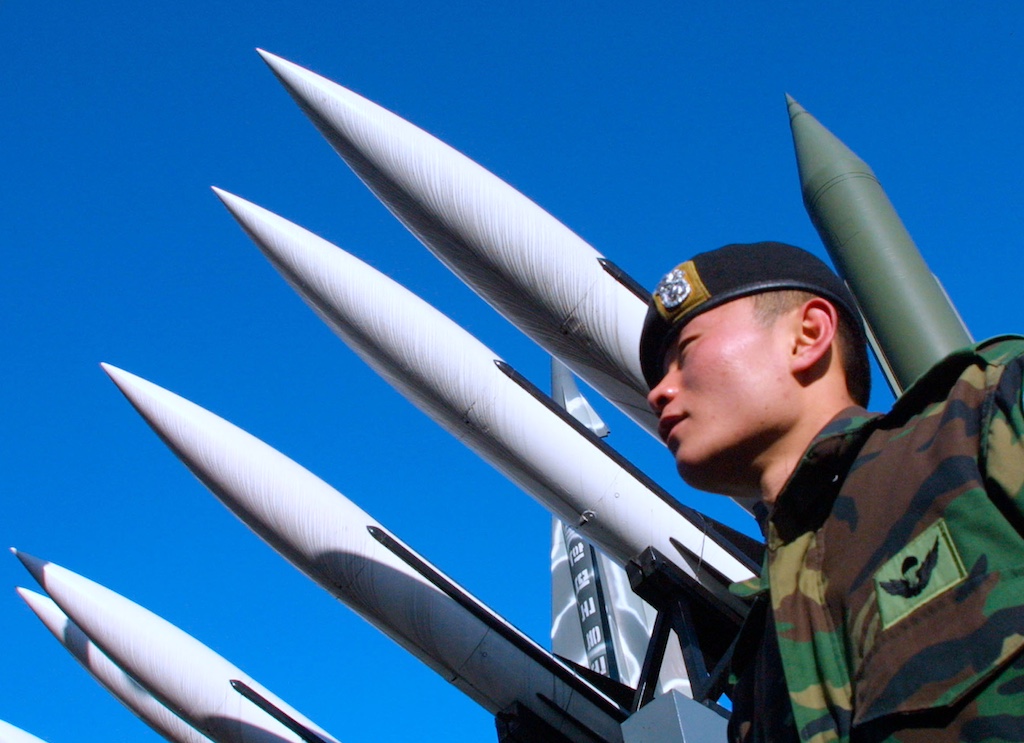
The latest step toward further normalizing and embedding nuclear weapons as a basis for global politics into an indefinite future has been sped on by the US conducting preemptive attacks with no real effort at a coherent justification for its actions. (Chung Sung-Jun / Getty Images)
In the ongoing US attacks on Iran, nuclear weapons are serving a familiar purpose: as pretext for military action that has already been decided on. On March 2, Secretary of State Marco Rubio justified the attacks as an effort to limit damage from an Israeli attack that had already been decided on, and to head off a situation where Iran had “so many conventional missiles, so many drones, and can inflict so much damage, that no one can do anything about their nuclear program.”
It’s become even less clear in intervening days what role Iran’s nuclear infrastructure — the country does not have nuclear weapons, but it does have the ability to develop them — currently plays in the administration’s strategic thinking. Some recent reporting suggests that Trump is considering sending US forces into the country to remove nuclear materials, but there are other indications that directly ending the country’s nuclear program is not on the table.
This is not to say that the US and Israeli attacks on Iran have nothing to do with the politics of nuclear weapons. The status quo for nuclear weapons is in fact getting much worse, even since the attacks began: on March 2, in a speech at the Île Longue submarine base in Brittany, French president Emmanuel Macron announced that the country would be expanding its nuclear arsenal, which currently consists of about three hundred nuclear weapons. That same day, France and Germany announced that they would be collaborating more closely on military and security policy involving France’s nuclear weapons. “The next fifty years will be an era of nuclear weapons,” in the words of the French president.
At the moment, France and the United Kingdom are the only two European countries with their own nuclear weapons. They, along with other NATO members, rely on the United States for “extended deterrence,” which means that the United States would, in theory, respond to a nuclear attack on one of these countries with its own nuclear weapons. Because this would then almost certainly expose the United States to a counterattack on its own territory, this arrangement has been regarded with some anxiety and skepticism. When it came down to it, would an American president really “sacrifice New York for Paris,” in the words of Charles de Gaulle?
This may not be the case indefinitely, however. Leaders of nonnuclear European countries occasionally muse out loud about developing their own nukes: in mid-February, Polish president Karol Nawrocki said that efforts to shore up the country’s security could be “even based on nuclear potential.” The country’s prime minister, Donald Tusk, said that “Poland will not want to be passive when it comes to nuclear security in a military context.” Other European countries have voiced enthusiastic willingness to take part in a France-led nuclear deterrence planning process, dubbed “forward deterrence.”
European statements around France’s plans take pains to portray it as an add-on to the coverage provided by US nuclear weapons, and most of Europe has cautiously supported, verbally or materially, the United States in its attacks against Iran. But that very caution speaks to a more durable change in global nuclear-weapons politics, one further solidified by those attacks.
This change has been driven by a progressive rejection of diplomacy in favor of military action, threatened or actual. It was the first Trump administration that left the Joint Comprehensive Plan of Action Iran deal negotiated under the Barack Obama administration, which provided for stable international oversight of Iran’s nuclear capabilities.
The United States and Iran had been conducting negotiations until just before the attacks. Some commenters, attempting to read a coherent strategy into the chaos of recent days, have suggested that Iran might now be more willing to accede fully to US demands, but, as innumerable commenters have noted, US statements about its intentions don’t seem to reflect anything resembling a long-term strategy.
Recent US administrations have taken a rather slack attitude to possible proliferation scenarios, especially if they involve countries the United States sees as allies. The Biden administration’s response to a 2023 announcement by then–South Korean president Yoon Suk-yeol that South Korea would consider building nuclear weapons of its own was muted, to say the least.
The Trump administration seems set on concluding a deal with Saudi Arabia that would provide it with the means to produce nuclear power. Unlike the Biden administration’s approach to negotiations for the deal, Trump and his team have let Congress know that it intends not to include an additional protocol (or “123 agreement,” after the relevant section in the Atomic Energy Act) that would create safeguards against the program being used to produce nuclear weapons. Saudi Arabia, which has been supportive of US and Israeli attacks on Iran, has openly indicated that it would develop a nuclear weapon if Iran did.
Under Secretary of War Elbridge Colby responded to the possibility of new European nuclear states by saying, “I think we’d more than try to talk them out of it [. . .] . We’d obviously at a minimum strenuously oppose it.” This is not an unequivocal statement. There’s a sense that, for all its violent bluster in defense of its status as the global superpower, the most powerful people in the United States regard preventing proliferation as simply beyond its capabilities. Instead, it is another risk to be managed with its military, whether through the direct use of force or by invoking the United States’ role in an ally’s national defense.
Above all, this latest step toward further normalizing and embedding nuclear weapons as a basis for global politics into an indefinite future has been sped on by the United States conducting preemptive attacks with no real effort at a coherent justification for its actions. Today, in 2026, Poland’s military-industrial base is nowhere near capable of producing nuclear weapons nor the means to use them. But maybe that’s just a confirmation of the timescale of this change: in couple of decades, that could be less true.
As the war in Ukraine drags on, Europe is making efforts to develop its constituent states military-manufacturing capabilities and to create and sustain links between different European national military industries. Given enough time and the right contingencies, additional European nuclear weapons programs could be spurred on by the sharing, overt or otherwise, of technological information, expertise, materials, and facilities among European governments.
This would not even have been conceivable were it not for the fact that the United States is gradually abandoning efforts to prevent the emergence of new nuclear-weapons countries, despite its legal obligation to do so under the Non-Proliferation Treaty. It’s tempting to brush the attack on Iran off as fundamentally not more brutal than US foreign policy of preceding decades. In many ways, that’s true: it’s clear that both the people perpetrating the attacks and the loudest voices criticizing them have Iraq and Afghanistan at the forefront of their minds.
But it’s equally important to notice who is feeling vulnerable here. If some of the United States’ closest allies now see benefit in moving toward the long road to independence from that country’s “nuclear umbrella,” it’s a real indication of the limits of its power, and an indication that its status as global hegemon has an expiration date. More countries ready to conduct the kind of diplomacy-by-force that the United States is modeling could create a much more complex and dangerous status quo under the US “nuclear umbrella.”