Trump Gets Real About US Dominance of Latin America

The United States has stopped pretending that the Monroe Doctrine was about anything other than its own freedom of action. Donald Trump has now declared dominance over the entire western hemisphere.
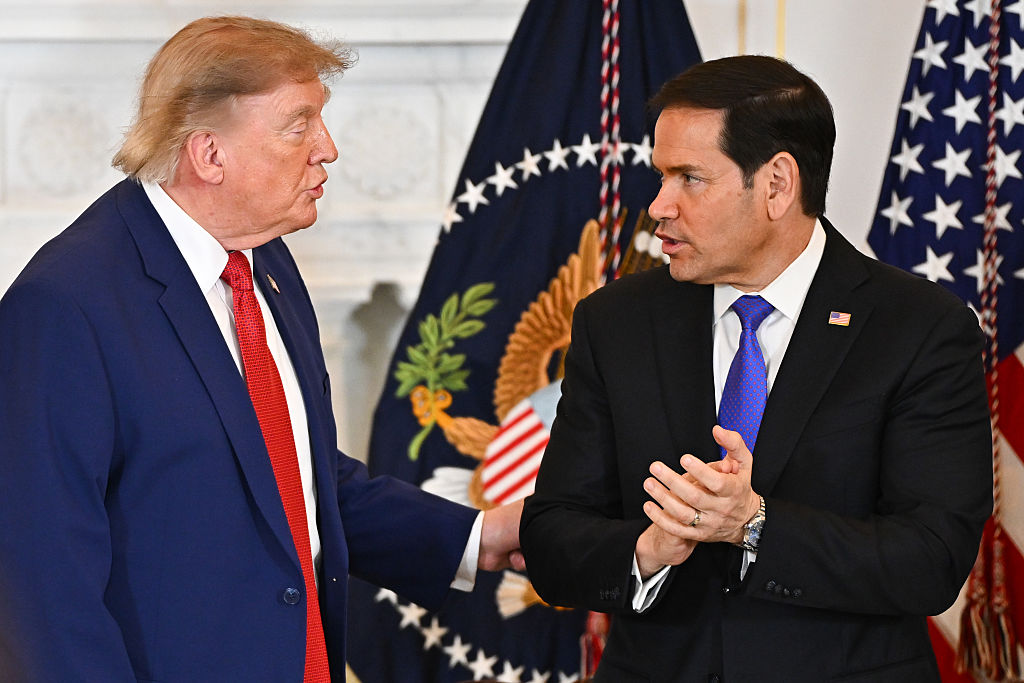
Donald Trump and Marco Rubio speak during an American mining industry roundtable at the State Department in Washington, DC, on August 7, 2026.

The Monroe Doctrine’s defenders have always insisted that it protects the Americas. Both its history and the Trump administration’s contemporary rhetoric and actions in Latin America show something narrower: the protection of US supremacy. (Graeme Sloan / Bloomberg via Getty Images)


In 1914, addressing the University of Buenos Aires, President Theodore Roosevelt called the Monroe Doctrine a policy “which the United States promulgated, partly as a matter of policy in its own interest, partly as a matter of policy in the interest of all the republics of the New World.” Earlier this week, the State Department posted a five-minute video to its official account on Twitter tracing a straight line from James Monroe’s 1823 message to Congress through the Spanish-American War, the Roosevelt Corollary, and the Cuban Missile Crisis, arriving finally at the abduction of Nicolás Maduro from Caracas this past January. The video presents Donald Trump as the doctrine’s “latest defender.”

Dispensing with two centuries of diplomatic euphemism, the video concludes that “American dominance in the Western Hemisphere will never be questioned again.” Rather than a defense of hemispheric independence that just so happens to benefit the United States, the Monroe Doctrine today is presented openly as a tool of American dominance.

This is not entirely surprising — the pretense of goodwill has never been central to the MAGA project. But for most of its history, the Monroe Doctrine required a certain interpretive work to be understood as an instrument of US hegemony. Defenders could point to its origins as a warning against European recolonization, a solidaristic shield extended over shaky, newly independent republics. Critics had to trace how the shield became a cudgel.

Henry M. Brackenridge, who led a special mission to Brazil in 1817 at President James Monroe’s behest, captured the ambiguous sensibility of US officials. “As an American, I cannot but feel a kind of pride in looking forward to the lofty destinies of this new world,” he wrote, concluding, however, that “when we consider the vast capacities and resources of Brazil, it is not visionary to say, that this empire is destined to be our rival.” All suspicion and no grace or gesture at understanding, the Trump administration is clearly being moved by the darkest historical impulses of the United States toward Latin America.

On the day after the State Department tweet, Celso Amorim — chief foreign policy adviser to Brazilian president Luiz Inácio Lula da Silva and former foreign minister of Latin America’s largest nation — told Brazil’s Congress that the video calls into question the sovereignty of every country in Latin America. He noted that Brazil goes unmentioned but insisted this hardly matters. A declaration of hemispheric dominance does not need to name targets if it claims them all.

Amorim then told lawmakers what enforcement could look like. Washington’s recent designation of Brazilian criminal factions as terrorist organizations, he warned, cannot be read apart from this context. Elastic interpretations of the terrorist and narcoterrorist labels have already justified military operations elsewhere.

Ironically, the government of Dom Pedro I was the first in South America to publicly endorse the Monroe Doctrine. The young emperor had the US president’s declaration printed in Portuguese and circulated as welcome news. Brazil, which had earned its independence only two years prior and remained anxious to assert itself in the region and beyond, read the doctrine as a promise that the New World would be left to govern itself. José Silvestre Rebello, Brazil’s first envoy to Washington, invoked exactly this logic when he pressed John Quincy Adams for recognition, which came on May 26, 1824, following the adoption of Brazil’s first constitution. Brazil’s independence was just and constitutional, Rebello argued, and Brazil should therefore be free to follow its own path.

That was the bargain as the most optimistic nineteenth-century Latin Americans understood it. The hemisphere would be closed to European empire, and the American nations would determine their own destinies. What the region got instead is well documented. Theodore Roosevelt’s 1904 corollary converted a warning to Europe into a license for the United States to police its neighbors. The doctrine underwrote occupations in the Caribbean and Central America, gunboat diplomacy, dollar diplomacy, and, during the Cold War, support for coups and dictatorships from Guatemala to Chile to Brazil itself.

Rep. Delia Ramirez, whose parents fled Guatemala during the US-backed slaughter there, responded to the State Department’s video by calling it cheap imperialist propaganda for an approach that has delivered “instability, deep poverty, extreme migration, and colonialism throughout Latin America and the Caribbean.”

Last November, the administration’s National Security Strategy announced a “Trump Corollary” to the Monroe Doctrine, declaring that the United States would deny non-hemispheric competitors — above all China — any foothold in the Americas and treat the region’s strategic assets as matters of American security. The first months of 2026 showed what that means in practice. Maduro was seized in a US military operation the administration called Operation Absolute Resolve. Cuba, meanwhile, has been subjected to an expanding sanctions regime.

“What we’re trying to teach them is there are no escape valves,” Rubio told Axios.

In a recent interview, Amorim called the Venezuela operation a violation of international law in its oldest sense, the law of nations, and observed that its only recent parallel is the fate of Saddam Hussein. He was careful to say he was not defending Maduro. That is precisely the point. One need not defend any particular government to grasp that a world in which Washington abducts hemispheric heads of state is a world in which no government’s sovereignty is secure.

With the bilateral relationship at its lowest point in decades — perhaps its historical nadir — Brazil has particular reasons to fret about the implications of this message from Washington. Brazil has never sought a break from the United States. It endorsed the Monroe Doctrine before any of its neighbors. It has fought alongside the United States, traded with it, and cooperated with administrations of both parties. What Brazil has sought, consistently, is something more valuable and apparently harder to grant than friendship: recognition of its right to pursue its own interests as Brazilians define them, even when doing so inconveniences Washington.

Lula trades with China because China buys what Brazil sells. He talks to Moscow and Tehran because Brazil believes conflict ends through mediation rather than escalation. Despite the Trump administration’s implications, none of this constitutes alignment with US enemies. It constitutes the foreign policy of a large, self-governing nation that declines to live inside anyone’s sphere of influence.

That refusal is the real target of the video. Amorim has argued that multipolarity is degenerating into something cruder: a carve-up of the world into spheres of influence, with the great powers rhetorically condemning one another’s land grabs while respecting them in practice. Asked what Brazil would do if the United States invaded, Brazil’s defense minister said recently that a helpless Brazil “would have to open the gate.” For his part, Amorim has concluded that Brazil cannot match the military power of the United States, China, or Russia, and should not try, but it can make aggression costly. Hence his call for defense spending approaching 2 percent of GDP and for a national strategy around critical minerals, where Brazil already ranks second in the world in rare-earth reserves. A country announces that hemispheric dominance is its birthright; its largest neighbors start pricing submarines. This is how the Trump administration has the hemisphere thinking.

The deeper problem is the one many Latin Americans identified in 1823. A doctrine that closes the hemisphere to outside empires is only as good as the self-restraint of the power announcing it. Simón Bolívar realized this early on. Brazilian diplomats saw it by the 1820s, when Rebello, no republican, left Washington convinced that the United States favored its own interests over any abstract principle.

The doctrine’s defenders have always insisted that it protects the Americas. Its history shows something narrower: it protects American primacy. The State Department’s video has now discarded the distinction. The United States has stopped pretending that the Monroe Doctrine was about anything other than its own freedom of action. Latin America clocked this two centuries ago. Washington is only now catching up with its own record.

Brazilians will go to the polls in October under the shadow of capricious tariffs imposed for political gain, terrorist designations that could license intervention, and a superpower openly proclaiming dominance over their hemisphere. If they conclude that sovereignty is on the ballot, they will be reading the moment correctly.