Mexican Sovereignty in the Era of the Donroe Doctrine

US governments have long relied on Mexico as a southern gendarme, even as it proudly declares its sovereignty. Faced with Trumpian imperialism, the challenge for Claudia Sheinbaum’s government is to make that independence more real.
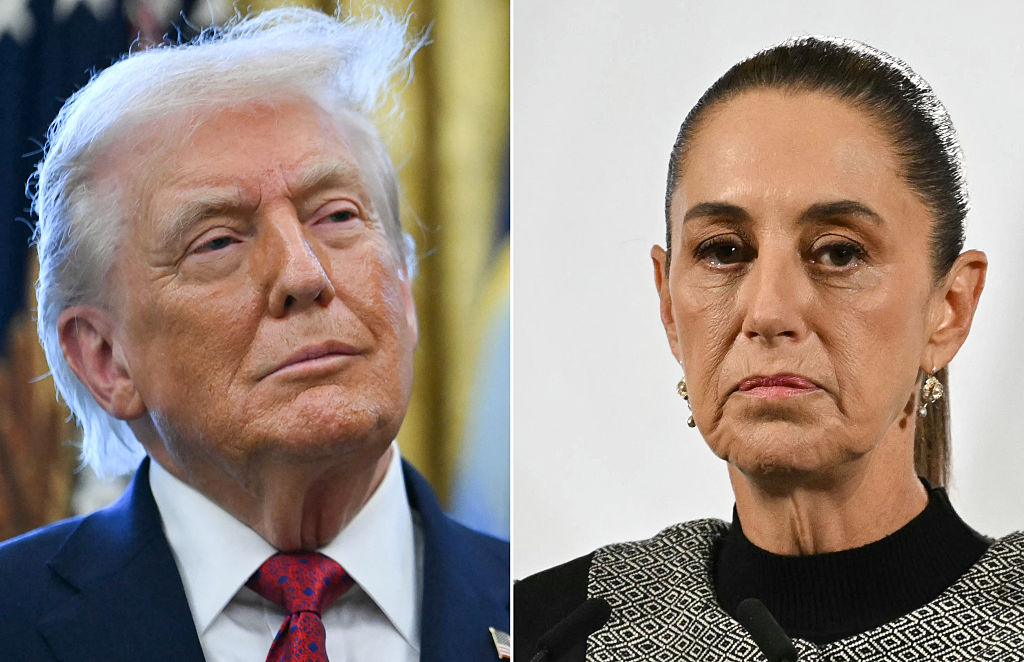
A diptych featuring portraits of Donald Trump and Claudia Shienbaum

Past Mexican governments often proclaimed their sovereignty while kowtowing to Washington. Yet today the disastrous effects of Donald Trump’s wars are pushing Claudia Sheinbaum’s Mexican government to seek allies further south. (Andrew Caballero-Raynolds and Yuri Cortez / AFP via Getty Images)


When it comes to US-Mexico relations, 2026 thus far reads like a Taylor Sheridan script. Last April, the CIA’s clandestine operations inside Mexico became public when two agents died in a car crash in the northern state of Chihuahua after raiding and dismantling a mountain drug lab. Reporters soon revealed that four CIA agents had participated in the operation, albeit wearing Chihuahua state police uniforms, and that this was their third counter-narcotics raid since January.

In May, CNN and the New York Times broke a stunning and seemingly related story. Reporters claimed that the CIA had been running a “secret war on cartels” since last year, assassinating lower- and mid-ranking members to dismantle entire criminal networks. This secret war went beyond the kingpin strategy that prioritized the arrest or killing of “cartel” leaders to “a playbook not much different than counterterrorism missions to destroy groups in the Middle East and elsewhere in the world.” Except that this was taking place clandestinely and illegally inside Mexico.

The Mexican government responded to both reports by loudly proclaiming its national sovereignty. President Claudia Sheinbaum initially denied that Mexico’s federal government knew about the Chihuahua CIA operations, placing the blame on a state governor (a member of a right-wing opposition party) gone rogue. Yet contradictions have emerged in this account. High-level conversations about these operations between the US and Mexican governments allegedly took place. And the April raid involved Mexican military personnel in a support capacity.

Sheinbaum, along with the CIA, also categorically rejected the existence of an elite spook death squad assassinating narcos inside the country. Indeed, she denied the direct participation of any US personnel in counter-narcotics operations in Mexican territory. The United States’ role, she argued, is limited to intelligence sharing.

For Mexico, the question of sovereignty — and its public discursive performance — has long involved a sort of rhetorical vagueness: strategic at best, Janus-faced at its worst. While this is not uniquely Mexican, its deeply interconnected history with the United States and the consequences of sharing a long border with a settler-colonial expansionist polity have produced the dynamic evident also in President Sheinbaum’s responses. This, in practical terms, weak sovereign power relative to the United States necessitates strong public claims to the contrary, alongside delicate negotiations in private. That long shared border — in addition to related questions of economic integration, geopolitics, migration, and internal Mexican stability — has required US political elites to generally tolerate public, nationalist assertions of Mexican sovereignty. That these two countries engaged in nearly $900 billion in trade in 2025 has also motivated such toleration more recently.

From both sides, then, Mexican sovereignty has required careful calibration.

Yet this profoundly unequal arrangement, deepened since the 1980s with Mexico’s “structural adjustment” and ongoing integration into the United States-Mexico-Canada Agreement (until 2020, the North American Free Trade Agreement) is in flux today. The so-called Donroe Doctrine, articulated in the Trump administration’s 2025 National Security Strategy, aims to undo, or at the very least create parallel institutions of power to, the so-called rules-based international order and its buttressing institutions created after World War II. The contingent, partly fictional aspect of this order — in its death throes during the global war on terror and buried in Gaza — is giving way to unilateral US power openly based on force, coercion, and domination in the Americas and West Asia, as evidenced by the kidnapping of Venezuelan president Nicolás Maduro.

Mexico has been here before.

Poinsettias and the “First Gringo in Mexico”

In an 1829 letter to President Martin Van Buren, the diplomat and former US Secretary of War Joel Poinsett wrote:

“It would lead you into error to compare [Mexicans] with the free and civilized nations of America and Europe in the Nineteenth century. They started from a period nearer to the age of Charles the fifth, and it is even a matter of some doubt whether this Nation had advanced one step in knowledge and civilization, from time of the conquest to the moment of declaring themselves Independent.”

The South Carolinian Poinsett had spent some years in Latin America, notably in Chile, prior to his arrival in 1825 as the first official US ambassador to Mexico. He headed there following his vote to execute the last “ringleader” of the 1822 Denmark Vesey–led slave rebellion in Charleston as part of a court commission. He was sent to Mexico by then-President James Monroe on a special mission to assess where the country merited US recognition of its independence. His ship briefly stopped in Puerto Rico, long enough for him to ponder the high probability of a slave insurrection due “to the vicinity of the Republic of Hayti.” Finally arriving in Veracruz in late 1822, during the tumultuous imperial rule of Agustín de Iturbide, the South Carolinian traveled through eastern and central Mexico. He fretted about Britain’s preponderant economic power in the country, scouted promising mining ventures for his personal portfolio, and (correctly) doubted that Iturbide’s unstable monarchy would last. Upon his return to the United States, Poinsett published his writings, reaching an international audience. As historian Lindsay Schakenbach Regele notes, these published “opinions formed the basis for Alexis de Tocqueville’s statements in Democracy in America about Mexico’s inability to sustain democracy.”

Poinsett was not the first choice for this new diplomatic posting. Future President Andrew Jackson had previously declined Monroe’s offer. When the South Carolinian returned to Mexico, he immediately began meddling in its internal affairs. By the time Jackson allowed him to resign in 1830, the ambassador had interfered in negotiations between Mexico and the last remaining Spanish military forces located near Veracruz; secretly organized political opposition via a Masonic Lodge to the ruling Centralist party “which he saw as antithetical to U.S. interests because of its close ties to British business”; and, in 1828, even supported a coup to further US political and economic interests in the country. He also used those “Masonic connections” to obtain “favorable plots of land for himself and his friends and establish an American-based mining company.” Poinsett later went on to serve as Jackson’s secretary of war and carry out the genocidal Indian Removal Act.

Now remembered more for the red cuetlaxochitl flower that he sent back to the United States than his diplomatic misadventures, Poinsett created the script for future ambassadors. From the beginning of the United States’ diplomatic relations with Mexico, its sovereignty was titular and negotiable. The United States’ neighbors were not equal nation-states. The question, past and present, is not whether the United States should infringe upon Mexican sovereignty, but how much, and how it should calibrate and determine the scale and form of said infringements.

The first ambassador’s actions highlight a broader, structural feature of US-Mexico relations. From the US perspective, Mexico merely serves as a strategically important territory, a launching pad for the regional and global projection of imperial power, and a key to ensuring its own domestic stability (particularly in the past decades through the control of migration and illicit drug trafficking). US national security is premised on viewing Mexico as a territory to control, exploit, and subordinate. In that regard, Poinsett set the rule for a type of meddling that combines state and private interests in aid of imperial policy. That rule led to the theft of more than half of Mexico’s national territory in the mid-nineteenth century and the coup plot that murdered the country’s first democratically elected president of the twentieth century.

The US architect of the coup that overthrew President Francisco Madero in 1913, Henry Lane Wilson, was a twentieth-century version of Poinsett. When Madero’s wife implored Wilson to save her husband, the ambassador retorted, “Your husband’s downfall was due to the fact that he never wanted to consult with me.”

Josephus Daniels represents the rare exception. A southerner like Poinsett, Franklin Delano Roosevelt appointed him ambassador in the days of the New Deal and Good Neighbor Policy. Daniels (like others in FDR’s “brain trust”) viewed Mexico as a revolutionary laboratory from which to learn and draw lessons. In his recent book, America, América, historian Greg Grandin narrates how Daniels — despite his white-supremacist past and ideas — pushed FDR to consider borrowing from the 1917 Mexican Constitution’s revolutionary advances on social rights. “Mexico,” he told the president in 1934, “is looking to do more for the forgotten man than you have been able to do.”

It was a brief moment when some progressive US politicians managed to recognize the limits of political liberalism and of US power itself by reading about and analyzing in good faith the social and economic radicalism unfolding south of the border. Mexico — and Latin America — had something to teach the so-called colossus of the north about social justice, noninterventionism, liberal multilateralism, and respect for national sovereignty, and as Grandin argues, an actual “rules-based international order.” There were surely contradictions, particularly for some Caribbean and Central American nations that chafed under the dictatorial rule of FDR’s (and the United Fruit Company’s) preferred “sons of bitches”: the likes of Fulgencio Batista (Cuba), Anastasio Somoza (Nicaragua), Rafael Trujillo (Dominican Republic), Maximiliano Hernández Martínez (El Salvador), and Jorge Ubico (Guatemala).

Yet this looks like a brighter moment when contextualized in a longer history of US-Latin American ties. Tragically for the region, the United States has been a terrible, unwilling student, unable to take responsibility for a violent imperial history, or even acknowledge it.

This same history continues to this day, as we have witnessed in Venezuela and Cuba. It is as if the region is there only for the United States to control and dominate it, making the imperialist aspirations of the Monroe Doctrine into reality — including in its southern neighbor.

The Donroe Doctrine, as cartoonishly brutish as its namesake, imagines two political options when dealing with Latin America today: work with obsequious, pliant authoritarian local proxies (Nayib Bukele, Daniel Noboa, Javier Milei) or hold a gun to the head of recalcitrant leaders through economic, legal, or military threats. Cynical recourse to “international niceties,” as Stephen Miller puts it, are out; strength, force, and power as the “iron laws of the world” are back in. There are efforts to legitimize this will to power by deploying framings that fuse security and anti-communist discourses, like “narcoterrorism.” But overall, sheer dominance without hegemony is the aspiration for the Americas, even as the United States rhetorically or militarily concedes the limits of its power elsewhere in the world.

But Mexico represents a different sort of challenge for this imperial arrangement. It always has.

US Empire and Indian Wars

Since winning independence in 1821, the first of Mexico’s three popular revolutions, outsiders have doubted Mexico’s capacity for republican democratic self-rule and, by extension, its ability to exercise sovereignty. Modern sovereignty, as political theorist Bikrum Gill reminds us, depends on “two relations of force”: internally as effective control over a geographically delimited territory,and a monopoly of force within it; and, externally as recognition accepted, granted, or forced from other sovereign powers.

The United States has long doubted the Mexican state’s ability to translate internal sovereign aspirations into reality. Such doubts have consistently connected Mexicans’ alleged incapacity for self-rule — expressed as perpetual political disorder and social violence — to the immediate safety of the US homeland. Mexico even presents the biggest threat. “And you thought World War III started in Eastern Europe,” a CIA contractor in Taylor Sheridan’s television show Lioness tells his teammates, “No, no, no everyone. It’s Mexico.”

In contemporary terms, we are talking here about “border security.” In the 1830s, a Mexican Texas dominated by indigenous polities like the Comanches capable of organizing large raids, made unstable by undocumented proslavery Anglo migrants, and open to European capital, potentially undermined US border regimes and capitalist frontier fantasies. Today, it is an amorphous mix of migrants, illicit drugs, and “narcoterrorists” that is allegedly threatening the evergreen American Maginot Line: The barbarians are at the gates, “The Hispanic Challenge,” as Samuel Huntington wrote in the immediate aftermath of 9/11, threatened to undermine “Anglo-Protestant culture” and US national identity. Whereas this illustrious Harvard professor and dedicated consultant to authoritarian regimes feared a country split in two, it’s not too difficult to see how some of his students moved on to think about racialized civilizational warfare and even great replacement theories.

To diagnose US imperial and domestic anxieties in any given era, look to the US-Mexico border, a space of exception where US empire justifies myriad forms of violence as acts of “preemptive self-defense.” US empire, following Nick Estes and Stefan Aune, is one long Indian War. Enemies are rendered “Indian,” subject to exceptional forms of justified violence beyond the law, beyond political rights, beyond so-called civilization, reserved for its “barbarous” opponents. This settler-colonial and imperialist logic — underscored by a notion of self-defense against “irrational” and “savage” enemies whose form of warfare is total “undistinguished destruction” — links Thomas Jefferson’s comments about “merciless Indian savages” in the Declaration of Independence to the genocidal wars waged by the United States against indigenous polities throughout the late eighteenth and nineteenth centuries to the ongoing extrajudicial executions of Caribbean “narcoterrorists” on boats who kill “millions” of Americans with illicit drugs. As the lawyer, Dylan Saba, argues, these frontier-border-Indian wars, saturated in racial colonial violence, formed the core of US legal understandings of (just) warfare — a core projected onto international law in the aftermath of World War II as the United States became the global hegemon.

In this imperial imaginary, Nicolás Maduro represents a current manifestation of Geronimo, or perhaps a hybrid version that includes Pancho Villa: revolutionaries who treated the US-Mexico border like a Möbius strip.

But when the empire is everywhere, the imperial borders/frontiers are global. Understanding the history of US empire as grounded in the logic of Indian War helps us understand why the global war on terror‘s legal justifications for torture invoked the Seminole Wars; or why Osama bin Laden was code-named Geronimo in the US operation that killed him in Pakistan.

As such, the US policing of imperial borders and the hapless but violent search for new “regenerating” frontiers — like Greenland today — depend on what is called the security of the southern border and the country below it. For two centuries, US tolerance for some degree of mediated Mexican sovereignty has hinged on the existence of political-social stability, economic opportunity for US capital, and “border security.” Viewing the interdiction of illicit drug trafficking as a tense and negotiated binational exercise since the early twentieth century helps us understand the US-Mexico relationship today and Mexican sovereignty more broadly. According to the Donroe Doctrine, as incoherent and contradictory as this “project” seems, the tripartite war on migrants, drugs, and the nebulous concept of “narcoterrorism” is at the core of, as Pete Hegseth said last year in Panama, the project “to put America first,” and, to accomplish this, “we will put the Americas first.”

In this paradigm, what connects Minneapolis, Caracas, and Cuba to the Caribbean, the eastern Pacific, and the US-Mexico borderlands is the US imperial power to decide who gets to live and who must die. It is the power to detain, imprison, and extrajudicially murder individuals and communities deemed existential threats to the United States. With impunity and no due process or regard to international law. With no distinction between the foreign and the domestic. And celebrated via snuff video clips or “banger memes” disseminated throughout social media platforms.

Tenuous Sovereignty

In addition to a shared border, a history of military interventions and territorial conquests has shaped US-Mexico relations and lasting Mexican definitions of nationalism and sovereignty. Changes in US government and geopolitics have at times provided Mexico more space to assert its sovereignty: President Lázaro Cárdenas’s nationalization of Mexican oil during the late 1930s is one important example. This story is not just one of unilateral, overwhelming US dominance over its southern neighbor. Mexican political officials have had to learn something about waging asymmetrical warfare, mostly in a metaphorical sense, to defend sovereignty from external pressures.

Mexican political leaders since the 1960s have also repurposed those external pressures to firm up domestic political and social stability and to extend state power into internal frontiers and rebellious zones like the states of Guerrero and Sinaloa. Since World War II and the Cold War, public and now-declassified transcripts have helped scholars understand the dynamics of US-Mexico relations. Publicly, US political leadership has generally tolerated even strong Mexican rhetorical and diplomatic assertions of sovereignty. For instance, during the 1960s, Mexico maintained diplomatic relations with revolutionary Cuba even as the United States cajoled the rest of the region into isolating the revolution. Yet as we now know thanks to historian Renata Keller, Mexican political and diplomatic officials secretly passed along intelligence about the Cubans to the US government. The Cubans reciprocated by not supporting revolutionary movements within Mexico. 1970s President Luis Echeverría was later revealed as a CIA asset, having secretly pushed US officials to elevate and tolerate Mexico’s international position as a progressive but anti-communist state within a rapidly decolonizing and nonaligned Global South. Three other Mexican presidents were also on the CIA payroll from 1958–82.

During the Cold War, Mexico thus remained “the last good neighbor” — albeit with some reservations. In a now-declassified military analysis from 1965, a Mexican intelligence officer considered the possible consequences of the US buildup in Vietnam. If the United States sought to more aggressively protect its “southern flank” as it (over)extended its military capacity in Asia, would it coerce Mexico into a more direct collaboration? And even violate “our sovereignty over land, sea, and air?” And if Mexico refused, considering the status of its military, designed for the police maintenance of internal security, not for resisting external aggression? Such refusal in the name of defending “territorial sovereignty,” the author hypothesized, could lead to direct US military intervention.

That threat remains today. Replace Vietnam with “the drug cartel” or “narcoterrorism” and you have the twenty-first century version.

Nuestra América

As historian Christy Thornton shows, historical experiences of US intervention led Mexican intellectuals and diplomats to formulate important new multilateral approaches to international governance and global economic development in the decades after the 1910 Revolution. In meaningful ways, these Mexican contributions helped shape the so-called rules-based international order and offered more progressive alternatives throughout the twentieth century, such as the New International Economic Order. This is one legacy that President Sheinbaum could draw upon in this current precarious moment, faced with a serial killer US empire.

Mexico also has leverage. The current criminal war waged by the United States and Israel on Iran — and the economic fallout that promises to worsen, particularly for energy and food markets — only enhances the primary significance of the US-Mexico economic relationship. The shared border, too, gives Mexico power in this unequal arrangement.

Trying to satiate this erratic, warmongering US empire is a dangerous, self-defeating option. It will not stop at Venezuela, Haiti, or Cuba. The killing or capture of cartel kingpins like Nemesio Oseguera Cervantes “El Mencho” will not suffice; “narcoterrorism” is a convenient label that can be slapped on anyone deemed a threat to US regional interests. A day after journalists reported last January that President Sheinbaum had decided to end oil shipments to Cuba, the GOP-controlled Foreign Affairs Committee of the House of Representatives demanded more: “ending all support for this oppressive regime and its friends in Moscow and Beijing.” Threats of US military intervention have not stopped.

The challenge for the current Mexican government is to reject the role of colonial gendarme and look south to engage in the ever-seemingly impossible task of uniting “Nuestra América.” It must do so in the face of a bellicose northern colossus and its growing number of regional lackeys that comprise the so-called Shield of the Americas.

At the least, increased coordination with Brazil (the biggest country in the region, demographically, along with Mexico) to defend sovereignty as a foundational, nonnegotiable principle is a must. Sending oil to Cuba would help alleviate national electrical blackouts and a collapsing power grid. Not by coincidence, the global grassroots convoy that sailed to Cuba earlier this year to break the murderous blockade bears the name of José Martí’s idea of revolutionary, internationalist, and anti-imperialist solidarity put into practice.

Or, as the Argentine delegation to the 1889 Pan-American Conference put it, this means building an America not for the United States but an “America for humanity.”