Colombia’s Far Right Sees an Earthquake as an Opportunity
The response of Colombia’s new leader, Abelardo de la Espriella, to a deadly earthquake has been tawdry beyond belief. The reactionary president has used the disaster for publicity stunts and will only accept overseas aid from his far-right allies.
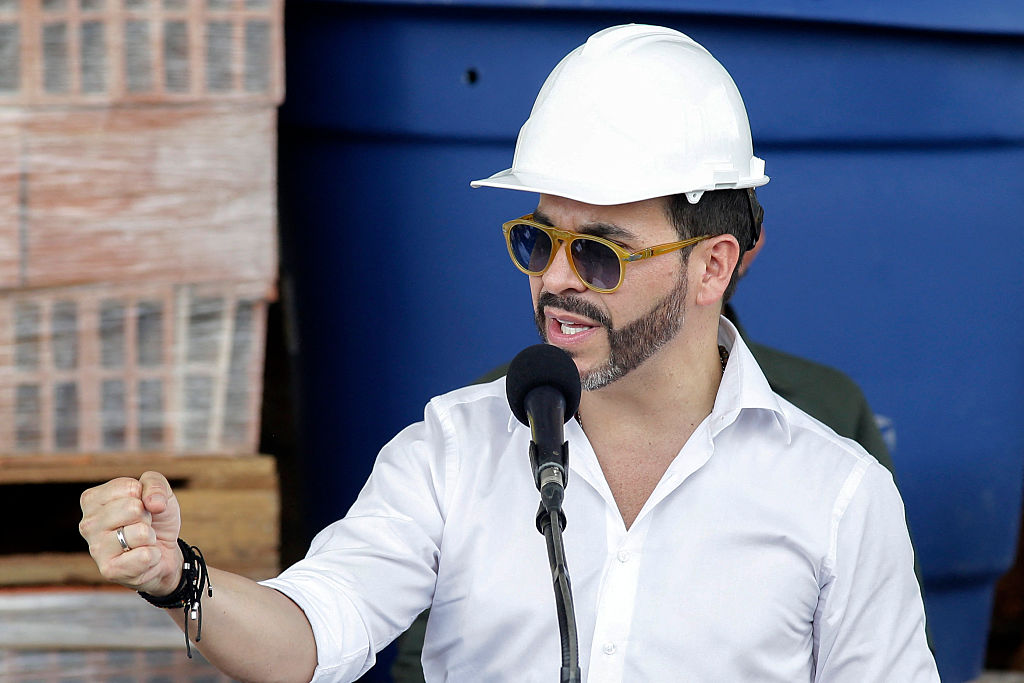
Since an earthquake hit western Colombia, the region is taking center stage for the new administration of Abelardo de la Espriella as it reverses Gustavo Petro’s redistributive policies and seeks to refound Colombia as a bastion of far-right politics. (Cesar Queiroz / AFP via Getty Images)
On August 10, western Colombia was rocked by a 7.8 magnitude earthquake. Images of collapsed buildings and ordinary citizens organizing to remove the rubble quickly circulated on social media and through news agencies. Cali, the region’s largest city, quickly became the week’s trending topic.
This came just three days after the country’s far-right President Abelardo de la Espriella had taken power in a highly divisive and militarized spectacle held at a military base in the city, which voted overwhelmingly for his leftist competitor Iván Cepeda. Now after the earthquake, Cali and western Colombia are taking center stage in the administration’s reversal of Gustavo Petro’s redistributive policies and its attempt to refound Colombia as a bastion of far-right politics.
The Initial Response
Instead of coordinating international support for those affected by the earthquake, de la Espriella’s foreign ministry sent shockwaves through much of the diplomatic community by releasing a statement that legitimized Israel’s occupation of Syrian territory in the Golan Heights. This made it one of only two countries to do so — the other being the United States.
This was a decision that seemed severely out of place even to many of the government’s supporters. It unnecessarily isolated the country from the international community at a time when it faced one of the most vulnerable moments in its recent history. Simultaneously, the foreign ministry also issued a similar statement recognizing Moroccan sovereignty over Western Sahara and freezing diplomatic relations with the Sahrawi Arab Democratic Republic.
At home, de la Espriella’s colossal ego dominated the initial response to the disaster, with the newly inaugurated president waving and blowing kisses to the audience just before announcing the death toll and damage caused by the earthquake.
Ironically, because de la Espriella abstained from conducting a formal transition of power for the first time in the country’s recent democratic history, the director of the Colombian disaster agency, Javier Pava, was still a leftist appointed by outgoing President Petro. Pava and his team had to deal with the uncomfortable task of handling the initial response and dispatching government workers to the site of the disaster in cooperation with a hostile administration.
In the midst of the crisis, de la Espriella also began bombing National Liberation Army encampments in the Catatumbo region on the other side of the country, reportedly causing civilian casualties and damage to infrastructure in the region. The bombing was criticized by various members of the opposition for disproportionate use of force and violations of international humanitarian law while the country was immersed in a humanitarian crisis. The bombing also occurred in parallel with an announcement from the United States Secretary of War Pete Hegseth that US troops would be involved in future military operations on Colombian soil.

One of the most jaw-dropping moments of the government’s reaction to the earthquake was the failure to ask for international assistance to rescue those trapped in the rubble. Of all people, it was El Salvador’s right-wing President Nayib Bukele who revealed that the Colombian government had rejected his initial offer to provide a rescue team. Mexican President Claudia Sheinbaum also emphasized that Mexico was ready to send their own disaster team at a moment’s notice but had not received a response.
After mounting pressure for a statement on how the government planned to ask for international help, the government stated that it would only receive rescue teams from Ecuador, Israel, the United States, and El Salvador, all of which are governed by far-right allies. Government officials claimed that, while they were open to receiving help in the form of supplies from other countries, only these four states had the certificates necessary to conduct disaster relief operations.
Afro-Colombian and Indigenous Mutual Aid
The regions hardest hit by the earthquake are ones where Afro-Colombian and indigenous peoples make up a large part, and in many cases a majority, of the population. For instance, in the department of Chocó, the department home to the epicenter of the earthquake, nearly 95 percent of the population identifies as Afro-Colombian or indigenous.
As with many other countries of the Americas, including the United States, in Colombia black and indigenous communities constitute some of the most marginalized and oppressed communities due to the lasting impacts of colonization and slavery.

In Colombia, such marginalization is exacerbated by the concentration of these communities in rural areas where there is a weak state presence in the provision of services and where the armed conflict continues to have an impact. These issues were key to the Petro administration’s peace negotiations, and they were part of the reason why regions with large indigenous and Afro-Colombian populations voted overwhelmingly for Iván Cepeda in both the first and second round of this year’s presidential election.
Afro-Colombian and indigenous communities were more vulnerable to the destruction the earthquake caused because the infrastructure that exists in those communities is already precarious. However, the communities themselves began to organize directly for support and mutual aid.

In the capital Bogotá, organizations ranging from large indigenous federations to Afro-Colombian cultural associations made calls to their networks to donate what they could to provide a lifeline for those displaced by the earthquake. Even Shakira took part in the effort, pledging to donate over a million US dollars to Chocó and publicly criticizing the Colombian state’s historical abandonment of the region.
Afro-Colombian and indigenous members of Congress have created funds to directly reach the communities affected by the earthquake. Óscar Benavides, a representative for the leftist Afro-Colombian Libres Party, has gained national attention for his early role in raising funds and supplies for communities on the Pacific coast of the country.
Despite attacks from the right-wing media, Benavides has reportedly raised over $100,000 for the relief effort. He has also shipped thirteen trucks full of supplies to the region and conducted visits there with the Indigenous representative and former vice-presidential candidate, Aida Quilcué.
Rebuilding in Buenaventura
In Buenaventura, one of the cities most affected by the earthquake and the country’s largest port on the Pacific coast, 82 percent of the city’s population was already living in conditions of extreme poverty prior to the earthquake. The city has a population of about 433,000 people, with the vast majority living in its urban core. Eighty-nine percent of the city’s population are Afro descendent, and 1 percent are considered indigenous.
María Eugenia Mosquera, who works with the organization Conpazcol, told us about the impact of the disaster:
Unfortunately, whenever these disasters happen, it’s the working-class neighborhoods that are most affected, right? Where there are fewer conditions for a decent life, and these were precisely the homes that were most destroyed. And sadly, sometimes the focus is more on those who have and not on those who don’t.
Conpazcol is an organization of human rights defenders and victims of Colombia’s armed conflict that works closely with Afro-Colombian, indigenous, and campesino communities in different parts of Colombia and has worked for years in Buenaventura. In the days since the earthquake, the organization has been trying to understand the ways in which different communities have been impacted while also seeking to ensure that earthquake aid is distributed to people and families that need help.

The Buenaventura mayor’s office recently published the following preliminary statistics regarding the earthquake’s impact: twenty-seven dead; 476 people injured; 10,148 families affected; 10,148 homes impacted; and 954 homes destroyed. These figures will very likely continue to rise as authorities are able to more clearly account for the damage caused by the earthquake. It’s probable that many more families were impacted, since multiple families often occupy a single home.
Mosquera expressed concern about the reaction of the new Colombian government:
The current president is more interested in war and extractive industries than actually thinking about what’s happening here. After the earthquake, all he’s done is arrive, take pictures, laugh, do things that aren’t appropriate for the situation, and he hasn’t provided the necessary response.
Several Colombian officials have engaged in controversial actions and statements during visits to Buenaventura in the aftermath of the earthquake. President de la Espriella’s visit on August 16 was particularly controversial, because he threw soccer balls printed with propaganda from the recent electoral campaign promoting his own political party at earthquake victims. The situation reminded observers of the moment when Donald Trump threw paper towels at victims of Hurricane Maria in Puerto Rico in 2017.
Silvia Estupiñán, a community leader from the neighborhood of Pampalinda in Buenaventura, was not impressed:
The new government is out of touch with the disaster in the territory. It needs better guidance, because coming to Buenaventura or visiting other areas to hand out soccer balls is an insult to the people. It’s disrespectful and lacks professional ethics.
Interior Minister Rodrigo Lara made headlines when he toured the earthquake damage with the mayor of Buenaventura. He said that the government would get the wood and cement, while the people of the area would “provide the labor themselves and fix it in two minutes.” Critics argued that it was insensitive for Lara to claim that the poorest residents of Buenaventura would be able to rebuild their houses almost immediately.
Profit Over People
The earthquake has revealed two contrasting models of disaster response in Colombia, corresponding to the political divisions that separated the country in June’s elections: a response from capital and a response from the people.
De la Espriella’s administration has used the crisis as an opportunity to consolidate its ideological model and mold Colombia in the image of the global far right, fully aligning the country with Washington even if it means leaving citizens under the rubble and isolating the country from the rest of the world. It looks as if the reconstruction effort in the coming months will serve as a key part of the spectacle of capital accumulation in the territories destroyed by the earthquake, territories that overwhelmingly voted for Petro and Cepeda.
However, the crisis following the earthquake has revealed another model of disaster response, one based upon solidarity and collective organizing. As Mosquera remarks:
We have always said that international solidarity is crucial for the affected territories. First, it raises awareness. Second, it provides support . . . because amidst the crisis caused by the earthquake, there are also issues of protection.
The historical abandonment by the Colombian state means that communities in Buenaventura and Chocó already have experience organizing themselves in the face of marginalization and adversity. This experience will be essential to survival as de la Espriella continues to implement an agenda that favors capital over life itself.