The Donroe Doctrine: Making LatAm an Investor’s Paradise

The Trump administration is forcing Latin American governments into arbitration courts that grant multinationals the extraordinary power to sue states that nationalize resources or even just raise the minimum wage, if perceived to threaten investor profits.
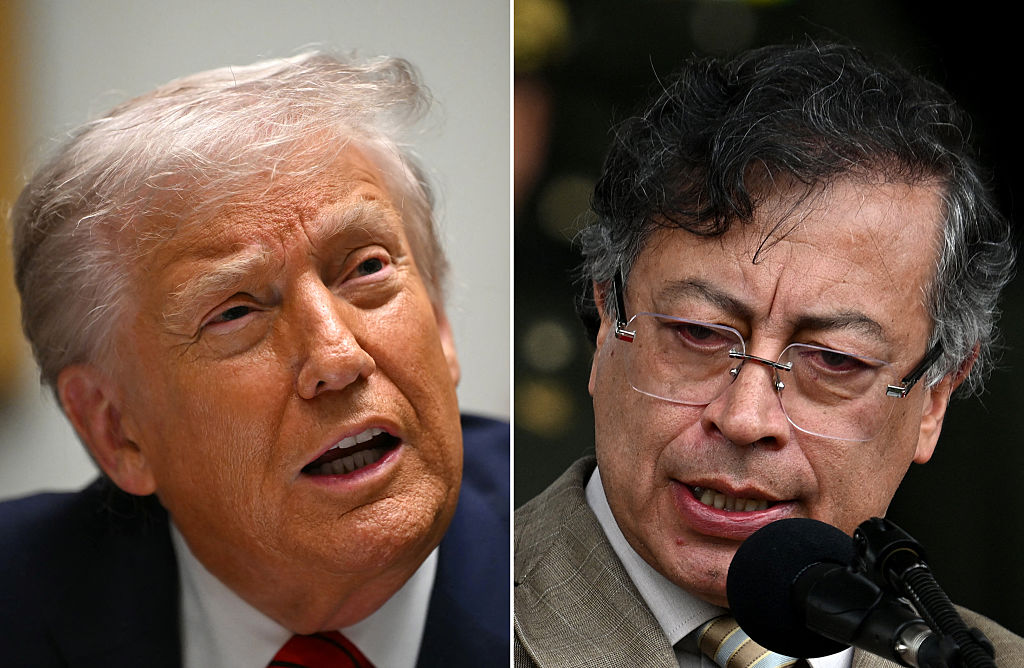
A diptych featuring US President Donald Trump and Colombian President Gustavo Petro

The Trump admin is aggressively pushing “investor-state dispute settlement” arbitration in South America, punishing everything from environmental protections to minimum-wage increases with crippling fines levied on states by investors. (Andrew Caballero-Reynolds and Raul Arboleda / AFP via Getty Images)


Venezuela’s sweeping new mining law, passed on April 9, is the latest in a series of domestic “reforms” purportedly directed at rebuilding the country’s energy and mining sectors. This follows years of debilitating US sanctions and disinvestment, which have seen the mining centers of the Amazonas, Bolívar, and Delta Amacuro states abandoned to governance by “criminal syndicates.” But buried deep within the text of this law is a historic concession that will redefine Venezuela’s relationship with transnational energy and mining capital for the foreseeable future, a mandate that Caracas must submit to investor-state dispute settlement (ISDS)–style arbitration.

By agreeing to resolve business lawsuits in extraterritorial courts, the Venezuelan legislature under President Delcy Rodriguez has agreed to surrender a key pillar of their authority. Under an ISDS-style system, transnational energy and mining corporations would be granted the extraordinary power to sue the Venezuelan state for enacting policies like environmental protections or minimum wage increases, which could be perceived as threatening “expected future profits.” These are dual procedural and policy tools, promoted largely by development banks and the United States government, designed to disincentivize socialist state formation in favor of “de-risking” state formation.

The inclusion of this arbitration clause is an enormous defeat for the broader Bolivarian resource nationalist project. Venezuela represents the crowning achievement of the Donroe Doctrine’s strategy of turning countries like Bolivia and Ecuador into securitized, “investor-friendly” resource corridors. By pressuring states to accept arbitration outcomes that can result in fines in the hundreds of millions of dollars, backed by the implicit threat of US Treasury sanctions, the Bretton Woods institutions can limit the appetites of future leaders promoting economic sovereignty, strictly defining the purview of domestic policy.

ISDS-style systems are quickly becoming a litmus test for sovereign governance in the Andean region, drawing a clear line between leaders who defend the people’s right to benefit from the free gifts of nature and leaders who dismantle their constitutions under pressure to facilitate foreign extraction. As Colombian President Gustavo Petro’s recent decision to withdraw Colombia from this investor-friendly system of arbitration reveals, however, US hegemony in the region may have its limits.

Market-Friendly Reforms in the Andes

The standard toolkit of the Donroe Doctrine has involved throwing diplomatic and political support behind right-wing candidates in Andean countries, including ArgentinaChile, and Ecuador, offering them military cooperation, favorable bilateral trade deals, and investment via development banks in exchange for “market-friendly” reforms upon taking power.

In the case of Bolivia, President Rodrigo Paz has rolled back decades of economic and social progress that was made under two decades of socialist rule. Since coming to power under the mandate of “capitalism for all,” Paz has slashed fuel subsidies, opened soybean commodities for export, negotiated IMF loans, and undermined labor protections. He has also sought to facilitate transnational mining investment in — and extraction from — Bolivia’s extraordinarily abundant and notoriously capital-intensive lithium reserves.

In addition, Paz is threatening one of the world’s most robust legal defenses against imperialism by “Supreme Decree.” For nearly two decades, the Bolivian Constitution has explicitly stipulated that business lawsuits must be settled within sovereign jurisdiction; if Paz gradually undermines the spirit of that clause by approving individual “strategic investments” that play by ISDS-style rules, he will have succeeded in aligning La Paz, Caracas, and Quito — while leaving Bogotá isolated in its defense of economic sovereignty.

When coercion fails, the “Donroe Doctrine” resorts to violence, as it did most spectacularly in the January invasion of Venezuela. “Operation Absolute Resolve,” which killed at least eighty people in service of illegally abducting President Nicolás Maduro and First Lady Cilia Flores on dubious drug trafficking charges, was an unprecedented use of military force in South America. It also served as a crucial precondition for reforms to the country’s oil and mining sectors, as well as a warning to the rest of the region to fall in line — or else.

The Trump administration has continued this playbook by bombing the Colombian border region in joint operations with Ecuadorian forces. By funneling military support and political capital into Ecuadorian President Daniel Noboa’s escalating “drug war,” the Pentagon is replicating the failures of a decades-long approach that fails to address the economic roots of the problem, and instead exacerbates them.

Simultaneously, Noboa is trying to manufacture an economic crisis in Colombia ahead of its upcoming elections. By imposing 100 percent tariffs on Colombian goods starting May 1, Noboa is severing a vital trade artery that leads directly through southwest Colombia, a crucial base of support for the country’s left-wing Historic Pact coalition. President Petro recently accused members of the opposition of colluding with Noboa to exacerbate this crisis; Álvaro Uribe, leading figure of the Colombian right, reportedly visited Ecuador mere days before new tariffs were announced.

Just off the coast of this border region, the US military has recently expanded its strikes on alleged “drug smuggling” boats. This policy of extrajudicial killing, which has also targeted the Caribbean, has left at least 180 dead. The resulting instability of all of these policies provides ammunition to the argument that transnational capital needs more “legal certainty” through ISDS-style arbitration to operate in the region.

Expanding ISDS-style arbitration does more than merely secure favorable contracts for energy and mining capital. It also fractures solidarity within the Andean Community, thus ensuring the Andes continue to play a subordinate role within the global value chain and “outlawing” both resource nationalism and high-value industrialization.

Yet for all the sweeping ambitions of the Donroe Doctrine, the US imperial project is far from invincible.

Colombia at the Vanguard

In March, President Gustavo Petro took the historic and defiant step of initiating Colombia’s withdrawal from ISDS systems like the World Bank’s International Centre for Settlement of Investment Disputes (ICSID). He did so at the encouragement of hundreds of economists that bridge both mainstream and heterodox schools. At the time of his announcement, Colombia had upward of $14 billion at risk in court cases that developing countries nearly always lose.

By rejecting arbitration, Petro has safeguarded Colombia’s national resources and its path to a sovereign green energy transition. He also pointed out the double standard underlying ISDS courts in which countries in the Global North can reject them whereas many countries in the Global South must acquiesce to their jurisdiction as a precondition for securing loans. In his announcement, he argued that if several other countries have already “exited this type of arbitration, including the United States, I don’t see why Colombia shouldn’t do the same.”

This builds on Petro’s track record of challenging the geopolitical dictates of both the United States and Europe, which include his repeated condemnations of the aforementioned “War on Drugs,” his refusal to ship Colombian weapons to Ukraine, his pursuit of economic integration with the BRICS block, and, notably, his severing of diplomatic ties with Israel.

By leaving ISDS courts and pursuing a nonaligned foreign policy, Petro has also shown regional leaders that holding the line on economic sovereignty is possible, even under direct military threat. This explains why the Trump administration remains fixated on undermining him.

A Complex Geopolitical Reality 

This struggle is playing out against a shifting global backdrop that is undermining the long-term solvency of the US empire. Trump’s illegal war on Iran is poised to drive up inflation globally, accelerating the trend of central banks abandoning the dollar. While lawyers in the Trump administration review Bolivia’s constitution, thinking of clever ways to pry open the Andes for the World Bank, soldiers in the Persian Gulf are attempting to shore up US financial dominance with bombs, ironically threatening future investments.

Thus, while ISDS arbitration remains formidable in theory, the broader geopolitical reality is far more complex. The United States is pushing Venezuela toward extraterritorial courts to levy notional fines that it may soon lack the unilateral military and economic supremacy to enforce.

Trapped between an oil supply crisis in the Middle East and the endless global demand for critical minerals, transnational capital is now destined to return to Venezuela. The Bolivarian Revolution was, at its core, a resource nationalist project rooted in the belief that nature’s free gifts could serve as a bridge to prosperity and sustainable development. Having gutted every meaningful protection in the Venezuelan Constitution, the Legislature has now fully subordinated the state’s raison d’être to the “de-risking” needs of transnational energy and mining capital. This has accomplished a bizarre-but-functional result after years of US coup attempts and sanctions — winning the war against the Bolivarian State by way of the Bolivarian State.