US Empire’s Belligerent Decline in Latin America
Brutish and bigoted, grubbing and petulant, Donald Trump is an uncannily apt embodiment of the full sweep of US imperial arrogance and decadence in Latin America.
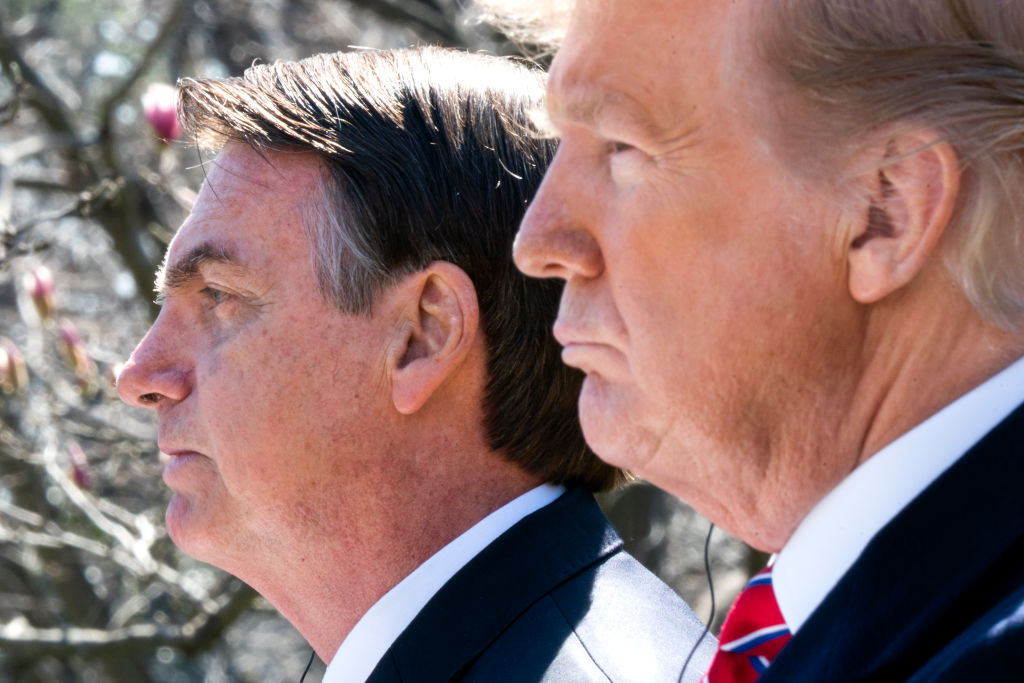
Latin America’s new reactionaries have dispensed with nationalist pretense. Instead, servility carries the day, with leaders tripping over each other to show themselves the more eager subordinates of Trump’s project for the region. (Jim Lo Scalzo / Pool / Getty Images)
On July 4, the United States of America will celebrate its 250th birthday. Initially an inspiration to Latin American and Caribbean independence fighters seeking liberation from European colonization, the United States soon emerged as the premier obstacle to the pursuit of peace, equality, and self-determination in the region. It is a mantle that the country continues to bear.
Donald Trump’s presidency — especially his present, second term — has revived the ugliest faces of US imperialism in the hemisphere: gunboat diplomacy, unilateral military and economic aggression, electoral intervention, and the persecution of migrant populations within and approaching US borders.
These hostilities have been performed under the auspices of a rehabilitated Monroe Doctrine, christened by no lesser authority than the New York Post as the “Donroe Doctrine.” Mercurial even in its early nineteenth-century iteration, the doctrine was briefly celebrated by newly independent Latin American nations as a rejection of European recolonization in the hemisphere. Soon, however, it was invoked to broadly justify US intervention in what the ruling class came to consider the country’s “backyard.”
By no means unprecedented, US empire today nevertheless represents an extraordinary escalation of long-standing bipartisan tactics and strategies deployed in the name of defending US interests in Latin America, carried out to devastating effect across the globe. Even as they affirm US power, however, Trump’s extreme actions are a response to historical shifts that are eroding US influence in the region.
Empire’s Legacy
It did not take long for the independent United States of America to assume its expansionist character, steadily acquiring by fraud, force, and finance abutting territories held by indigenous nations and European colonial powers. After doubling its size through the purchase of French holdings west of the Mississippi River at the dawn of the nineteenth century, the United States went on to seize more than half of newly independent Mexico; in 1898, the United States wrested Puerto Rico, Guam, Cuba, and the Philippines from Spain, commanding varying guises of formal and informal control over the islands, and annexed Hawaii.
As European powers retreated, US military incursions sought to impose the emergent US imperial hegemony by force in Mexico, Central America, and the Caribbean throughout the first decades of the twentieth century. In 1903, the United States orchestrated Panama’s secession from Colombia in order to build and control an interoceanic canal. Between 1910 and 1934, the United States invaded and occupied Nicaragua, Mexico’s port of Veracruz, Haiti, and the Dominican Republic.
Since conquest, raw materials exported from the region had fueled industrialization across the emergent world system’s imperial core, locking Latin America into a structural disadvantage that radical theorists characterized as dependency: a self-reinforcing dynamic that reproduced development at one pole and the conditions associated with underdevelopment at the other. For the Marxists of this school, dependency was understood not as a condition or situation, but a social relation reproduced through structural mechanisms of value appropriation and transfer from the global periphery to its center. Dependent capitalism was therefore not deficient, distorted, or immature; it was the necessary and mature counterpart of imperialist capitalist development.
Such an order could only be maintained by force. From colonization through independence, imperialist powers enforced Latin American nations’ subordinate insertion into the international division of labor, while Latin American oligarchs imposed tyrannical regimes to enforce the stark racialized inequalities that structured their plantations and extractive economies.
These conditions forged a broad tradition of contestation, from the anti-imperialist, liberal conspiracies of the Caribbean Legion to the Mexican Revolution’s agrarian insurrection, with early Communist Party organizing brutally suppressed from Brazil to El Salvador in the 1930s. The mid-century saw a new generation of democratic reformers challenging military rule, foreign domination, and despotic labor relations. But after a short-lived period of relative good will under President Franklin Delano Roosevelt, US Cold War policy in Latin America ran red-hot. Washington orchestrated military coups, propped up dictators, and implemented counterinsurgent regimes of torture, enforced disappearance, extrajudicial executions, and mass murder that left hundreds of thousands dead and millions displaced.
As a result, the democratic revolution begun in 1944 in Guatemala was overthrown in 1954 by a CIA-backed military coup, as was Chile’s in 1973. In the interim, the 1959 Cuban Revolution promised an armed path to popular power, inspiring insurgencies worldwide. The United States responded by staging a failed invasion at the Bay of Pigs and engaging covert operations and economic warfare to sabotage the government. In South America, the United States backed a continental assassination campaign under the auspices of Plan Condor, targeting exiles and dissidents of the allied military dictatorships it had helped bring to power through a series of coups throughout the 1960s and ’70s.
In 1979, the Sandinista Revolution triumphed in Nicaragua, and the United States spent the next decade waging genocidal counterinsurgency campaigns to undermine Sandinista rule and stave off the guerrilla armies fighting for national liberation in El Salvador and Guatemala. In addition to providing military aid, arms, and training to military dictatorships and paramilitary forces, US combat troops conducted regime change operations directly, invading Granada in 1983 and Panama in 1989.
These counterrevolutionary wars paved the way for a new US-led regime of market liberalization and privatization that conditioned the region’s reinsertion into a globalized economy through free trade agreements, neoliberal restructuring plans, and security cooperation deals that enforced the terms of transnational capital’s access to Latin American natural resources, labor, and strategic geographies. Alongside the traditional extractive enclaves, the region’s economies were repurposed as low-wage export platforms for consumer goods and criminalized migrant labor, the latter dispatched to the lowest strata of US labor markets while remittances provided a growing share of household income and foreign exchange across the Caribbean basin.
Whether imposed at the barrel of a gun in nations like Chile or tied to democratization in others, neoliberal hegemony in Latin America was always characterized more by coercion than consent. Restructuring exacerbated inequality, expanded informality, and accelerated environmental destruction, sparking militant contestation across popular sectors. In the twenty-first century, a new wave of left and progressive political parties took office, the “Pink Tide,” whose various efforts to build counterhegemonic regional trade and diplomatic blocs, expand social policy, redistribute wealth, or challenge capitalist production relations altogether were met with predictable bipartisan hostility from the United States.
Under President George H. W. Bush, the United States backed an unsuccessful coup against Venezuela’s Hugo Chávez in 2002 and participated in the 2004 coup against Jean-Bertrand Aristide in Haiti. In 2009, the Obama administration legitimated the coup against Honduras’s Manuel Zelaya. After Trump imposed an asphyxiating regime of “maximum pressure” sanctions on Venezuela and Cuba in his first term, Joe Biden kept them in place, fueling a humanitarian crisis and migrant exodus while paving the way for the second Trump administration’s present enactment of Marco Rubio’s South Florida revenge fantasies.
Trump II
By the time Trump returned to the White House in 2025, the destabilizing effects of the global economic crisis and pandemic recession — and neoliberalism’s failure to project a solution — were emboldening reactionary forces worldwide.
In Latin America, an openly illiberal right wing surged to dispute a regional left increasingly weakened by internal contradictions, structural limitations, and antidemocratic interventions. Amid heightened polarization, the new reactionaries have dispensed with nationalist pretense. Instead, servility carries the day, with leaders tripping over each other to demonstrate themselves the more eager subordinates of Trump’s project for the region.
That project, as laid out in the November 2026 National Security Strategy, involves a reassertion of US military and resource dominance in the region amid growing Chinese influence and emergent geopolitical multipolarity more broadly, rewarding allies and subverting perceived adversaries.
These aims are bipartisan, the product of an imperial consensus generations in the making. Each party, however, has its style. While the Republicans have emphasized armed intervention and cultivated traditional partners among religious conservatives, oligarchs, and the military, the Democrats embraced soft-power approaches that leveraged concepts like democracy, human rights, and the rule of law to isolate, discredit, and de-finance the Left in favor of more palatable center-right actors. Both parties are more than willing to resort to force when necessary, but Trump’s methods are characteristically vulgar.
The second Trump administration has scrapped soft power altogether. Today it is waging a campaign of extrajudicial executions in the Caribbean and Pacific that has taken the lives of over two hundred people, including fishermen and likely victims of human trafficking; it invaded the nation of Venezuela, abducted its sitting president, Nicolás Maduro, and has effectively annexed its petroleum industry; it dispatched the CIA to coordinate covert operations with local opposition politicians in Mexico without that government’s authorization; and it is prosecuting a devastating economic war against Cuba and threatening imminent military action to overthrow its government.
As historian Greg Grandin argues, Latin America has long been the theater where US empire retreats to regroup and redeploy. Nowhere is that pattern plainer than in Cuba. Like Central America after Vietnam, Trump now threatens the island as a salve for his defeat in Iran. The prize for generations of Cold Warriors and diaspora zealots, the country has been thrust into an unprecedented humanitarian catastrophe as a result of Trump’s illegal, unilateral sanctions regime and deadly fuel blockade. Cuba has already repelled a recent paramilitary incursion from Florida. Direct US military action, the Trump administration assures, is “on the table.”
Through the Shield of the Americas military alliance, US forces are already engaging in joint combat operations with allied far-right governments against an all-encompassing “narcoterrorist” threat in the region. The designation of a wide range of local and transnational criminal groups as “Foreign Terrorist Organizations” has facilitated this pivot, providing the legal veneer for the kidnapping of Maduro and the air strikes against speedboats.
Under this pretext, US forces joined bombing missions along Ecuador’s border with Colombia against what turned out to be dairy farmers, in a reckless provocation against the leftist Petro administration. Recent reporting indicates similar agreements are being imposed in Central America in order to strong-arm Claudia Sheinbaum’s Mexico, hitherto resistant to direct US military action, into accepting US boots on the ground. On June 13, Trump shared footage of an air strike described as a joint operation with the newly subordinate government of Venezuela against an alleged gang leader.
The administration revealed its thin antidrug pretense to be a sham when, on the eve of presidential elections in Honduras, Trump pardoned notorious ex-president Juan Orlando Hernández, convicted in US courts of drug trafficking. Instead, these deployments are plainly political. Indeed, the Trump administration has engaged in brazen electoral intervention across the continent, working to sway outcomes toward far-right parties in Argentina, Colombia, and Honduras, as well as the upcoming votes in Brazil.
At the same time, Trump has escalated the turn to mass migrant expulsion and exclusion, staging spectacles of brutality to terrorize and humiliate the racialized working-class populations whose criminalized labor has sustained critical sectors of the US economy for decades. In addition to the suspension of asylum proceedings, heightening of immigration restrictions, and lethal federal deployments to major US cities, the administration rendered some 250 Venezuelan migrants to torture in a notorious Salvadoran prison and is regularly deporting migrants from Latin America, the Middle East, and beyond to unfamiliar third countries in Africa.
As converging global crises drive shifting patterns of mobility and accumulation in the hemisphere, Trump’s candor and cruelty have exposed the crudest aspects of US imperial power.
Belligerent Decline
In a rapidly changing geopolitical and geo-economic landscape, Trump is ordering radical interventions to stake out the US position in Latin America. But material realities are outpacing US reaction. The fact is that the US empire is losing ground.
After assuming the imperial mantle from European colonial powers, the United States now finds its economic grip on Latin American markets loosened, as China assumes a growing trade and investment footprint in the region. China is the top trading partner for massive economies like Brazil, and even Trump’s staunchest political allies, like El Salvador’s Nayib Bukele and Argentina’s Javier Milei, have embraced major Chinese infrastructure projects.
Since neoliberalism’s global crisis, the United States abandoned ambitions for vast multilateral regional free-trade deals like the Free Trade Area of the Americas or the Trans-Pacific Partnership. Trump has gone further, threatening to pull out of the US–Mexico–Canada Agreement, signed during his first administration, altogether. Instead, he has unilaterally imposed a shifting patchwork of tariff regimes and brokered a handful of bilateral deals with individual nations like Argentina, Ecuador, El Salvador, and Guatemala.
After early moments as an incipient regional leader and over a century as a combative hegemon, the US empire is lashing out dangerously as its imperial shadow appears to recede from Latin America. Rather than compete with Chinese capital through aid or investment, the United States is imposing domination by sheer military force. The Trump administration’s reckless and erratic behavior accentuates long-standing contradictions, tanking the remainders of US credibility and accelerating trends of polarization and realignment.
Brutish and bigoted, grubbing and petulant, Trump is an uncannily apt embodiment of US imperial decadence. Under his command, the direction of US policy is as many parts naked avarice as death drive. No outcome to the present crisis is guaranteed. Two hundred fifty years in, however, the US empire is starting to look its age.