New York’s Socialist Victories Can't Be So Easily Dismissed
Centrist Democrats are writing off New York City socialist wins as a fluke reducible to gentrification and low turnout. But it was the Democratic Party machine itself that spent decades cultivating a depoliticized electorate.
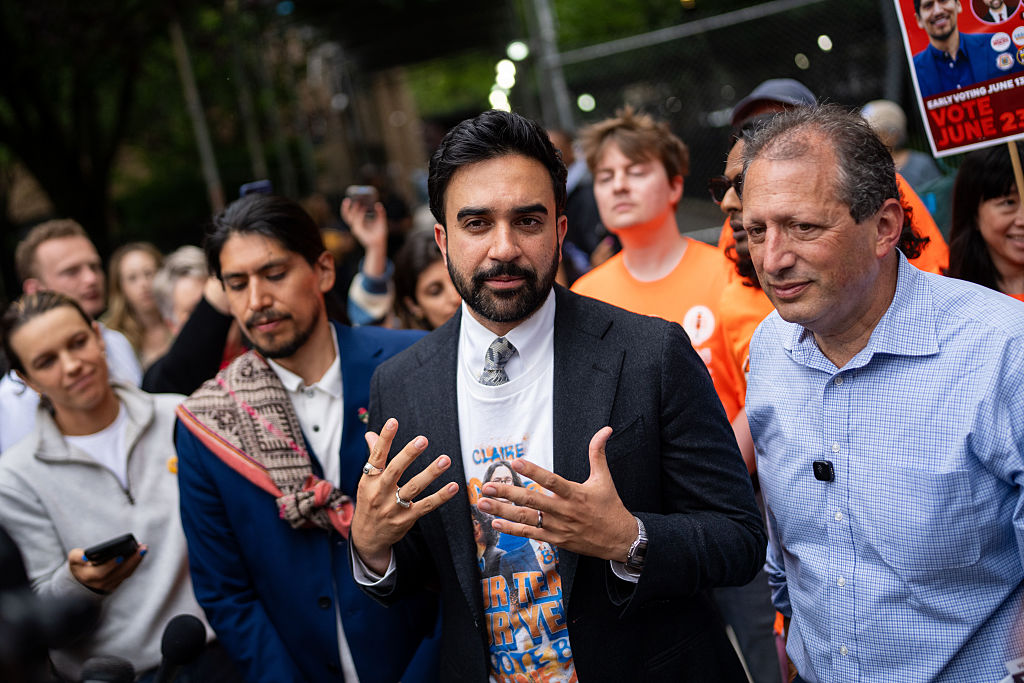
Illapa Sairitupac, Zohran Mamdani, and Brad Lander campaign during the recent primary elections in New York. (Adam Gray / Bloomberg via Getty Images)
Over the last few weeks, centrist Democrats have attempted mightily to discount the Democratic Socialists of America’s (DSA) and other recent progressive victories in New York City. The victories don’t bear real political significance, they argue, because they were propelled by gentrification and the turnout was low. Unfortunately for them, this is mostly cope.
Consider a specific case: Assembly District 54, covering Bushwick and Cypress Hills in Brooklyn. The district is home to 130,000 people, including 53,000 registered Democrats. It is currently represented by Erik Dilan, a machine politician of the old vintage who has held the seat since winning it in 2014, and who served on the city council for more than a decade before that, beginning in 2002.
DSA has run a candidate against Dilan twice: Samy Nemir Olivares in 2022, who lost, and Christian Celeste Tate in 2026, who won. In 2022, Nemir Olivares took 2,313 votes to Dilan’s 2,524; in 2026, Tate won 4,054 votes to Dilan’s 2,479. Before those two races, the last primary challenge Dilan faced was in 2014, when he defeated Kim Council, 1,955 votes to 1,305.
Several observations follow from these numbers. First, Dilan received almost exactly the same number of votes in 2022 and 2026 — around 2,500. The DSA candidate lost in 2022 with roughly 2,300 votes; in 2026, the DSA vote nearly doubled to more than 4,000, and the DSA candidate won overwhelmingly.
Second, Dilan represents a rapidly gentrifying district — but his voters haven’t been gentrified out. Judging from the electoral map, they appear to be largely homeowners in Cypress Hills who don’t pay the rising rents. He received about as many votes in 2026 as in 2022, and in both years he nearly doubled the largest vote total he had ever previously won in a primary.
Third, that still wasn’t many votes. Dilan represented a community of 130,000 people for more than twenty years in the city council and the state legislature on the basis of the support of a grand total of 2,500 of them on his best day. Those 2,500 votes were just barely enough to keep him in office in 2022. But in 2026, another 1,700 people showed up to the polls and sent him packing.
Fourth, who were those 1,700 or so people? Plausibly, many were young people who had recently moved to the district and — heaven forbid — wanted a say in how their community was represented. Just as plausibly, some were long-standing residents with long-standing complaints, activated for the first time by a very strong campaign operation.
Fifth, none of this should have been a problem for Dilan, because 1,700 isn’t that many people — not in a district of 130,000 residents and 53,000 registered Democrats. The establishment’s cope artists are right: turnout was low. It was higher than Dilan had ever faced before, but it never approached even 20 percent of the electorate. That low turnout should have made things easier for the incumbent. Dilan had more than a decade to make the case to a community of 130,000 people and give 1,700 more of them a reason to spend fifteen minutes at a poll site keeping him in office — and he couldn’t do it. Now someone else will get a turn.
This is a very common story in New York politics. The level of civic disengagement and apathy — the lack of interest or hope in politics, above all at the state and local level — is astonishingly high. In that context, politicians all over the city are kept in office by the active support of a minuscule minority of the communities they purport to represent, combined with the apathy and depoliticization of the overwhelming majority.
In principle, this system is extremely fragile: when so many politicians are subsisting on the support of 5 percent of the electorate, it shouldn’t be that hard to find another 6 percent. But it is stabilized by incumbents’ access to campaign cash from lobbyists and real estate, and by the machine’s monopoly on the mechanics of ballot access. The barriers to entry are such that most incumbents rarely face a challenge of any kind.
The result is a system that understands itself, sociologically, as representing the “community” — a tiny minority of district residents who skew older, are likelier to be homeowners, and may have some direct patronage connection to the machine — but that in practice produces a politics dominated by special interests, as politicians with no meaningful social base rely on donors for the sinews of power and face no countervailing pressure from below.
Then DSA comes along, breaks the ballot-access monopoly, makes a small but significant dent in the depoliticization and apathy of the electorate, and upsets the system — and suddenly we’re hearing about how the voices of the community are being silenced by the politics of gentrification.
Well, if the community had meaningful representation — if, in a district of 130,000 people, as many as, say, ten thousand voters could name their assembly member and one thing he had ever done for them — then DSA wouldn’t be a problem. But the establishment created and benefited for decades from a system of ultralow turnout and depoliticization, and now the establishment is paying the price.
One might hope that the establishment, if it is so keen to organically represent the community against us transplants, would say: “They beat us by getting an extra 1,700 people to show up. We need to find a way to appeal to those people, or to better engage our own. With our deep organic connections to the community, we can turn out 5,000 voters and beat them next year. Let’s get to work.”
Instead, the establishment’s response to another cycle of upset defeats has been to complain that new voters are participating in local politics — and how unfair that is to the community (that is, themselves), which has spent decades fighting for (read: sitting comfortably atop) this district.
The next time the establishment complains that young people don’t vote or get involved, don’t believe a word of it. As the old Chicago machine saying goes, “We don’t want nobody nobody sent.”
Well, then: they seem committed to losing, and they deserve to.