Even Donald Trump Couldn’t Ruin the World Cup

David Goldblatt

Donald Trump and his ally, FIFA president Gianni Infantino, have plumbed new depths with their political antics before and during the World Cup. But as David Goldblatt insists, they still couldn’t destroy the moments of collective joy it gives us.
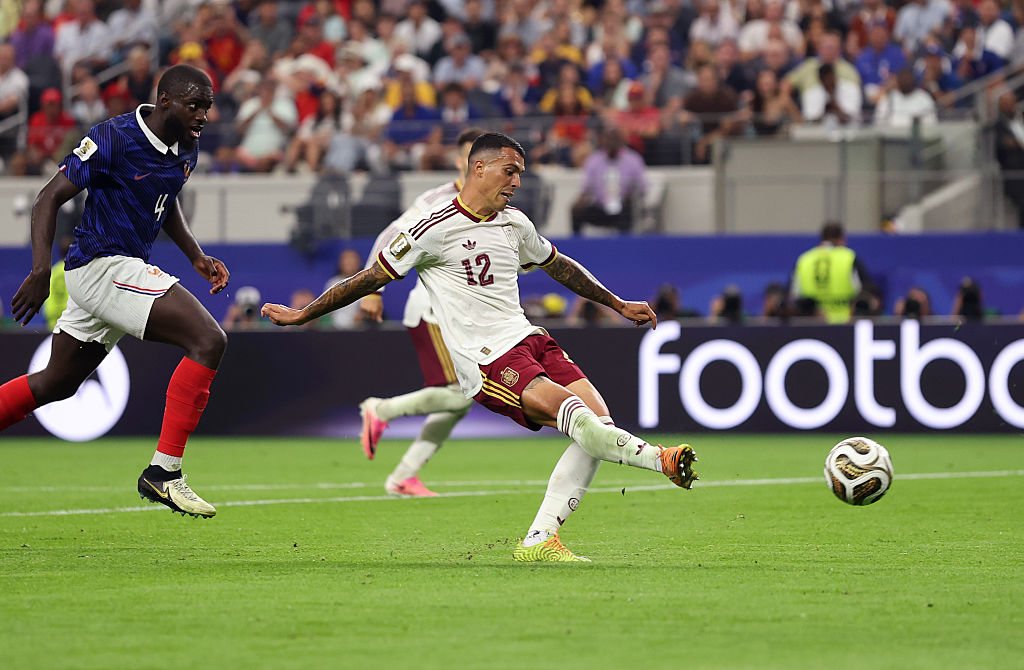
Pedro Porro of Spain scores his team's second goal during their World Cup 2026 semifinal match against France on July 14, 2026.

Football has the remarkable capacity to bring moments of resistance, of challenge, of joy, of beauty in an ugly world. (Julian Finney / FIFA via Getty Images)


Interview by
Daniel Finn

As the World Cup comes to an end, we’ve seen unprecedented levels of direct political interference in the organization of the tournament. FIFA president Gianni Infantino gave his friend Donald Trump a blank check to exclude anyone he liked from the United States, even referees, and Trump himself notoriously weighed in after a US player received a red card before their game against Belgium.

We spoke to football historian David Goldblatt about the way this World Cup has unfolded and whether anything can be done to break the stranglehold of figures like Infantino on the game. This is an edited transcript from Jacobin’s Long Reads podcast. You can listen to the interview here.


Daniel Finn

This isn’t the first time the World Cup has been staged in a controversial host country: going back to the early years of the competition, you had the World Cup in Italy under Benito Mussolini in 1934, then you had it in Argentina under the military regime in 1978, and of course we’ve had Russia and Qatar in the last decade. How does this experience compare with those?

David Goldblatt

I’m going to start by saying there have been three World Cups going on. One of them has been in the United States, which everyone tends to assume is the only World Cup, but there’s been a World Cup in Canada, and there’s sure as hell been a World Cup in Mexico. If the championship were determined by football energy, joy, and intensity, then Mexico were crowned the champions a long time ago.

A completely different World Cup has been going on there, where you’ve got large-scale funding for grassroots football and culture festivals, amazing arts programs, stadiums absolutely packed with folks who are meant to be there, and an energy in the streets that is unmatched. Mexico has been where I wanted to be during this World Cup.

In Canada, I think it was less of a big deal in terms of hosting, but still pretty amazing to see a Canadian team that had never won a game at the World Cup before take itself to the knockout rounds with a team that reflects the extraordinary demographic transformation of Canada over the last generation or so. Who knew Canada had such an amazing diversity within it?

So those have been the other World Cups. The United States, of course, is another matter. Where does it stand in the chamber of horrors or in the canon? I think it’s different in the sense that, certainly compared to 1934 or 1978, with the scale and intensity of global coverage, we’re in another world, with the political soft-power play available and the blow-by-blow nature of what is happening as it occurs during (as well as in the run-up to) the tournament.

When it comes to Qatar and Russia, it’s a similar world, technologically, economically, and so on, so there are certainly parallels. One would probably have thought that Qatar was the peak moment for a politically controversial World Cup, and that is what happens when you spend $250 billion rebuilding Doha in the image of the World Cup and make the hosting of tournaments the very center of your diplomacy as well as your domestic economic strategy.

It’s no wonder that Qatar was controversial and politicized. Has this exceeded it? In some ways yes, because Trump has the superpower Midas touch that enables him to turn everything into globally renowned shit the moment he touches it. Although he has been the ghost of the feast for much of the tournament itself, Trump’s presence and the nature of his America have made it as controversial as one can imagine.

The charge sheet is very long: ludicrously expensive tickets, rapacious ticketing resales, absurd prices for parking and food, a massive overemphasis on hospitality and high-end seats, the hydration breaks that have turned into advertising breaks. It’s almost as if they’ve done everything possible to make it as unpleasant as they can.

Trump’s visa system has obviously been unbelievably unpleasant. The exclusion of the Somali referee was indefensible; you had the racial profiling of the Uzbeks and the Senegalese at the border; and then there was the coup de grâce, with Trump boasting that he intervened to get Folarin Balogun’s red card rescinded from the round of thirty-two game.

In some ways, I enjoyed the Belgian team’s Trump dance afterward and the “overturn this” post, but on the other hand, Trump poisons everything with his bottomless cynicism. No wonder there are so many people thinking that video assistant referee (VAR) decisions and referee calls are conspiracies against them, but, as I often say, the conspiracy is in plain sight.

At the level of politicization and of social, political, and cultural controversy, I think we’re breaking new ground once again. But I would really emphasize that, alongside all of that, it’s been absolutely joyous. This is the extraordinary thing about football: we should really be looking at two regional wars and a planet that is burning in front of us, but we have given our deepest emotions and attention to the game for a month.

Of course we do — who doesn’t want to be in a place where we might see a better version of ourselves? I’d prefer a ticket at the Azteca over the Strait of Hormuz any day. Football has the remarkable capacity to bring moments of resistance, of challenge, of joy, of beauty in an ugly world.

Daniel Finn

Of course, the man who’s been at the heart of all of this, along with Trump himself, is FIFA president Gianni Infantino. Taking a couple of steps backward, how did Infantino position himself to replace Sepp Blatter, who was stepping down in a haze of controversy? Were there any indications that he would want to go on to be a sort of global political player?

David Goldblatt

When Blatter stepped down after the arrests in Zurich of a whole range of FIFA executives over kickbacks, all of the potential new presidents positioned themselves as reform candidates. Infantino did the same: he pretty much picked up Europe’s vote, inheriting it from Michel Platini, who had been his boss prior to that point. But there was a key moment in the speech that he made in Zurich to the special congress, in which he said, “the money of FIFA is not the president’s money — it is your money.”

Never has such a joyful, acclamatory cry been heard from the FIFA council in history. It was very clear what was going to happen: “We are going to make more money and more of it is going to be diverted to the football federations of the world.” The transactional politics that had been invented by João Havelange and bureaucratized by Sepp Blatter was now going to be supersized and entrenched. That is why Infantino won, and that is how he has maintained unambiguous power.

All of these sporting organizations tend to be centralized executive presidencies. The president is also basically the CEO of the organization, there are all sorts of conflicts of interest, and that’s a whole complex governance issue. In addition, there’s no opposition, because football at an administrative level is overwhelmingly conducted on the basis of transactional and patronage politics. The emergence of ideological debate and of organized opposition or challenge to anyone in power barely ever occurs, so it’s not difficult as a consequence to stay in power.

A lot more money has come into FIFA under Infantino’s auspices. Everybody is on the gravy train, so that’s how he did it. When he became president, one had to give him a certain benefit of the doubt, although I thought that his sacking of the people who ran the ethics committee was very telling. They were the ones who were responsible for investigating issues at FIFA, notionally independently, so it was a case of, “Oh dude, you want to choose your own judges, how terribly interesting!”

FIFA has become even less transparent and much more bristly and defensive even than it was under Blatter. Infantino has spent a lot of time with very rich and very powerful people. Particularly with Trump, I thought maybe this is just cynical gameplay. If I was dealing with Trump, and my most important asset was relying on his compliance and his not f–king it up, I would think, “How does one deal with this guy — you know, he likes flattery; flattery really works.” I would go down that route, clenching my teeth perhaps.

But I think that Infantino has really drunk the Kool-Aid. There’s a whole psychodrama to be written of the last near-decade he has been in power in which he has become ideologically aligned with the worldview of the world’s oligarchs while at the same time mouthing all the usual cosmopolitan and philanthropic platitudes of the Davos superrich.

Daniel Finn

Looking at the controversy over Iran’s participation in the World Cup, throughout the history of international sports, this was not the first time that two hostile or belligerent states have had to play each other or had to host each other in some kind of framework. Has there been any real precedent for the way that the Iranian team was treated before and during the tournament by US authorities?

David Goldblatt

I’d be very pleased to be proved wrong and would welcome guidance on this, but certainly, to my knowledge, no, this has not happened before. We’re through the looking glass, aren’t we? This is the festival of cosmopolitan humanity, and we’ve got two states at war in the same competition. I think the American treatment of the Iranians has been incredibly mean, but that’s the way this regime goes: performative cruelty and meanness is its modus operandi.

One of the sweet things to have come from it is how the people of Tijuana and Mexico in general have embraced the Iranians. It’s one of the great crossover moments of the World Cup: Mexican crowds have been singing “Iranians are Mexicans, they are our brothers,” and there have been great public celebrations and generosity toward the Iranians in Tijuana.

There have been other moments like that: who would have thought that the people of Lawrence, Kansas, a small town in the corner of the state, would fall in love with the Algerians, and that the Algerians would reciprocate? The Scots have also been such an amazing presence and brought supersized joy to the occasion.

The Iranians have been treated very badly, and why would we expect anything else? I don’t see any point in being too hotheadedly outraged: you have to say, “What do you expect from these people? This is what they do.” I refuse to be surprised. I know that they haven’t reached the bottom yet because there is no bottom with them, so I am wearily accepting of it in that sense, but also delighted that there have been other ripostes and responses.

Daniel Finn

Going back to the unavoidable issue that you alluded to already: the US red card, Trump’s intervention, and FIFA’s decision to rescind it. There has been a shadow cast over all the refereeing decisions as a result. After the Egypt-Argentina game, for example, the Egyptian manager was accusing FIFA of having an agenda to keep the big players, like Lionel Messi, and the big teams in the tournament. Because there has been such a blatant form of intervention, it becomes harder to dismiss accusations like that.

David Goldblatt

I disagree. I don’t think it is harder, because it is a mistake to think that these are the same things. Clearly the conspiracy that is out in the open is unproblematic, in the sense it’s so obvious what is going on. But just because that has happened, that doesn’t mean there are lots of other conspiracies.

There has to be evidence. You just can’t say that because there’s a conspiracy in one place, there’s a conspiracy in another. This is the most hopeless form of argumentation, and it completely ignores the fact that this happens in football all the time. Football is a deeply subjective game: in the very marrow of its rules are subjective terms that require interpretation.

When is dangerous play sufficiently dangerous? How do you begin to describe that? There are a thousand and one examples like that. VAR has made this worse, because it gives the illusion of the possibility of perfection. What it actually does mean is that there are fewer errors, which nobody remembers when they’re complaining about VAR: actually there are fewer egregious mistakes in football than there used to be, and VAR has gotten better.

The problem is not just the technology but the fact that in so many societies, pretty much everywhere in fact, belief in the possibility of disinterested, albeit fallible, judgment is so fragile. People can’t accept the idea that someone could make a mistake in good faith, because so much trust has been corroded. It makes the job of referees and officials impossible.

In relation to the Egyptian team, I would say yes, of course FIFA have organized it that way — there’s a seeding system, that’s what seeding systems are meant to do. Perhaps you want to make a case against the seeding system; fine, but this is out in the open.

As regards refereeing, Egypt were really hard done by on their disallowed goal, there’s no doubt about it. If I was the referee, I would have given it — it was absurd calling it back. But there are days on which it would be given by some referees, and there are days on which it would not be given, and I just don’t believe that there is some FIFA plot to mess with referees to give Argentina an edge. Come on guys, show me the receipts!

Daniel Finn

Coming out of the tournament, will Infantino simply shrug off the negative publicity if the viewing figures and the commercial deals satisfy his goals? If it is so difficult to challenge a figure like Infantino through the structures of an organization like FIFA, is there any channel or mechanism that might be available for those who want to challenge his authority, or should we expect to be seeing him back, not just at the next World Cup in 2030, but even at the one after that in Saudi Arabia in 2034?

David Goldblatt

If he’s doing it in Saudi Arabia in eight years’ time, he’s going to have to change the constitution of FIFA to give him yet more terms as president, which is a trick that Blatter played back in the day, so that’s a whole other can of worms. But let’s just leave it at 2030 for the moment.

He’s made some enemies. The Belgian Football Federation will not be forgetting this. The Union of European Football Associations (UEFA) have got hold of the Somali referee, Omar Artan, who was refused entrance to the United States and given him the European Super Cup final to preside over. UEFA have got the knives out for this dude, along with lots of European football federations.

I can’t imagine there will be too much support for Infantino in Egypt these days, and a few other countries aren’t happy with him either, so that’s important. There are enemies within. As for anything beyond that, this is one of the great challenges of football politics. FIFA and the other organizations live in a non-transparent netherworld of vaguely defined international law in which there is no oversight and no transparency.

I’m part of a campaign called Reboot FIFA, launched by the NGO FairSquare, and we are mounting a global campaign for the reform — indeed the breakup and restructuring — of FIFA and for it to be brought within the remit of some kind of meaningful international law and oversight. The most effective tool is probably the European Parliament, because although FIFA is based in Switzerland, the reach of the European acquis extends a very long way. There are quite a few people in the European Parliament who would like to stick it to FIFA and who can see that there is an important democratic and popular case to be made.

We are beginning our campaign there, so come and join us on that one, because nothing else is going shift these people. I’ve been calling for the heads of a whole variety of people for thirty years, but nothing happens. If you want something done, do it yourself. We have to try and make this happen.