What Marx Can Tell Us About Artificial Intelligence
Karl Marx’s analysis of capitalism’s tendency to replace living labor with machines can help shed light on how AI take-up may develop.
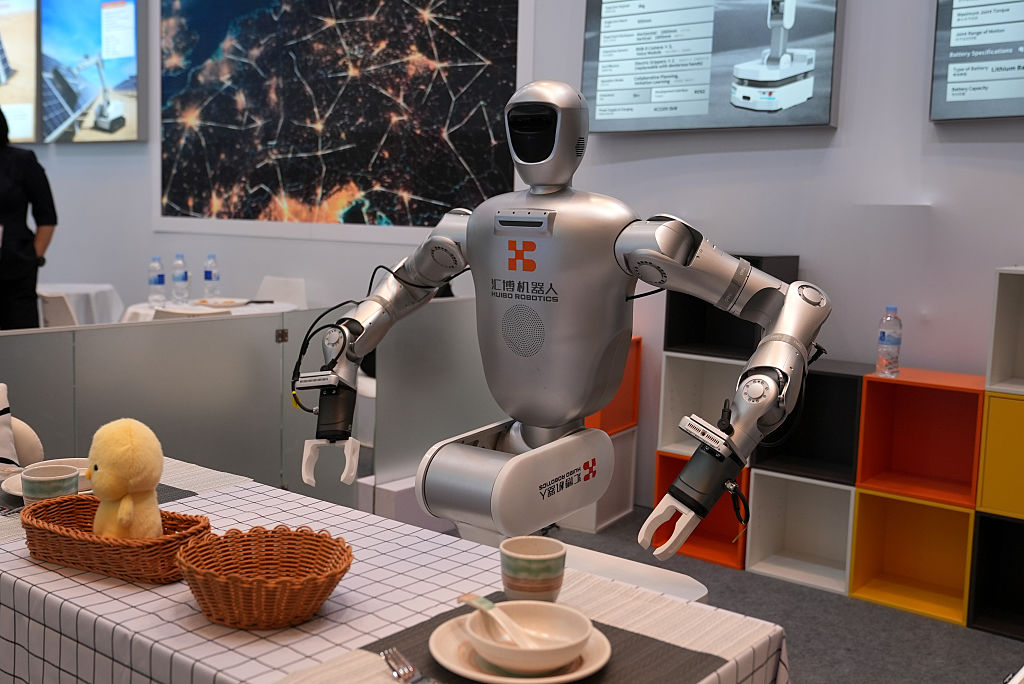
Service robots on display at the Canton Fair in Guangzhou, Guangdong Province, China, on April 15, 2026. (Stringer / Anadolu via Getty Images)
What would be the likely effects of massive introduction of artificial intelligence in the economy from the Marxist point of view?
At first, the implications for Karl Marx’s labor theory of value seem bad or in contradiction with the facts or our expectations. AI implies the introduction of extremely capital-intensive techniques of production or, to use Marxist terminology, of processes with a very high organic composition of capital. In other words, AI implies a very high c/v ratio. That is the ratio of constant capital (c) to capital engaged to hire labor (v). If the presence of labor is small and, perhaps in cases of fully automated production, close to zero, the surplus value produced by labor must also be small or close to zero. Regardless of how high the rate of exploitation is, a very small v implies a very small s (surplus value).
We thus establish that the rate of profit [s/(c+v)] must also be very small, consistent with one of Marx’s most famous “laws of capitalist development,” namely the tendency of the profit rate to fall with the introduction of more capital-intensive processes of production. In the case of almost wholly automated production, the rate of profit must become zero or be near zero. As Marx, Joseph Schumpeter, and common sense tell us, capitalism with zero profits is an absurdity. Capitalists will not invest if their expected return is zero. Thus the tendency of the rate of profit to fall spells the doom of capitalism.