For The Economist, Mentioning Workers’ Interests Is Heresy
Daron Acemoglu, who won the Nobel Prize in 2024, is no heterodox economist. But now The Economist magazine has damned his work, because it challenges the untrammeled power of Big Tech elites.
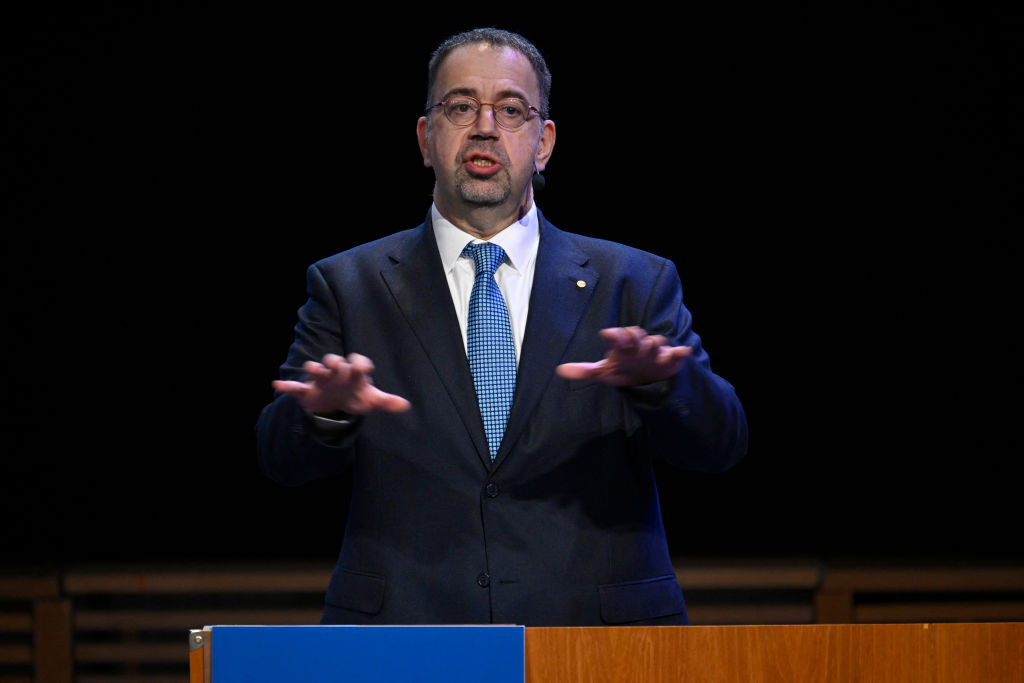
Economist Daron Acemoglu says that we need to better direct new technology in order to promote a shared prosperity. His proposals remain all too vague: yet the mere mention of working-class interests has earned him the wrath of The Economist. (Pontus Lundahl / TT News Agency / AFP) via Getty Images)
Daron Acemoglu, winner in 2024 of the so-called Nobel Prize in economics, has just published a new book, What Happened to Liberal Democracy? Now The Economist — the paper, founded in 1843, that stands as the epitome of free trade and economic liberalism — has seized on the opportunity to settle a few scores. In a piece that has taken everyone by surprise, it leveled a scattering of theoretical criticisms at Acemoglu’s work and, above all, called into question the standing of a highly regarded economist. Perhaps the clearest evidence is that The Economist declares in its headline that Acemoglu is “oddly unconvincing,” and that his arguments about AI are pessimistic to the point of losing credibility. Small wonder that the target of the attack took it personally and felt obliged to respond in public.
Everything suggests that the ultimate cause of the falling-out is that Acemoglu’s academic work, which revolves around technological change and the role of artificial intelligence, offers a proposal to strengthen the working class. This is one of the points The Economist goes after, labeling his approach pessimistic and unspecific. The economist Mònica Martínez Bravo captured the tension well when she wrote of “what curious things happen when a Nobel laureate in economics writes a book arguing for putting the working class back at the center of economic policy.”
In what follows, I want to examine in what sense, and how far, Martínez Bravo is right. And along the way I want to head into the fascinating and worrying world of the socioeconomic consequences of artificial intelligence.